

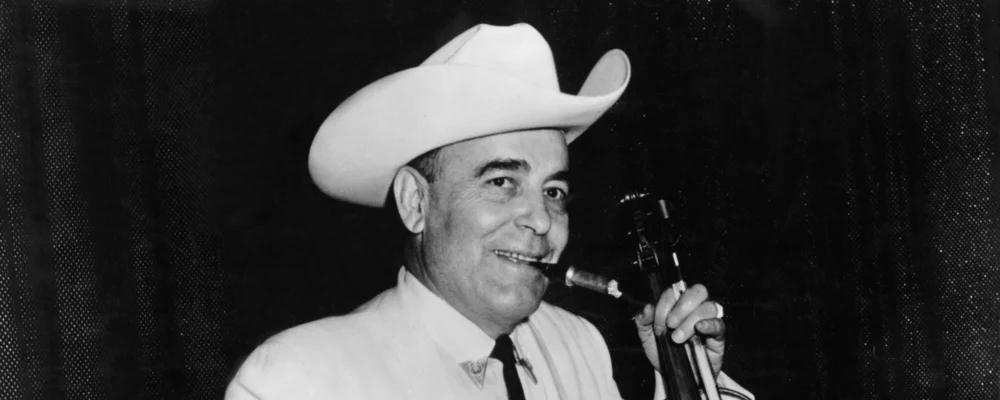
On March 6, 1905, in the small community of Kosse, Texas, James Robert Wills was born into a family of frontier fiddlers, setting the stage for a musical revolution that would eventually redefine the American soundscape. Known to history as Bob Wills, he became the primary architect of Western swing, a genre that seamlessly blended traditional fiddle music with jazz, blues, and big-band swing. His life and career represent a pivotal chapter in the evolution of American popular music, bridging the gap between rural folk traditions and the sophisticated urban arrangements of the mid-20th century. By the time of his passing in 1975, Wills had not only transformed the role of the fiddle in popular music but had also laid the groundwork for the emergence of rock and roll and the modern country music industry.
The Cultural Melting Pot of East Texas
Wills’ musical foundation was built on a unique intersection of cultural influences. Growing up in Limestone County and later moving to the Texas Panhandle, he was immersed in a diverse environment where the sounds of the frontier met the burgeoning rhythms of the South. His father, John Wills, was a champion fiddler, and from him, Bob learned the intricate techniques of traditional dance music. However, the younger Wills was equally captivated by the music of the Black migrant workers with whom he worked side-by-side in the cotton fields.
Music historians and archives from the Country Music Hall of Fame note that the area was a hotbed for legendary Black musicians, including ragtime pioneer Scott Joplin and blues icons Blind Lemon Jefferson and Victoria Spivey. Wills frequently recounted how he learned the blues and jazz directly from his neighbors and coworkers. This exposure was instrumental in his development; he didn’t just play the fiddle—he infused it with a rhythmic "swing" and blue notes that were entirely foreign to the Appalachian-style fiddling of the era. By the age of 17, when he left home to pursue a career as a performer, Wills was already a phenomenal musician capable of navigating multiple genres with ease.
From the Light Crust Doughboys to the Texas Playboys
The professional journey of Bob Wills began in earnest during the Great Depression, a time when radio was becoming the dominant medium for cultural dissemination. After years of drifting and working odd jobs—including a stint as a barber—Wills moved to Fort Worth in 1929. In 1930, he partnered with guitarist Herman Arnspiger and the Brown brothers, Milton and Derwood, to form the Wills-Arnsperger-Brown Trio. This group eventually secured a sponsorship from the Burrus Mill and Elevator Company, the makers of Light Crust Flour.
Rechristened the Light Crust Doughboys, the band became a sensation on WBAP in Fort Worth. Under the management of W. Lee "Pappy" O’Daniel, who would later use the band’s popularity to propel himself to the governorship of Texas, the Doughboys pioneered the early iterations of Western swing. However, creative and administrative tensions led Wills to depart the group in 1933. He took with him the talented vocalist Tommy Duncan, and together they moved to Waco and then to Oklahoma, where they formed the legendary Texas Playboys.
The Tulsa Years and the Expansion of the Sound
By 1934, Bob Wills and His Texas Playboys had established a residency at KVOO in Tulsa, Oklahoma. It was here that the "Western swing" sound reached its full maturity. While the band began as a standard five-piece string ensemble, Wills’ ambition and the demands of the dance halls led him to expand the lineup significantly. By 1940, the Playboys had grown into a massive 16-piece orchestra that featured a full horn section (brass and woodwinds), drums, and the innovative use of the steel guitar.
This period saw the release of "New San Antonio Rose," the band’s signature song. Originally recorded as an instrumental titled "Spanish Two-Step," the addition of lyrics transformed it into a national crossover hit. The success of the song demonstrated Wills’ ability to appeal to both rural audiences and urban jazz enthusiasts. The "Tulsa years" are often cited by musicologists as the golden age of the Texas Playboys, a time when the band’s precision was compared to the great jazz orchestras of Duke Ellington and Benny Goodman, yet they maintained a rugged, Western identity characterized by Wills’ trademark "Aah-haa!" interjections and his driving fiddle leads.
War, Migration, and the Electrification of Country Music
The onset of World War II brought significant changes to the band’s trajectory. In 1942, at the age of 37, Wills enlisted in the United States Army. Although he did not see combat and received a medical discharge in 1943, the hiatus disrupted the band’s momentum in Oklahoma. Upon his return to civilian life, Wills recognized the shifting demographics of the country; thousands of Southerners and Midwesterners were migrating to the West Coast to work in defense plants.
Relocating to Hollywood, Wills rebuilt the Texas Playboys for a new era. In a move that was revolutionary for the time, he largely replaced the horn section with multiple electric guitars and amplified steel guitars. This shift not only allowed the band to be heard in the massive, cavernous dance halls of California but also created a sharper, more aggressive sound. During the mid-1940s, Wills was one of the highest-paid entertainers in the United States, commanding fees that rivaled the top Hollywood stars of the day. His popularity in California was a major catalyst for the "Bakersfield Sound," which would later be popularized by artists like Buck Owens and Merle Haggard.
Defying the Establishment: The Grand Ole Opry Incident
One of the most famous anecdotes in country music history occurred in 1944 when Bob Wills and His Texas Playboys were invited to perform at the Grand Ole Opry in Nashville. At the time, the Opry was a bastion of traditionalism, maintaining a strict ban on drums and horns, which were considered "too jazz" or "too pop" for the hallowed stage of the Ryman Auditorium.
Wills, however, refused to compromise his sound. Despite explicit instructions from Opry management to leave his drummer behind the curtain, Wills insisted that the full band perform with the drum kit front and center. This act of defiance was more than just a theatrical stunt; it was a statement of musical validity. It signaled that the "Western" half of "Country and Western" would not be dictated by Nashville’s conservative standards. While the incident caused a temporary rift with the Opry, it solidified Wills’ reputation as a maverick and an innovator who prioritized the integrity of his music over industry gatekeeping.
A Chronological Timeline of Bob Wills’ Life and Career
- March 6, 1905: Born in Kosse, Texas.
- 1929: Moves to Fort Worth and begins performing with various string bands.
- 1931: The Light Crust Doughboys are formed, sponsored by Burrus Mill.
- 1933: Wills leaves the Doughboys and moves to Oklahoma to form the Texas Playboys.
- 1934: Begins a long-term residency at KVOO in Tulsa.
- 1940: "New San Antonio Rose" becomes a national hit, selling over a million copies.
- 1942: Enlists in the U.S. Army.
- 1943: Receives medical discharge and moves to California; rebuilds the band with an emphasis on electric instruments.
- 1944: Performs at the Grand Ole Opry, breaking the "no drums" rule.
- 1950s: Continues to tour despite the rising popularity of television and rock and roll.
- 1968: Inducted into the Country Music Hall of Fame.
- 1973: Records his final session, For the Last Time, during which he suffers a major stroke.
- May 13, 1975: Passes away in Fort Worth, Texas.
- 1999: Inducted into the Rock and Roll Hall of Fame in the "Early Influence" category.
Legacy and Influence Across Genres
The impact of Bob Wills on subsequent generations of musicians is nearly impossible to overstate. In the realm of country music, George Strait stands as perhaps the most prominent torchbearer. Strait’s early career was defined by a revival of Western swing elements; his 1984 chart-topper "Right or Wrong" was a direct cover of a jazz standard that Wills had popularized decades earlier. Strait has frequently cited Wills as his primary influence, noting that the "King of Western Swing" provided the template for the modern "Texas Country" sound.
Merle Haggard, a pillar of the Bakersfield Sound, was similarly obsessed with Wills’ work. In 1970, Haggard released A Tribute to the Best Damn Fiddle Player in the World (or, My Salute to Bob Wills). Haggard actually learned to play the fiddle specifically for the album and hired several former Texas Playboys to perform on the tracks. This project did more than just honor a hero; it introduced Wills’ music to the hippie and rock-and-roll audiences of the early 1970s, ensuring the genre’s survival.
Perhaps most surprisingly, Wills’ influence extends deep into the roots of rock and roll. Chuck Berry, the legendary guitarist often called the "Father of Rock and Roll," famously credited Wills’ "Ida Red" as the primary inspiration for his first hit, "Maybellene." The driving beat and the "two-step" rhythm of Western swing were essential components of the rockabilly sound that emerged from Sun Records in the 1950s. Waylon Jennings further immortalized this cross-genre respect in his 1975 anthem "Bob Wills Is Still the King," a song that remains a staple of Texas music culture.
Broader Impact and Implications
The enduring relevance of Bob Wills lies in his refusal to acknowledge the artificial boundaries between musical genres. At a time when the music industry was strictly segregated into "Hillbilly," "Race," and "Pop" categories, Wills ignored the silos. He saw no reason why a fiddle couldn’t play jazz or why a country band couldn’t have a horn section.
By blending the blues of the South with the swing of the East and the folk traditions of the West, Wills created a truly American art form. His career proved that "country" music could be sophisticated, danceable, and commercially viable on a global scale. Today, the spirit of Western swing lives on not just in tribute bands, but in any artist who dares to mix traditional roots with modern innovation. As the music industry continues to grapple with the concept of "genre-bending," the blueprint laid down by Bob Wills over a century ago remains the gold standard for musical evolution.
