

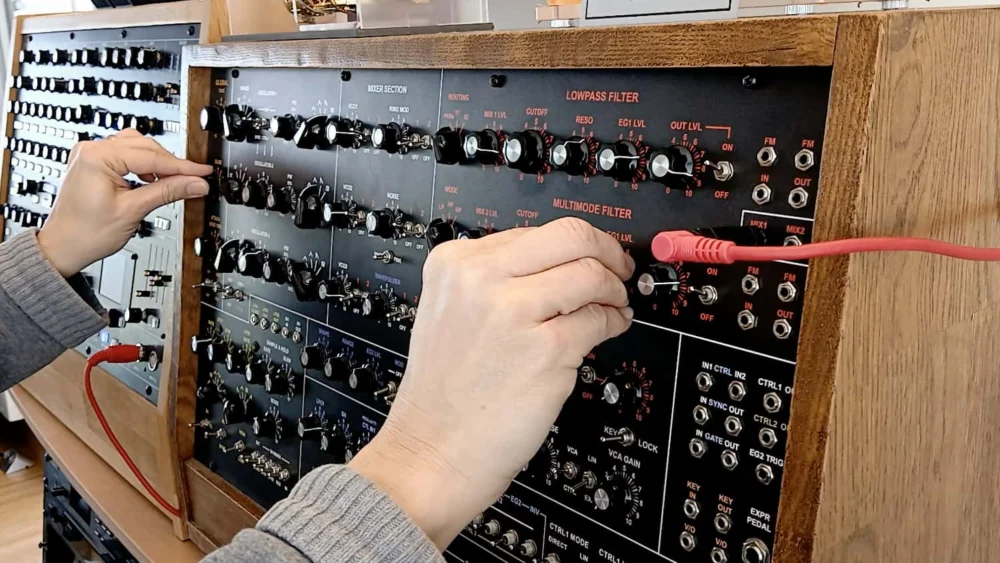
Jean Luc Briançon, the acclaimed French synthesist and composer performing under the moniker Kurtz Mindfields, has released a comprehensive live performance demonstration titled "Modular dream / Art of analog sequencing." This presentation serves as both a musical exploration and a technical showcase of high-end analog synthesis, specifically highlighting the capabilities of instruments crafted by the French boutique manufacturer NRsynth. By utilizing a sophisticated array of hardware, including the Ancestor and SynthR4 synthesizers, Briançon demonstrates the enduring relevance of subtractive synthesis and complex analog sequencing in the contemporary electronic music landscape.
The performance is characterized by its reliance on a massive configuration of sound sources, totaling nine Voltage Controlled Oscillators (VCOs), four Low-Frequency Oscillators (LFOs), four noise generators, and four distinct filters. This "wall of sound" approach harkens back to the golden age of the Berlin School of electronic music, yet it utilizes modern refinements in stability and sequencing logic. Briançon’s work with NRsynth is not merely as a performer but as a developer and explorer of musical possibilities, bridging the gap between the artisanal craftsmanship of "synth luthiers" and the practical needs of the professional recording artist.
Technical Overview and Hardware Specifications
The cornerstone of the performance is the NRsynth Ancestor, a machine designed to replicate the sonic architecture and tactile response of the original Moog modular systems. According to Briançon, the Ancestor is an "extremely sensitive" instrument that prioritizes the raw, organic character of its components. It features three original-style VCOs and a dual-filter setup that includes a classic Moog-style ladder filter and a Steiner-Parker filter. The inclusion of the Steiner-Parker filter is a notable departure from standard Moog clones, offering a multi-mode resonance that provides a more aggressive, "acidic" character compared to the smooth, creamy response of the Moog ladder.
The second primary instrument in the setup is the SynthR4, a semi-modular multi-tasking synthesizer that acts as the rhythmic and logic hub of the performance. The SynthR4 is equipped with four VCOs and two sub-VCOs, providing a deep harmonic foundation for the sequences. Its filter section is equally robust, featuring a Moog Ladder filter alongside the 4012 ARP filter—a component famous for its role in early ARP 2600 models and the subject of historical patent disputes between Moog and ARP in the 1970s. The SynthR4 also houses three LFOs and two noise generators, and it is driven by specialized sequencing software that allows for real-time manipulation of complex rhythmic patterns.
Chronology of the Development and Performance
The journey toward this performance began several years ago as NRsynth sought to revitalize the French tradition of electronic instrument manufacturing. Briançon, established in the European electronic scene for his mastery of vintage textures, joined forces with the manufacturer to refine the user interface and sonic capabilities of these modern-analog machines.
- Phase One: Prototyping and Sound Design: The development of the Ancestor focused on recreating the specific voltage behaviors of 1960s-era components while ensuring modern tuning stability. Briançon provided feedback on the "playability" of the modules, emphasizing the need for high-resolution potentiometers.
- Phase Two: Integration of the SynthR4: The SynthR4 was introduced as a versatile bridge between traditional modular synthesis and the needs of a live performer. Its semi-modular nature allowed Briançon to create complex patches without the "spaghetti" of cables that often complicates live modular sets.
- Phase Three: The Sequencing Logic: Briançon spent several months developing the "Art of Analog Sequencing" project, focusing on how to move away from static loops toward evolving, generative-style patterns using the SynthR4’s internal software and hardware triggers.
- Phase Four: Live Performance Recording: The recently released video is the culmination of this testing period, recorded in a single take to emphasize the real-time interaction between the synthesist and the hardware.
Supporting Data: The Physics of the 9-VCO Setup
In analog synthesis, the use of multiple oscillators is not simply a matter of volume, but of harmonic complexity and phase interaction. A 9-VCO setup allows for:
- Micro-tuning Discrepancies: By slightly detuning nine different oscillators, the performer creates a "thick" chorus effect that is impossible to replicate perfectly in the digital domain. This results in a "beating" frequency that adds movement to the sound.
- Layering of Waveforms: Briançon utilizes a mix of saw, square, and triangle waves across the VCOs. This allows for a full-spectrum sound where the low-end is anchored by sub-oscillators while the high-end remains harmonically rich.
- Poly-rhythmic Modulation: With four LFOs and four noise generators, the modulation matrix becomes a living system. The noise generators are often used to add "grit" or "breath" to the attack of the sequences, mimicking the unpredictable nature of acoustic instruments.
The filter count is equally significant. Having four filters allows for parallel processing of different frequency bands. For instance, the Moog filter might handle the low-pass duties for a bass sequence, while the Steiner-Parker filter operates in band-pass mode to highlight the resonant peaks of a lead melody, all occurring simultaneously within the same patched environment.
Professional Reactions and Musical Implications
The release of this performance has garnered attention from both the synthesizer community and proponents of the "New Berlin School" movement. Industry analysts note that Briançon’s choice to work with NRsynth highlights a growing trend toward "boutique" hardware. Unlike mass-produced synthesizers from global corporations, these instruments are often hand-wired by individual "luthiers," a term Briançon explicitly uses to describe the creators at NRsynth.
"The idea is to rediscover the possibilities of the old modular synthesizers, the sound, and the pleasure," Briançon stated during the presentation. This sentiment reflects a broader industry shift known as the "Analog Renaissance." Despite the convenience of software-based instruments (VSTs), professional synthesists are increasingly returning to physical hardware for its tactile feedback and the "happy accidents" that occur when manipulating high-voltage circuitry.
From a musicological perspective, Briançon’s performance emphasizes "real-time control." In an era where much electronic music is pre-programmed and played back via laptops, the "Art of Analog Sequencing" insists on the performer’s active role in shaping the sound as it happens. Every turn of a knob on the Ancestor or SynthR4 directly affects the voltage, resulting in a performance that is unique to that specific moment in time.
Broader Impact on the Electronic Music Industry
The collaboration between Jean Luc Briançon and NRsynth serves as a case study for the sustainability of small-scale musical instrument manufacturing. By producing high-quality Moog and ARP "clones" that also integrate modern features, French luthiers are carving out a niche in a competitive market.
Market Implications:
- The Demand for Authenticity: High-end collectors and professional studios are willing to invest in boutique instruments that offer the specific "warmth" of discrete circuitry.
- Educational Value: Briançon’s demonstration serves as a masterclass in signal flow, showing how VCOs, LFOs, and filters interact. This is invaluable for the next generation of sound designers.
- Technological Preservation: By recreating the 4012 ARP and original Moog VCO circuits, companies like NRsynth ensure that the sonic heritage of the 20th century remains available for 21st-century compositions.
Conclusion
Jean Luc Briançon’s "Modular dream" is more than a gear demonstration; it is a testament to the sophisticated evolution of analog technology. By managing a complex system of 9 VCOs and multiple filter architectures, Briançon proves that the limitations of the past have become the creative catalysts of the present. As he continues to explore the boundaries of the NRsynth Ancestor and SynthR4, the electronic music community gains a deeper understanding of the "art of sequencing"—an art form where mathematics, physics, and musical intuition converge.
The performance stands as a definitive statement on the power of the French synthesizer scene and the enduring appeal of the modular format. In the hands of a master like Kurtz Mindfields, these machines are not merely tools, but extensions of the composer’s intent, capable of producing a landscape of sound that is as vast as it is intricate.
