

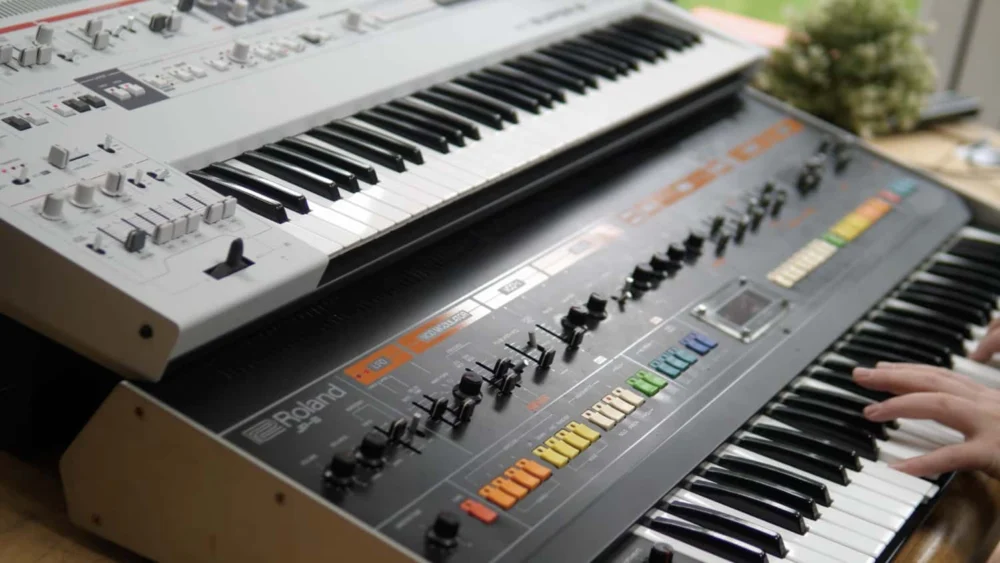
The landscape of high-end polyphonic synthesis has undergone a significant transformation over the last decade, transitioning from a market dominated by vintage restoration to one defined by innovative hybrid engineering. At the center of this evolution is the ongoing quest to capture the sonic character of the Roland Jupiter-8, an instrument widely regarded as one of the most influential synthesizers in music history. In a detailed technical evaluation, renowned synthesizer expert Starsky Carr has released a comprehensive head-to-head comparison between the original 1981 Roland Jupiter-8 and the newly released UDO Super 8. This analysis seeks to determine if modern digital-analog hybrid technology has finally reached a point of parity with the discrete analog circuitry of the early 1980s.
The Historical Significance of the Roland Jupiter-8
To understand the weight of this comparison, one must first examine the legacy of the Roland Jupiter-8 (JP-8). Released in 1981, the JP-8 was Roland’s flagship response to the American dominance of Sequential Circuits and Oberheim. It featured eight voices of polyphony, two voltage-controlled oscillators (VCOs) per voice, and a distinctive 12/24 dB per octave resonant low-pass filter.
The Jupiter-8 was celebrated not just for its technical specifications, but for its "hi-fi" sound—a characteristic clarity and shimmer that distinguished it from the darker, more aggressive tones of its contemporaries. Its inclusion of features such as cross-modulation, oscillator sync, and a sophisticated arpeggiator made it a staple in the studios of artists ranging from Duran Duran and Howard Jones to Tangerine Dream and Queen. Today, the Jupiter-8 has transcended its status as a mere tool, becoming a blue-chip asset in the vintage instrument market, with well-maintained units frequently commanding prices upwards of $25,000 to $30,000 on the secondary market.
The Rise of UDO Audio and the Super 8 Architecture
The UDO Super 8 represents a different philosophy in sound design. Founded by George Hearn, UDO Audio entered the market with the Super 6, a synthesizer that gained immediate acclaim for its "binaural" signal path. The Super 8 is the latest evolution in this lineage, offering a 16-voice polyphonic (or 8-voice binaural) architecture that utilizes FPGA (Field-Programmable Gate Array) oscillators paired with genuine analog filters and amplifiers.
Unlike traditional DSP (Digital Signal Processing) which relies on standard microprocessors, FPGA technology allows for high-resolution oscillators that function at a sample rate of nearly 50MHz. This eliminates the "aliasing" often associated with digital synthesis, providing a frequency response that mimics the behavior of analog VCOs while maintaining the stability and precision of digital control. The Super 8 is designed as a performance-oriented instrument, featuring a 61-note weighted keybed with polyphonic aftertouch—a feature notably absent from the original Jupiter-8.
Comparative Analysis: Oscillators and Harmonic Complexity
In his comparative video, Starsky Carr meticulously aligns the parameters of both instruments to isolate the core "DNA" of their sound. A primary point of interest is the behavior of the oscillators. The Jupiter-8’s VCOs are known for their subtle instabilities—slight pitch drifts and harmonic fluctuations that create a sense of "movement" in the sound.
Carr’s analysis demonstrates how the UDO Super 8 utilizes its "Super" mode to simulate this complexity. By shifting the phase of the oscillators across the stereo field (the binaural effect), the Super 8 achieves a spatial depth that the original Jupiter-8 could only approximate through external processing or chorus effects. However, the raw, unmodulated sawtooth wave of the Jupiter-8 remains a benchmark for many purists. The comparison highlights that while the Super 8 can match the Jupiter-8 in sheer weight and presence, it offers a more modern, wider stereo image that reflects contemporary production standards.
Filter Characteristics and Envelope Response
The filter is often described as the "soul" of a synthesizer, and the Roland Jupiter-8’s IR3109 filter chip is legendary for its smooth resonance and musicality. In the head-to-head test, Carr examines how the Super 8’s analog filters handle high resonance and fast modulation.
The UDO Super 8 utilizes a four-pole, 24dB per octave resonant low-pass filter based on a modern SSI2144 design, which is a contemporary descendant of the classic SSM chips found in early Korg and Sequential instruments. While not a direct clone of the Roland filter, the Super 8’s filter exhibits a similar "creamy" quality. A critical aspect of the Jupiter-8’s sound is its snappy envelope generators, which allow for percussive bass lines and fast-attack brass sounds. Carr’s testing suggests that the Super 8’s digital envelopes are calibrated to provide a similarly rapid response, bridging the gap between digital control and analog feel.
The Binaural Advantage vs. Discrete Analog Realism
One of the most significant architectural differences identified in the comparison is the UDO Super 8’s binaural signal path. In standard synthesizers, voices are summed to a mono or stereo output. In the Super 8’s binaural mode, the instrument creates eight "twin" voices. Each ear receives a slightly different version of the sound, with independent timing, phase, and filter position.
This results in a 3D soundstage that the Jupiter-8, a mono-voice-per-channel instrument, cannot natively replicate. While the Jupiter-8 has a "dual" mode that allows for layering two different sounds, it remains a traditional stereo-summed experience. The implication for modern producers is significant: the Super 8 provides a finished, "mixed" sound directly from the outputs, whereas the Jupiter-8 often requires outboard gear to achieve the same level of spatial width.
Market Positioning and Professional Implications
The comparison between these two instruments is not merely academic; it has profound implications for the professional audio industry. For decades, the Jupiter-8 was the "unattainable" standard. The emergence of the Super 8, priced at approximately $4,000, offers a viable alternative for professional studios that require the "Jupiter-style" sound without the maintenance risks and exorbitant costs of 40-year-old hardware.
Economic Comparison Data:
- Roland Jupiter-8 (1981): Original Price: $5,295 | Current Market Value: $25,000–$35,000.
- UDO Super 8 (2024): Current Price: ~$3,999.
- Maintenance: Jupiter-8 requires specialist technician support for discrete components; Super 8 includes modern warranty and firmware update capabilities.
From a workflow perspective, the Super 8 introduces MIDI CC control, MPE (MIDI Polyphonic Expression) compatibility, and a robust modulation matrix—features that significantly expand its utility in a modern Digital Audio Workstation (DAW) environment. The Jupiter-8, while retrofitted with MIDI in many cases (such as the Encore or Kenton kits), remains limited by its original 1980s control resolution.
Industry Reaction and Future Outlook
While UDO Audio has not officially marketed the Super 8 as a "Jupiter-8 clone," the design cues—ranging from the color-coded buttons to the slider-heavy interface—clearly pay homage to the Roland flagship. Industry reactions to Carr’s comparison have been largely positive, with many observers noting that the Super 8 captures the "spirit" of the Jupiter-8 while carving out its own sonic identity.
George Hearn, the designer of the Super 8, has frequently stated in interviews that his goal is to create instruments that feel "alive." The consensus among synthesists following this comparison is that the Super 8 succeeds in this regard, offering a level of tactile engagement and sonic unpredictability that was previously the sole domain of vintage analog gear.
Conclusion: A Modern Successor?
The comparison conducted by Starsky Carr reveals that while the Roland Jupiter-8 remains an incomparable icon of the analog era, the UDO Super 8 stands as its most formidable modern spiritual successor. The Super 8 does not merely replicate the Jupiter-8; it translates its core philosophy—polyphonic power, intuitive interface, and harmonic richness—into a 21st-century context.
For the touring musician or the working film composer, the reliability and expanded feature set of the Super 8 make it a more practical choice. However, for the collector and the purist, the discrete analog behavior and historical gravity of the Jupiter-8 remain unmatched. The debate highlights a broader trend in the music technology industry: the shift from "emulation" to "evolution." Rather than trying to be a perfect mirror of the past, instruments like the Super 8 are using modern technology to fulfill the original promise of the vintage giants, providing musicians with a palette that is both familiar and fundamentally new.
