

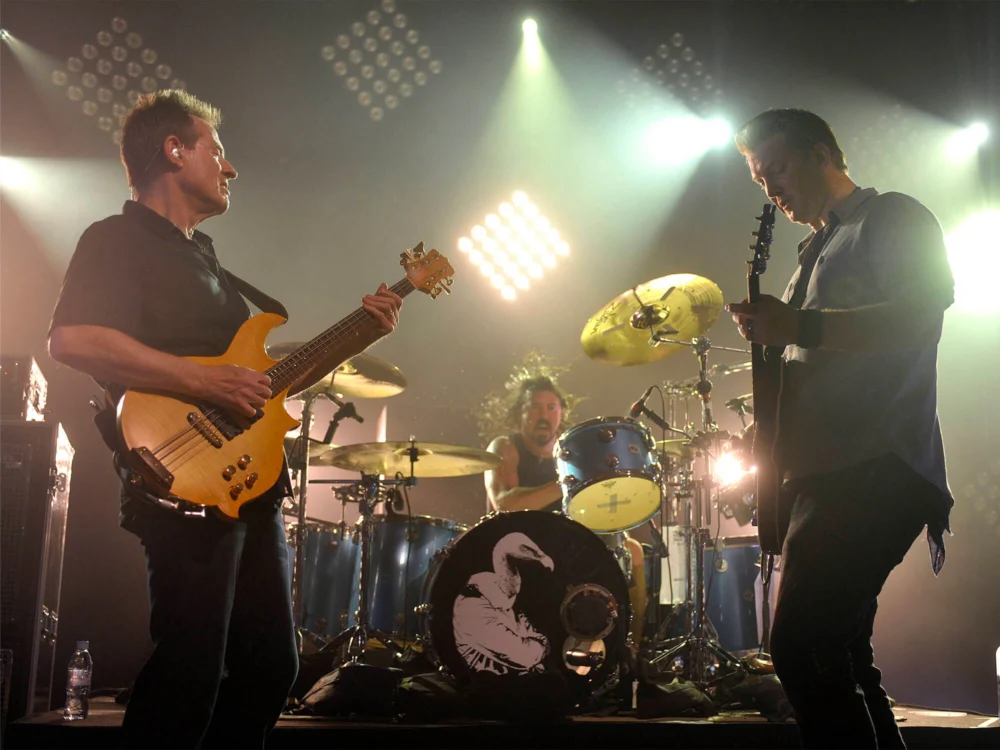
Josh Homme, the revered frontman of Queens of the Stone Age and a pivotal figure in modern rock, has long been celebrated for his distinctive sonic palette, a sound meticulously crafted through a deliberate embrace of unconventional and often overlooked gear. A recent interview with Guitar World brought to light a revealing anecdote involving Homme’s Them Crooked Vultures bandmate, the legendary Led Zeppelin bassist John Paul Jones, underscoring Homme’s philosophy of prioritizing unique sound over conventional equipment prestige. The incident involved Homme showcasing a decidedly "underdog" bass rig to Jones, comprising a Yamaha hollowbody bass fed into a modest Peavey Decade practice amplifier, which initially elicited a reaction of bewildered amusement from the seasoned musician before transforming into genuine appreciation.
The Genesis of a Distinctive Sound: Josh Homme’s Gear Philosophy
Homme’s approach to musical instrumentation is fundamentally rooted in a quest for sonic individuality. Unlike many contemporary guitarists who gravitate towards industry-standard, high-end amplifiers and instruments, Homme has consistently sought out pieces of equipment that are either obscure, inexpensive, or simply not traditionally associated with professional-grade rock music. This philosophy, which he terms "getting behind the underdog," is not merely a quirk but a calculated strategy to carve out a unique sonic identity that is immediately recognizable. "You’re looking for any way, visually and sonically, to do something that nobody else is doing," Homme explained, emphasizing the desire to avoid being pigeonholed or sounding derivative. This commitment to unconventionality has been a hallmark of his career, from the downtuned, heavy riffs of Kyuss in the early 1990s to the expansive, hypnotic soundscapes of Queens of the Stone Age, which has now spanned three decades. His goal, he states, is that "within three seconds, you know it’s [him]."
The driving force behind this methodology is a resistance to conformity and a belief that true innovation stems from challenging established norms. Homme’s artistic output, characterized by its desert rock origins, heavy grooves, and unique vocal stylings, is inextricably linked to this gear-agnostic approach. He views the act of making music as a continuous evolution, and his equipment choices reflect this fluidity. "Anything is an amplifier to me," he asserts, detailing his experimental use of "old stereo tuners, old tape machines; anything with a speaker and a jack." This stands in stark contrast to the predictability he associates with more conventional setups, such as a Les Paul guitar paired with a Marshall amplifier, which he acknowledges would yield a known outcome. For Homme, the unexpected is paramount; it is the fertile ground from which truly original sounds emerge.
The Them Crooked Vultures Nexus: A Confluence of Legends
The stage for this memorable encounter was Them Crooked Vultures, a supergroup formed in 2009 that brought together a formidable trio of rock titans: Josh Homme on guitar and vocals, John Paul Jones on bass and keyboards, and Dave Grohl (Foo Fighters, Nirvana) on drums. The formation of Them Crooked Vultures was a significant event in the rock music landscape, uniting three musicians with distinct but complementary legacies. Jones, renowned for his innovative basslines, multi-instrumental prowess, and sophisticated arrangements with Led Zeppelin, brought a profound musicality and a vast reservoir of experience. Grohl, a powerhouse drummer and successful frontman in his own right, contributed his signature rhythmic intensity. Homme, with his distinct guitar work and vocal delivery, acted as a crucial creative fulcrum.
The band’s self-titled debut album, released in November 2009, was met with widespread critical acclaim, praised for its heavy, blues-infused rock that managed to sound both classic and contemporary. The collaborative environment within Them Crooked Vultures was evidently one that fostered experimentation and mutual respect among its highly accomplished members. This setting, where three giants of rock were free to explore new musical territories without the constraints of their primary bands’ expectations, provided the perfect backdrop for Homme to present his unorthodox sonic tools. It was in this atmosphere of shared musical exploration that Homme chose to reveal a piece of his "underdog" arsenal to Jones, a musician known for his own deep understanding of sound and instrumentation.
The Anecdote Unpacked: John Paul Jones’s Surprising Encounter
The specific interaction, recounted by Homme, involved him introducing Jones to a particular bass rig. "I showed the Decade to John Paul Jones when we were in Them Crooked Vultures," Homme recalled. The rig consisted of a Yamaha hollowbody bass, affectionately dubbed "Lame-aha" by Homme, strung with flatwound strings. This bass featured an unusual volume knob that functioned as a pickup blend control, allowing for a spectrum of tones rather than discrete pickup selections. The signal from this distinctive bass was then routed into a Peavey Decade, a compact 10-watt solid-state practice amplifier primarily designed for beginners or casual home use, typically not found in a professional studio or stage setup. To capture this unique sound, Homme employed a Coles ribbon microphone, a high-fidelity studio microphone known for its warm, natural sound, often used for critical recording applications.
Jones’s initial reaction, as described by Homme, was one of pure disbelief and amusement. "He laughed – and I love that, because the looks are deceiving," Homme stated. The visual incongruity of such a rudimentary setup, particularly for a musician accustomed to world-class equipment and sonic perfection, was striking. Jones’s laughter stemmed from the sheer "shittiness" of its appearance, a stark contrast to the sophisticated gear he had utilized throughout his illustrious career. However, this initial skepticism quickly dissipated once Jones actually played through the rig. "Then he played it. It was fun to see him go from giggling about how shitty something looks to complete joy," Homme recounted. This transformation from mirth to genuine delight speaks volumes about the unexpected sonic capabilities Homme had coaxed from the humble components. It underscored Homme’s core belief that appearance can be profoundly misleading in the realm of sound and that true quality can be found in the most unexpected places.
Dissecting the "Underdog" Rig: Yamaha "Lame-aha" and Peavey Decade
To fully appreciate the significance of this anecdote, it is essential to delve into the specific components of Homme’s "underdog" rig.
-
The Yamaha Hollowbody Bass: While the exact model is not specified, Yamaha has a long history of producing diverse instruments, including hollowbody basses. These instruments are generally known for their warm, resonant tones, often favored in jazz, blues, and roots music, providing a distinct sonic character compared to solid-body basses. The use of flatwound strings further contributes to a mellow, thuddy, vintage-like sound with less sustain and brightness than roundwounds. Homme’s unique "volume knob as pickup blend" feature on his "Lame-aha" bass highlights a modification or an unusual design choice that adds to its idiosyncratic nature, allowing for a broader sonic palette beyond standard two-pickup selector switches.
-
The Peavey Decade Practice Amp: This is arguably the star of Homme’s "underdog" philosophy. The Peavey Decade, produced in the 1980s, was a quintessential budget-friendly, solid-state practice amplifier. It featured a simple control layout, minimal wattage (typically 10-12 watts), and a small speaker. It was designed for beginners or as a compact, portable option for quick practice sessions. Its sound is often described as raw, unrefined, and prone to breaking up quickly, particularly when pushed. These characteristics, often considered drawbacks by conventional standards, are precisely what Homme seeks. The amp’s inherent limitations, when expertly manipulated, can yield a distinctive, gritty, and compressed tone that stands apart from the pristine sounds of high-fidelity tube amplifiers. For Homme, the Decade’s lack of sophistication is its strength, offering a unique sonic texture that cannot be replicated by more polished, expensive alternatives.
-
The Coles Ribbon Mic: The inclusion of a Coles ribbon microphone in this setup is also telling. Coles microphones, particularly the 4038 model, are highly regarded for their smooth, natural frequency response, excellent transient handling, and ability to capture a rich, warm tone. They are often used for recording brass, drums, and vocals in professional studios. Pairing such a high-fidelity, studio-grade microphone with a humble practice amp like the Peavey Decade demonstrates Homme’s understanding of how recording techniques can elevate and transform even the most unassuming source material. The Coles mic would accurately capture the nuanced characteristics of the Decade’s breakup and the Yamaha bass’s unique timbre, presenting it in its most flattering light.
The Art of Distinctive Sound: Beyond Conventional Gear
Homme’s philosophy extends beyond mere gear selection; it’s about the conscious pursuit of a sonic signature. In an industry often driven by trends and the adoption of popular or expensive equipment, Homme champions the idea of forging an identity that is inimitable. "Getting shit from people is the best thing that could happen," he remarked, indicating that initial negative reactions or skepticism often confirm that he is indeed treading an unconventional path. This rebellious stance against sonic homogeneity is a powerful statement, reinforcing the idea that true artistry lies not just in the notes played but in the unique texture and character of the sound itself. His enduring influence with Queens of the Stone Age is a testament to the success of this approach; their music is instantly recognizable, a quality that many artists strive for but few achieve with such consistent distinction.
The broader implication of Homme’s "underdog" philosophy is its democratizing effect on music production. It challenges the notion that superior sound is solely the domain of expensive, high-end equipment. Instead, it posits that creativity, experimentation, and a deep understanding of how different components interact can yield exceptional results from even the most unexpected sources. This mindset empowers musicians to look beyond marketing hype and explore the sonic potential of readily available or forgotten gear, fostering a culture of innovation rather than imitation.
From Niche to Mainstream: The Peavey Decade’s Resurgence
The anecdote with John Paul Jones, coupled with Homme’s consistent use and endorsement, has brought significant attention to the humble Peavey Decade. What was once a forgotten relic of the 80s practice amp market has now garnered cult status among musicians seeking to replicate Homme’s distinctive tones or simply explore its unique character. This surge in interest has not gone unnoticed by manufacturers.
Peavey, recognizing the renewed appeal of their vintage product, responded by introducing the Peavey Decade Too amplifier. This modern iteration aims to "revive that voice and makes it accessible again," allowing contemporary musicians to experience the distinctive sound without the arduous task of "hunting for vintage originals" in potentially poor condition. The Decade Too is designed to capture the essence of the original’s gritty, solid-state sound while offering the reliability and features expected from modern amplification. This move by Peavey highlights a growing trend in the gear industry where iconic, often budget-friendly, vintage pieces are reissued or reimagined due to their newfound popularity, often spurred by the endorsement of influential artists.
The Acorn Amps Solid State Pedal: A Modern Homage
Further testament to the Peavey Decade’s cult status and Homme’s influence came in 2022 with the release of the Acorn Amps Solid State pedal. Acorn Amps, known for their boutique, hand-built pedals, embarked on a project to transform the entire circuit of Homme’s beloved Peavey Decade into a compact, pedalboard-friendly format. The Solid State pedal is marketed as a "full circuit recreation" of the 10-watt practice amp, effectively putting the core tone-generating capabilities of the Decade into a stompbox. This innovation allows guitarists and bassists to integrate the Decade’s unique sound into their existing rigs without needing to carry the full amplifier.
The development of such a niche product underscores the significant impact Homme’s gear choices have had on the market. It caters directly to a segment of musicians inspired by his sonic aesthetic, providing them with a convenient and reliable way to access those specific tones. The success of products like the Decade Too and the Acorn Amps pedal demonstrates a tangible commercial implication of Homme’s philosophy: by championing the "underdog," he inadvertently creates new markets and revitalizes interest in forgotten gear, proving that authentic artistic expression can directly influence consumer demand and product development.
Implications for Musicians and the Gear Industry
Josh Homme’s narrative with the Peavey Decade serves as a powerful case study with broad implications for both aspiring musicians and the music gear industry. For musicians, it offers a liberating perspective: that true originality often lies outside the conventional and the expensive. It encourages experimentation, listening critically, and understanding how to manipulate any piece of equipment to serve one’s artistic vision, rather than passively accepting its perceived limitations. This mindset fosters creativity and resourcefulness, crucial traits in an ever-evolving musical landscape.
For the gear industry, Homme’s influence highlights the power of artist endorsement, particularly when it comes to championing unconventional tools. It demonstrates that innovation isn’t solely about creating entirely new technologies but also about rediscovering and recontextualizing existing ones. The revival of products like the Peavey Decade through modern reissues and pedal recreations indicates a market responsiveness to authentic artist-driven trends, pushing manufacturers to consider the untapped potential of their past catalogs and the evolving preferences of musicians seeking unique sonic identities.
The Enduring Legacy of the Unconventional
The story of Josh Homme, his "Lame-aha" bass, and the Peavey Decade is more than just an amusing anecdote; it is a profound testament to a deeply held artistic principle. It reinforces the idea that innovation in music often stems from challenging the status quo, looking beyond superficial appearances, and finding beauty and utility in the unexpected. Homme’s ability to coax "complete joy" from John Paul Jones, a musician who has literally shaped the sound of rock, using such a humble setup, solidifies his reputation not just as a gifted songwriter and performer, but as a true sonic alchemist. His enduring legacy will undoubtedly continue to inspire countless musicians to embrace the "underdog" and forge their own distinctive paths in the ever-expanding universe of sound.
