

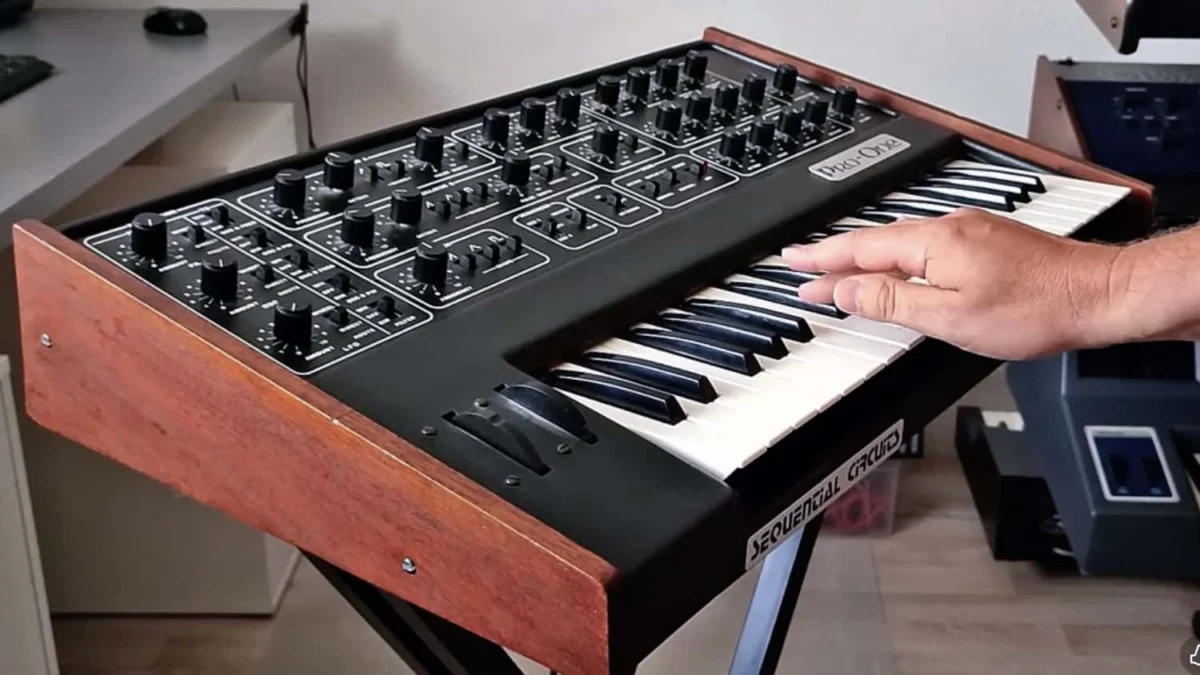
The Pro-One was the brainchild of Dave Smith and the engineering team at Sequential Circuits. At a time when the market was shifting toward portable and cost-effective gear, the Pro-One provided musicians with a high-fidelity analog signal path and a sophisticated modulation matrix that surpassed many of its contemporaries. Its role in shaping the sonic identity of the early 1980s cannot be overstated, as it provided the aggressive basslines, piercing leads, and intricate sequences that defined the era’s charts.
Technical Architecture and Engineering Excellence
To understand the enduring appeal of the Sequential Circuits Pro-One, one must examine its internal architecture. The instrument was built using high-quality components from Curtis Electromusic Specialties (CEM), which were renowned for their stability and character. Specifically, the Pro-One utilized two CEM 3340 Voltage Controlled Oscillators (VCOs). These oscillators offered a variety of waveforms, including sawtooth, pulse, and triangle, which could be mixed to create complex tonal textures.
The heart of the Pro-One’s "screaming" character lies in its four-pole low-pass filter, based on the CEM 3320 chip. This filter was capable of self-oscillation, allowing musicians to generate sharp, resonant pings and aggressive sweeps. Unlike many budget synthesizers of the time, the Pro-One featured two ADSR (Attack, Decay, Sustain, Release) envelope generators—one dedicated to the filter and the other to the amplifier—providing precise control over the shape and duration of sounds.
Perhaps the most significant feature for the budding synth-pop genre was the Pro-One’s modulation section. It allowed users to route the filter envelope and the second oscillator to modulate the frequency or pulse width of the first oscillator, as well as the filter cutoff. This flexibility made it possible to create "sync" sounds and metallic timbres that were previously only available on much more expensive modular systems or high-end polyphonic synths.
The Yazoo Connection: Vince Clarke’s Sonic Blueprint
The Pro-One is perhaps most famously associated with Vince Clarke, the founding member of Depeche Mode and one half of Yazoo (known as Yaz in North America). Following his departure from Depeche Mode after their debut album, Clarke teamed up with vocalist Alison Moyet to form Yazoo. The duo’s debut album, Upstairs at Eric’s (1982), is widely considered a masterclass in Pro-One programming.
In the RetroSound demonstration, several Yazoo tracks are highlighted to showcase the Pro-One’s range. For "Don’t Go," the synthesizer provides the driving, syncopated bassline and the sharp, percussive lead sounds that pierce through the arrangement. The track "Situation" demonstrates the instrument’s ability to create "rubbery" bass tones that defined the early house and techno precursors. In "Only You," the Pro-One is utilized for softer, more melodic duties, proving that despite its reputation for aggression, it could also produce delicate, flute-like textures.
Clarke’s workflow often involved the Pro-One’s built-in 40-note sequencer. While primitive by modern standards, the sequencer allowed for the creation of tight, repetitive patterns that were essential for the duo’s dance-oriented tracks. By syncing the Pro-One to a Roland MC-4 Microcomposer or a drum machine, Clarke was able to build entire tracks using almost nothing but the Pro-One for all melodic and percussive synthesis.
Chronology of Influence: From New Wave to Industrial
The timeline of the Pro-One’s dominance spans roughly from 1981 to 1985, though its influence persisted long after it was discontinued.
- 1981: Market Entry. Sequential Circuits releases the Pro-One to compete with the Moog Prodigy and the Roland SH-101. It quickly gains favor due to its superior modulation capabilities.
- 1982: The Synth-Pop Explosion. Yazoo releases Upstairs at Eric’s. Simultaneously, artists like Japan and Thompson Twins begin incorporating the Pro-One into their live rigs and studio sessions.
- 1983: Expansion into Europe. The instrument becomes a favorite in the German "Neue Deutsche Welle" scene. Peter Schilling’s "Major Tom (Coming Home)" utilizes the Pro-One for its space-age textures and driving low-end.
- 1984: Industrial and EBM Foundations. Early industrial pioneers such as Skinny Puppy and Front 242 begin utilizing the Pro-One for its ability to create harsh, distorted, and metallic sounds, laying the groundwork for Electronic Body Music (EBM).
- 1985: The Digital Shift. With the rise of the Yamaha DX7 and digital FM synthesis, production of the Pro-One ceases. However, the used market begins to flourish as the instrument becomes a "secret weapon" for underground producers.
Notable Use Cases in 1980s Hits
Beyond the work of Vince Clarke, the Pro-One left an indelible mark on various genres. The RetroSound video highlights several key examples that illustrate the instrument’s versatility:
- Berlin – "The Metro" and "Masquerade": The Los Angeles-based band Berlin utilized the Pro-One to achieve a cold, European electronic sound. The rhythmic pulses in "The Metro" are a quintessential example of the Pro-One’s snappy envelopes and stable oscillators.
- Eurythmics – "Here Comes the Rain Again": Dave Stewart and Annie Lennox utilized a variety of synthesizers to create their moody, atmospheric pop. The Pro-One contributed to the dark, undulating synth textures that provide the track’s emotional weight.
- Secret Service – "Flash in the Night": This Swedish synth-pop hit features the Pro-One’s ability to create crystalline, sequenced arpeggios that shimmer over a melancholic arrangement.
- Beagle Music Ltd. – "Like Ice in the Sunshine": This track demonstrates the more commercial, bright side of the Pro-One, showing how it could be programmed for upbeat, "jingle-like" melodies without losing its analog warmth.
Market Impact and the Legacy of Dave Smith
The Pro-One was not just a musical success; it was a strategic triumph for Sequential Circuits. By leveraging the reputation of the Prophet-5, Sequential was able to capture the entry-level professional market. However, the instrument was known for its somewhat fragile build quality, often featuring a plastic chassis and a "J-wire" keyboard mechanism that required frequent maintenance. Despite these physical shortcomings, the internal electronics remained highly regarded.
The legacy of the Pro-One is intrinsically tied to the late Dave Smith, who was often called the "Father of MIDI." While the Pro-One predated MIDI (utilizing CV/Gate for control), Smith’s philosophy of making powerful synthesis accessible to the masses was embodied in the instrument. Following the resurgence of interest in analog synthesis in the 21st century, Smith’s newer company, Sequential (formerly Dave Smith Instruments), released the Prophet-6 and the Mopho, both of which drew inspiration from the Pro-One’s voice architecture.
Contemporary Relevance and Replicas
In the modern era, the Sequential Circuits Pro-One has reached legendary status, with vintage units often fetching high prices on the secondary market. The demand for its specific sound—described by enthusiasts as "organic," "unpredictable," and "raw"—has led to a new generation of hardware and software tributes.
In 2019, Behringer released the Pro-1, a hardware clone that sought to replicate the original circuitry of the Pro-One in a desktop format. While purists argue over the subtle nuances between the vintage original and the modern clone, the existence of such a product highlights the Pro-One’s enduring importance. Additionally, software companies like Repro-1 by u-he have created highly accurate digital emulations, allowing modern producers to access the "Yazoo sound" within a digital audio workstation (DAW).
Conclusion: An Enduring Sonic Identity
The Sequential Circuits Pro-One stands as a testament to an era of musical innovation where the limitations of technology fostered immense creativity. Its presence in the hits of Yazoo, Berlin, and the Eurythmics serves as a reminder of how a single instrument can define the aesthetic of an entire decade.
As demonstrated in the RetroSound retrospective, the Pro-One is more than a relic of the past; it is a functional tool that continues to offer a unique sonic palette. Whether through its original 1981 hardware or modern reinterpretations, the raw analog character of the Pro-One remains a benchmark for monophonic synthesis, ensuring its place in the pantheon of great musical inventions. The instrument’s ability to transition seamlessly from the pop charts to industrial warehouses proves that true engineering excellence transcends genre and time.
