

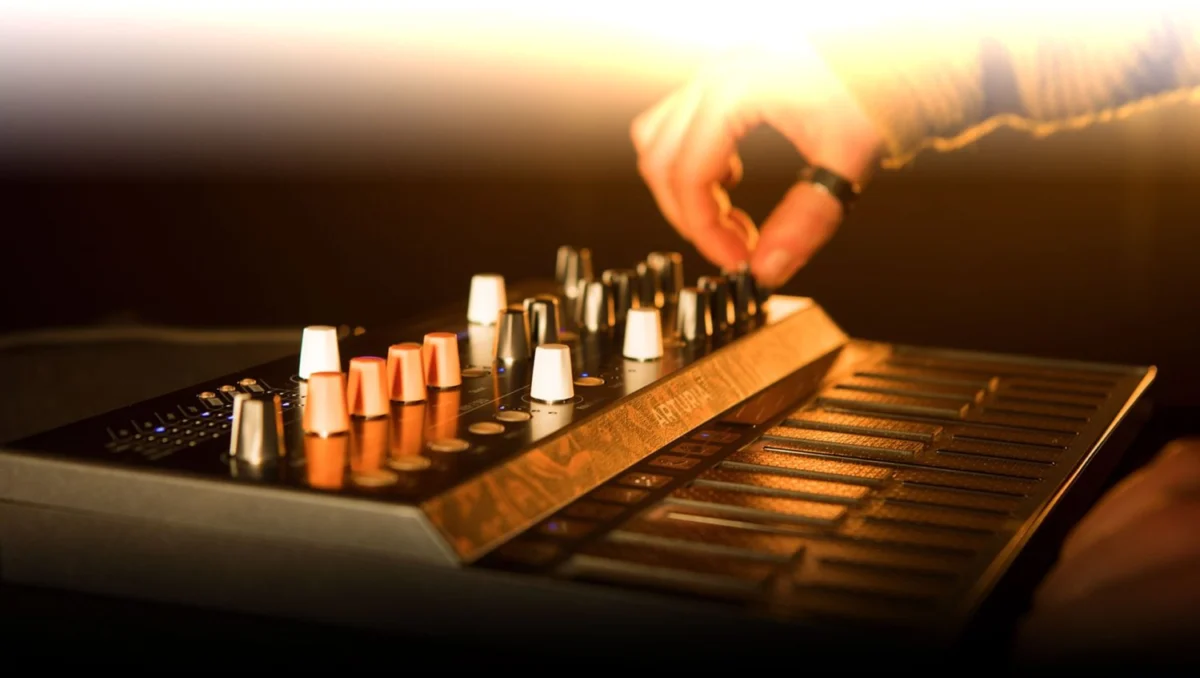
The Arturia MicroFreak has emerged as a singular phenomenon in the electronic musical instrument industry, maintaining a trajectory of relevance and market desirability that defies the typical lifecycle of budget-tier synthesizers. Since its initial unveiling at the NAMM Show in 2019, the device has transitioned from a niche experimental curiosity into a foundational tool for both amateur sound designers and professional producers. Recent assessments by industry commentators, including prominent synthesis expert Woody Piano Shack, highlight a significant maturation of the platform, driven primarily by Arturia’s aggressive firmware development strategy. In an era where hardware is often superseded by newer iterations within 24 months, the MicroFreak stands as a case study in how digital-analog hybrid architecture can be leveraged to provide long-term value, with current used market valuations hovering around the $250 mark, representing one of the highest feature-to-cost ratios in contemporary music technology.
Historical Context and the 2019 Market Entry
When Arturia first introduced the MicroFreak, the synthesizer market was largely divided between traditional analog subtractive synthesizers and high-end digital workstations. Arturia, previously known for its "Brute" line of purely analog instruments and its extensive suite of software emulations, sought to bridge the gap with a hybrid approach. The MicroFreak was designed to offer the flexibility of digital oscillators paired with the warmth of an analog filter, all controlled via a distinctive capacitive touch-plate keyboard.
The launch was met with both intrigue and skepticism. The inclusion of a PCB (Printed Circuit Board) keyboard in place of traditional moving keys was a bold ergonomic choice, intended to provide polyphonic aftertouch—a premium feature usually reserved for instruments costing thousands of dollars. Furthermore, the collaboration with Mutable Instruments to include open-source code from the acclaimed "Plaits" Eurorack module signaled Arturia’s intent to cater to the modular synthesis community. This strategic alignment allowed the MicroFreak to offer complex synthesis types, such as Karplus-Strong, Wavetable, and Virtual Analog, within a portable, affordable chassis.
Technical Architecture and Hybrid Design
The core appeal of the MicroFreak lies in its "Freaky" oscillator engine. Unlike traditional synthesizers that utilize one or two fixed waveforms, the MicroFreak features a digital oscillator capable of running multiple distinct algorithms. At launch, this included several modes, but the architecture was designed to be extensible. This digital brain is then routed through a 12dB/octave resonant filter based on the legendary Oberheim SEM design. This combination allows for the creation of sharp, modern digital textures that are subsequently "tamed" or enriched by analog circuitry, providing a sonic character that is difficult to replicate with software alone.
The modulation matrix is another defining feature of the hardware. With five sources and seven destinations (three of which are user-assignable), the 12×32 matrix allows for complex routing that mimics the workflow of a modular synthesizer. This level of interconnectivity is rare in instruments at this price point and serves as a primary driver for the "super synth" designation often applied by reviewers.
Chronology of Evolution: The Firmware Transformation
The most significant factor in the MicroFreak’s longevity is the series of major firmware updates released by Arturia between 2019 and 2024. These updates have effectively transformed the hardware into a new instrument multiple times over.
- Version 2.0 (2020): This update introduced the Noise Engineering oscillator modes (SawX, Harm, and Chirp), which brought gritty, industrial, and experimental textures to the device. It also improved the sequencer functionality and added a chord mode.
- Version 3.0 (2021): This milestone added a 4-voice Unison mode, allowing the paraphonic synth to deliver much thicker, "wall-of-sound" textures. It also expanded the preset memory from 256 to 384 slots to accommodate the growing library of user-created sounds.
- Version 4.0 (2022): Arturia introduced Wavetable synthesis capabilities that allowed users to import their own tables, alongside a sophisticated Vocoder mode. By connecting a microphone via the TRRS headphone jack, the MicroFreak became a fully functional vocoder, further expanding its utility in vocal production.
- Version 5.0 (2023): Perhaps the most ambitious update, Version 5.0 added sample playback and granular synthesis engines. This allowed users to upload their own audio samples (up to 21 seconds) and manipulate them using the MicroFreak’s modulation tools. This update effectively moved the device into the territory of samplers and granular workstations.
This timeline demonstrates a commitment to hardware support that is nearly unprecedented in the budget sector. By consistently adding high-value features for free, Arturia has maintained a high resale value for the unit and fostered a loyal user base.
Market Analysis and Economic Positioning
In the current economic climate, the MicroFreak occupies a unique position. With a manufacturer’s suggested retail price (MSRP) that has remained relatively stable around $349 USD, it competes directly with the Korg Volca series, the Roland Boutique line, and the Behringer "clone" synthesizers. However, the MicroFreak differentiates itself by being an original design rather than a recreation of 1980s technology.
Data from secondary marketplaces such as Reverb and eBay indicate that the MicroFreak retains approximately 70% to 80% of its original value even after years of use. Used units typically trade between $225 and $275 USD. For entry-level musicians, this represents a low-risk investment; for professionals, it represents a versatile "Swiss Army knife" tool that occupies minimal desk space while offering expansive sound design capabilities.
The "Super Synth" label mentioned in recent reviews refers to this density of features. When calculated as a "cost-per-synthesis-engine," the MicroFreak outperforms almost every other hardware synthesizer on the market. It provides virtual analog, FM, wavetable, granular, vocoder, and physical modeling synthesis in a single box for less than the price of many premium software plugins.
The Significance of Polyphonic Aftertouch
A critical, though sometimes misunderstood, feature of the MicroFreak is its implementation of polyphonic aftertouch. In traditional MIDI controllers, "channel aftertouch" applies a modulation effect to all notes currently being held. Polyphonic aftertouch, however, allows the player to modulate each individual note independently based on the pressure applied to the key.
This level of expressive control was historically associated with elite instruments like the Yamaha CS-80 or the modern Deckard’s Dream. By utilizing a capacitive touch plate, Arturia bypassed the mechanical complexity and high cost of traditional poly-aftertouch keybeds. While the "flat" feel of the PCB is polarizing for some keyboardists, it provides a level of expressive nuance that is essential for modern electronic music styles, particularly in the ambient and cinematic genres.
Broader Impact on the Synthesizer Industry
The success of the MicroFreak has influenced the broader industry’s approach to "small-format" synthesis. It proved that there is a substantial market for experimental, non-traditional interfaces if they are backed by powerful sound engines and continuous software support. Following the MicroFreak’s success, Arturia expanded the line with the MiniFreak, a larger, fully polyphonic version with a traditional keyboard, further solidifying the "Freak" ecosystem.
Furthermore, the MicroFreak has played a role in the democratization of music production. By providing complex synthesis types—previously the domain of expensive modular rigs—to a wider audience, Arturia has lowered the barrier to entry for avant-garde sound design. The integration of CV/Gate outputs also ensures that the MicroFreak acts as a gateway drug for the modular synthesis world, allowing users to control external analog gear with the MicroFreak’s advanced sequencer and touch-plate.
Implications for Future Hardware Development
The sustained interest in the MicroFreak suggests a shift in consumer expectations. Modern musicians are increasingly looking for "evergreen" hardware—devices that will grow in capability over time rather than becoming obsolete. The MicroFreak’s ability to host samples and perform granular synthesis via a firmware update suggests that the hardware was over-engineered at launch, providing a "headroom" for growth that has paid dividends in brand loyalty.
Industry analysts suggest that the MicroFreak’s model of "hardware as a platform" will likely be emulated by other manufacturers. As the cost of powerful microprocessors continues to fall, the limitation on hardware becomes less about the silicon and more about the creativity of the firmware engineers. Arturia’s strategy has effectively turned a $300 purchase into a five-year (and counting) journey of musical discovery.
In conclusion, the Arturia MicroFreak remains a benchmark in the industry. Its combination of a unique hybrid voice, a highly expressive interface, and a relentless update cycle has secured its place in the pantheon of modern classic synthesizers. Whether purchased new for its current suite of features or used as a budget-friendly entry point into synthesis, the MicroFreak continues to justify its reputation as a "super synth" that punch significantly above its weight class. As the community looks toward future updates or potential successors, the MicroFreak stands as a testament to the enduring power of innovative design and dedicated post-launch support.
