

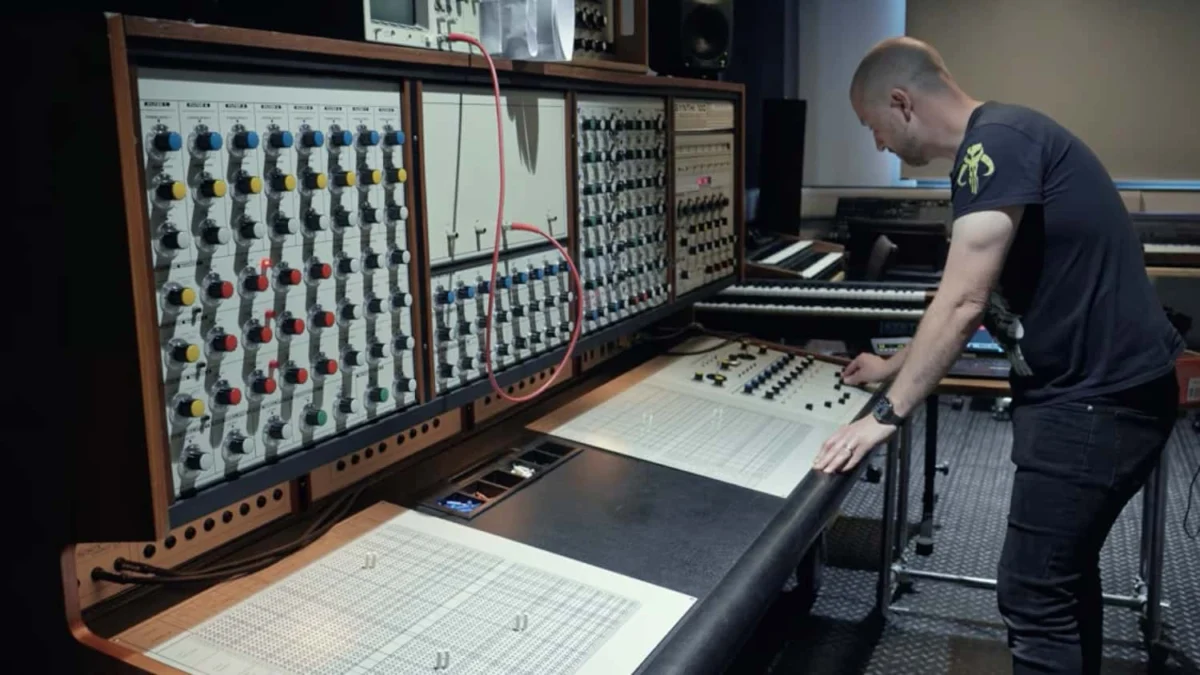
The electronic music community has recently seen a resurgence of interest in vintage modular synthesis, catalyzed by a comprehensive video documentary released by synthesist and historian Alex Ball. The documentary focuses on the EMS Synthi 100, a monolithic instrument that represents a pinnacle of 1970s engineering and a cornerstone of the history of Electronic Music Studios (EMS). Originally introduced in 1971, the Synthi 100—often referred to as the "Digitana"—remains one of the rarest and most complex analog synthesizers ever produced. Ball’s exploration provides not only a technical overview of the machine’s capabilities but also a historical deep dive into the London-based company that sought to revolutionize the way sound was generated and controlled.
The Genesis of Electronic Music Studios
To understand the significance of the Synthi 100, one must look at the origins of Electronic Music Studios. Founded in 1969 by Dr. Peter Zinovieff, Tristram Cary, and David Cockerell, EMS was a pioneer in the British synthesizer market. Unlike its American counterparts, Moog and Buchla, which were making waves in the United States, EMS focused on a unique philosophy of "voltage control" that emphasized compact design and innovative patching systems.
Zinovieff, a geologist and mathematician, had established a sophisticated private electronic music studio in his basement in Putney, London. This studio featured some of the earliest examples of computer-controlled synthesis. Tristram Cary, a renowned composer of film and television music, and David Cockerell, a brilliant engineer, joined Zinovieff to commercialize these concepts. Their first major success was the VCS3 (Voltage Controlled Studio 3), a portable unit that became iconic for its use by bands such as Pink Floyd, The Who, and Brian Eno. However, the Synthi 100 was conceived as a grander, studio-grade expansion of these ideas, designed to meet the demands of major broadcasting institutions and avant-garde composers.
Technical Architecture of a Modular Monster
The EMS Synthi 100 is distinguished by its sheer scale and the density of its components. Housed in a massive wooden console, the instrument was essentially two VCS3s expanded to an industrial degree, integrated with a digital sequencer and a high-fidelity vocoder. While the VCS3 was often used for "wild" sound effects and experimental textures, the Synthi 100 was built for precision and orchestral-scale composition.
Oscillators and Sound Generation
At the heart of the Synthi 100 are twelve voltage-controlled oscillators (VCOs). These were divided into two groups, offering a wide range of waveforms including sine, sawtooth, and square waves. This abundance of oscillators allowed for the creation of incredibly thick, detuned textures or complex polyphonic arrangements that were nearly impossible on other contemporary systems. The machine also featured two white noise generators, which could be filtered and shaped to create percussive sounds or atmospheric effects.
The Pin Matrix System
One of the most defining characteristics of EMS synthesizers is the patchboard matrix. Rather than using the tangled "spaghetti" of patch cables found on Moog or ARP systems, the Synthi 100 utilized two 60×60 pin matrices. This allowed users to connect any source to any destination simply by inserting a small pin into the corresponding coordinate on the grid. These pins were available in different resistances, allowing for varying levels of modulation depth. The matrix system provided a visual representation of the signal path that was both elegant and efficient, though it required a high degree of foresight from the operator.
Filtration and Modulation
The instrument featured eight voltage-controlled filters (VCFs), eight voltage-controlled amplifiers (VCAs), and three ring modulators. The filters were known for their unique "un-stepped" response and a characteristic resonance that could be driven into self-oscillation. Modulation was handled by two joysticks, multiple envelope generators (shapers), and low-frequency oscillators (LFOs), providing a level of tactile control that made the Synthi 100 a favorite for live performance and real-time sound design.
The Digital Sequencer and Vocoder 5000
The Synthi 100 was remarkably ahead of its time due to its inclusion of a 256-step digital sequencer. In 1971, digital technology was in its infancy, and most synthesizers relied on simple analog step sequencers with limited memory. The EMS sequencer allowed for three separate tracks of CV (control voltage) and gate signals, enabling the machine to "remember" complex melodic lines and rhythmic patterns. This made it a proto-workstation, capable of functioning as a self-contained production environment.
Furthermore, the Synthi 100 was often paired with or integrated the EMS Vocoder 5000. As detailed in Alex Ball’s documentary, the Vocoder 5000 is considered one of the most sophisticated vocoders ever built. It featured 22 frequency bands, each with its own envelope follower and VCA. This allowed for incredibly articulate vocal synthesis and was used extensively in film scoring and experimental pop music to create "talking" instruments and robotic textures.
The Townshend Connection and Institutional Use
The Synthi 100 was an expensive instrument, costing roughly £6,500 at its launch—the equivalent of over $100,000 in modern currency. Consequently, only about 30 units were ever manufactured. These machines were primarily sold to universities, national radio stations, and wealthy rock stars.
One of the most notable owners was Pete Townshend of The Who. Townshend was an early adopter of EMS technology, using the VCS3 and the Synthi 100 to push the boundaries of rock music. His personal studio, as explored in the Ball documentary, served as a laboratory for these machines. The Synthi 100’s influence can be heard in the rhythmic textures and synth beds of various solo projects and The Who’s later recordings.
Beyond the world of rock, the Synthi 100 found a permanent home in the BBC Radiophonic Workshop. The Workshop used the machine to create sound effects and music for iconic British television programs, most notably Doctor Who. The machine’s ability to create otherworldly, organic-yet-synthetic sounds made it the perfect tool for science fiction. Other units were sold to Radio Belgrade, the Melodiya Studio in the Soviet Union, and various electronic music centers in Cologne and Paris.
Restoration and Preservation Challenges
Because of its complexity and the era in which it was built, maintaining a Synthi 100 is a monumental task for technicians. The instrument contains thousands of discrete components, many of which have reached the end of their natural lifespan. Potentiometers become scratchy, capacitors leak, and the pin matrices can suffer from oxidation, leading to intermittent signal loss.
In recent years, a small community of specialized engineers has dedicated themselves to restoring the remaining Synthi 100 units. These restorations often involve completely disassembling the console, cleaning thousands of contacts, and sometimes replacing aging components with modern equivalents while attempting to preserve the original "vintage" sound profile. The Alex Ball video highlights the importance of these preservation efforts, as they ensure that the unique sonic signature of EMS—characterized by a certain unpredictability and warmth—is not lost to history.
Broader Impact and Modern Implications
The legacy of the EMS Synthi 100 extends far beyond the 30 units that were produced. Its design philosophy influenced a generation of synthesizer manufacturers. The concept of the pin matrix, for instance, has been revived in modern instruments like the Arturia MatrixBrute and various Eurorack modules.
In the digital realm, software emulations have attempted to bring the Synthi 100 experience to a wider audience. Companies like Arturia and EMS Rehberg have developed virtual instruments that replicate the matrix patching and the specific filter behaviors of the original hardware. While these plugins offer convenience and stability, purists argue that the physical interaction with the massive console and the inherent instability of the analog circuitry provide a creative friction that cannot be fully replicated in code.
Furthermore, the Synthi 100 represents a specific era of "institutional" electronic music. It was a time when synthesizers were seen as scientific instruments as much as musical ones. The transition from these room-sized behemoths to the portable, affordable synthesizers of the late 1970s and 1980s (such as the Minimoog and the Roland Juno series) democratized electronic music, but it also marked the end of the "super-synth" era.
Conclusion
The EMS Synthi 100 remains a symbol of an era defined by bold experimentation and engineering ambition. Through the lens of Alex Ball’s documentary, the modern audience is given a rare glimpse into a machine that bridged the gap between the early academic world of electronic sound and the burgeoning world of progressive rock and film composition. As these rare units are restored and brought back into the public consciousness, they continue to inspire a new generation of sound designers and musicians. The Synthi 100 is not merely a relic of the past; it is a testament to the enduring power of innovation and the timeless allure of complex, beautiful noise. In an age of digital perfection, the "extraordinary" nature of the Synthi 100 lies in its massive physical presence and its ability to conjure sounds that feel alive, volatile, and profoundly human.
