

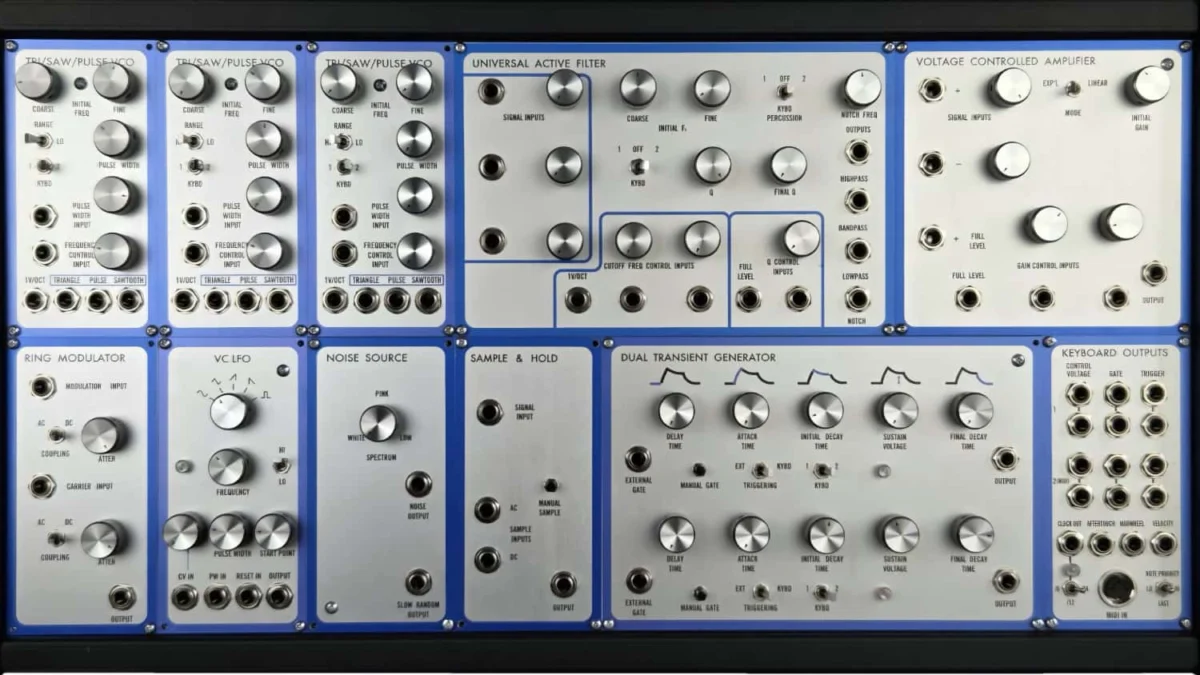
The resurgence of interest in vintage analog synthesis has reached a new milestone with the official release of the Mos-Lab E-mu Modular replica. French boutique synthesizer manufacturer Mos-Lab, led by engineer Sébastien Moumon, has announced the availability of a meticulously engineered tribute to one of the rarest and most technically sophisticated instruments in electronic music history. Described as a "faithful interpretation" of the original E-mu Systems modular units produced between 1973 and 1981, this new hardware aims to provide modern composers and sound designers with the distinct sonic palette and technical precision that once defined the upper echelon of 1970s synthesis.
Originally designed by Dave Rossum and Scott Wedge, the E-mu Modular was a pioneer in stability and functionality, often favored by academic institutions and high-budget recording studios over its contemporaries from Moog or Buchla. By offering both preconfigured systems and individual modules, Mos-Lab is attempting to bridge the gap between historical preservation and contemporary performance, ensuring that the legacy of Dave Rossum’s early engineering remains accessible to a new generation of musicians.
The Historical Significance of E-mu Systems
To understand the impact of the Mos-Lab replica, one must examine the origins of E-mu Systems. Founded in 1971 in Santa Clara, California, E-mu Systems began as a consulting firm for other synthesizer manufacturers before entering the hardware market. Unlike the Moog systems, which utilized a 1-volt-per-octave standard that was sometimes prone to pitch drift in early iterations, E-mu’s modular systems were renowned for their unprecedented tuning stability and sophisticated patch-point logic.
Between 1973 and 1981, E-mu produced approximately 100 to 150 modular systems. Because each unit was essentially a custom build, they became the "holy grail" for collectors. The systems were famously used by pioneers such as Hans Zimmer, Frank Zappa, Leon Russell, and Tangerine Dream. The E-mu Modular was also the birthplace of technologies that would later revolutionize the industry, including the first polyphonic keyboards and the foundation for Solid State Microtechnology (SSM) chips, which would go on to power legendary synths like the Prophet-5 and the Korg Polysix.
Mos-Lab’s decision to replicate this specific architecture is a significant undertaking. While Moog and Buchla replicas are relatively common in the boutique market, the E-mu circuitry is notoriously complex, requiring a high degree of technical rigor to reproduce without compromising the original’s "surgical" yet warm sonic character.
Technical Specifications and System Configurations
Mos-Lab has introduced the E-mu Modular replica in several formats to accommodate different studio requirements. The company has emphasized that every detail—from the silver-and-blue aesthetics to the internal component selection—has been scrutinized to respect the spirit of the original 1970s designs.

The Main System
The flagship offering is the "Main System," priced at €6,340.00. This configuration is designed to be a comprehensive production environment, mirroring the large-format setups found in 1970s film scoring stages. While the specific module list can be customized, the standard Main System typically includes a robust selection of:
- Voltage Controlled Oscillators (VCOs): High-stability oscillators capable of precise tracking across multiple octaves.
- Voltage Controlled Filters (VCFs): Re-creations of the classic E-mu filter designs, known for their smooth resonance and lack of distortion compared to the "ladder" filters of the era.
- Envelope Generators and VCAs: High-speed transients and linear/exponential amplification stages.
- Utility Modules: Including mixers, noise generators, and voltage processors.
The Top System
For users seeking a more compact entry point into the E-mu ecosystem, Mos-Lab offers the "Top System" at €3,620.00. This system serves as either a standalone synthesizer for lead and bass duties or as an expansion cabinet for an existing modular setup. It retains the same build quality and component standards as the Main System but with a curated selection of essential modules for signal generation and processing.
Individual Modules and Customization
Recognizing the diverse needs of the modular community, Mos-Lab is also offering individual modules starting at €130.00. This allows owners of other 5U (large format) modular systems, such as those by Moog or Synthesizers.com, to integrate E-mu-style processing into their existing workflows. Custom systems are also available upon request, allowing buyers to specify their preferred module density and signal path.
Engineering Philosophy and Manufacturing Standards
The development of the Mos-Lab E-mu replica involved an extensive period of research and development. Recreating a 50-year-old synthesizer requires more than just following a schematic; it involves sourcing components that match the tolerances of the originals or finding modern equivalents that do not alter the harmonic profile of the instrument.
Sébastien Moumon has built a reputation within the synthesizer community for his "no-compromise" approach to manufacturing. Mos-Lab’s previous work on Moog 15, 35, and 55 replicas established the company as a leader in the 5U format. With the E-mu project, the challenge was shifted toward the precision-engineered nature of Dave Rossum’s designs. Original E-mu systems were known for their clean, low-noise signal paths and highly accurate tracking, which was a departure from the more "organic" and sometimes unpredictable nature of other early modulars.
"Every detail has been carefully considered to respect the spirit, sonic character, and technical rigor of the original E-mu Systems designs," the company stated in its launch announcement. This commitment extends to the mechanical build, utilizing high-quality potentiometers, jacks, and faceplates that mimic the industrial feel of the 1973 originals.
The Market Context: Boutique vs. Mass Production
The release of the Mos-Lab E-mu Modular occurs at a time when the synthesizer industry is divided into two distinct sectors. On one side, companies like Behringer are mass-producing low-cost clones of vintage gear in the Eurorack format. On the other, boutique manufacturers like Mos-Lab, Moon Modular, and Buchla USA are focusing on high-end, large-format (5U or 4U) instruments that prioritize historical accuracy and artisanal craftsmanship.

The pricing of the Mos-Lab systems—ranging from €3,620 to over €6,000—positions them as professional-grade instruments. These are intended for serious collectors, film composers, and educational institutions who require the specific "high-fidelity" analog sound that E-mu was famous for. By maintaining the 5U format, Mos-Lab is catering to a niche but dedicated market that values the tactile experience of large knobs and 1/4-inch patch cables, which many argue offers a more ergonomic and expressive interface than the smaller Eurorack standard.
Chronology of the E-mu Modular Revival
The journey toward this release has been several years in the making. The timeline of the E-mu Modular’s transition from a discontinued relic to a modern replica can be summarized as follows:
- 1973: Dave Rossum and Scott Wedge debut the E-mu Modular.
- 1981: Production ceases as E-mu Systems shifts focus to digital sampling (the Emulator series).
- 1980s–2000s: Original systems become increasingly rare, with prices on the secondary market reaching tens of thousands of dollars.
- 2010s: Mos-Lab establishes itself as a premier boutique builder of vintage replicas.
- Early 2020s: Research and prototyping begin on the E-mu project, involving the sourcing of rare schematics and component testing.
- 2024: Mos-Lab officially announces the completion of the project and opens orders for the Main and Top systems.
Implications for Modern Music Production
The availability of a faithful E-mu replica has broader implications for the sound of modern music. In an era dominated by digital software and "in-the-box" production, the distinct, uncompressed voltage-controlled sound of a large-format modular provides a texture that is difficult to replicate digitally.
The E-mu sound is often characterized by its "clarity." While Moog filters are famous for their "growl" and "drive," E-mu filters are prized for their transparency and precision. This makes them exceptionally useful for complex polyphonic patches and intricate sequences where frequency separation is vital. By bringing these circuits back into production, Mos-Lab is giving modern producers a tool that was instrumental in the creation of early electronic soundtracks and experimental avant-garde music.
Furthermore, this release validates the enduring legacy of Dave Rossum. Rossum, who is still active in the industry through Rossum Electro-Music, is widely considered one of the "founding fathers" of synthesis. The Mos-Lab replica serves as a testament to the longevity of his early work, proving that the engineering solutions he devised in the early 1970s remain relevant and desirable over half a century later.
Pricing and Availability
The Mos-Lab E-mu Modular is currently available for order through the official Mos-Lab website. As a boutique operation, these systems are typically built to order, with lead times varying based on the complexity of the configuration.
- Individual Modules: Starting at €130.00
- Top System: €3,620.00
- Main System: €6,340.00
- Custom Configurations: Pricing available upon consultation
As the synthesizer community continues to look toward the past to inspire the future of sound, the Mos-Lab E-mu Modular stands as a significant achievement in hardware preservation. It offers more than just nostalgia; it provides a high-performance instrument that upholds the technical standards of one of the most innovative periods in audio engineering history.
