

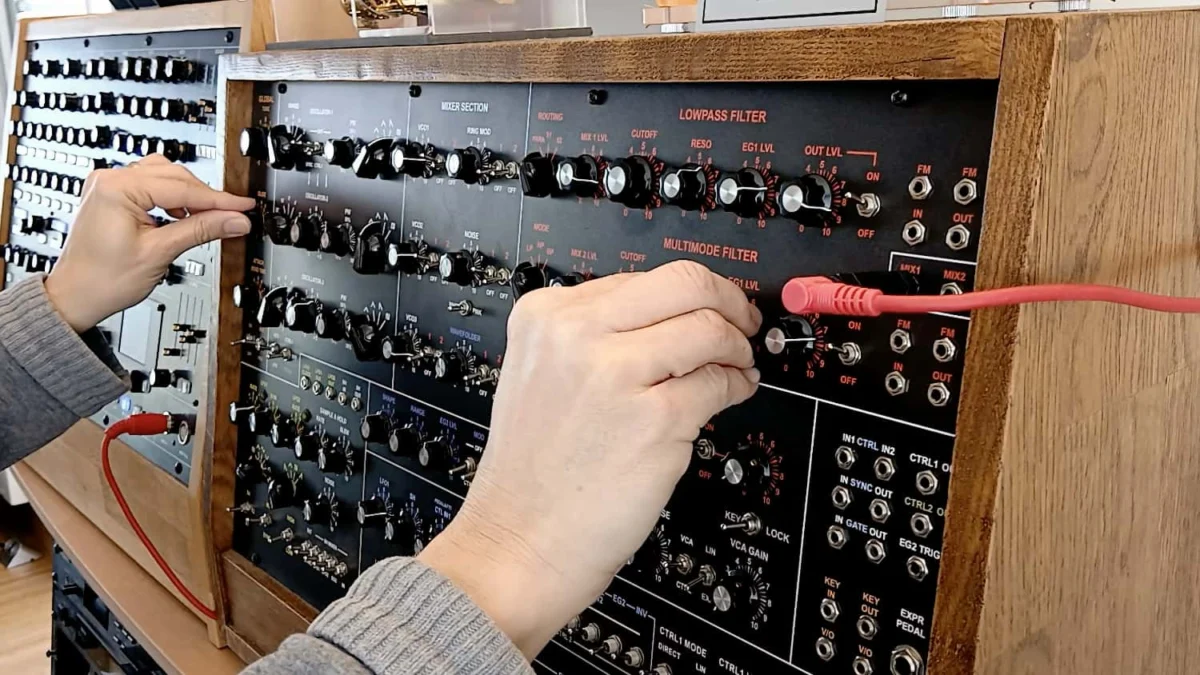
Renowned French synthesist and composer Jean Luc Briançon, performing under the moniker Kurtz Mindfields, has unveiled a sophisticated live performance centered on the intricate nuances of analog sequencing and modular synthesis. This technical showcase utilizes two flagship instruments from the French boutique synthesizer manufacturer NRsynth: the Ancestor and the SynthR4. The performance serves not only as a musical demonstration but also as a deep dive into the capabilities of modern "lutherie," a term traditionally reserved for stringed instrument makers but increasingly applied to high-end, artisanal electronic instrument designers. By integrating vintage-inspired circuitry with modern control stability, Briançon illustrates the enduring relevance of subtractive synthesis in a contemporary performance context.
Technical Architecture of the NRsynth Ancestor
The NRsynth Ancestor is a centerpiece of this performance, designed as a faithful yet expanded homage to the classic Moog modular systems of the 1960s and 70s. According to technical specifications provided by Briançon, the Ancestor is an exceptionally sensitive instrument that prioritizes the raw, organic character of analog voltage. It features three primary Voltage-Controlled Oscillators (VCOs) that utilize original discrete circuitry to replicate the warmth and slight instability associated with early modular units.
A defining characteristic of the Ancestor’s signal path is its dual-filter configuration. It incorporates a classic Moog-style transistor ladder filter, known for its resonant "growl" and smooth low-pass characteristics, alongside a Steiner-Parker filter. The Steiner-Parker design, originally found in the Synthacon synthesizer of the 1970s, offers a distinctively aggressive resonance and a multi-mode architecture (low-pass, high-pass, and band-pass) that provides a sharp contrast to the Moog ladder’s behavior. This combination allows the performer to layer disparate harmonic textures, ranging from creamy, foundational basses to piercing, acid-like leads. The unit is further rounded out by two Low-Frequency Oscillators (LFOs), a dedicated noise generator, and high-quality Voltage-Controlled Amplifiers (VCAs) and mixers that maintain signal integrity throughout the patch.
The Multi-Tasking Capability of the SynthR4
Complementing the Ancestor is the SynthR4, a semi-modular powerhouse that acts as both a sound source and the primary control hub for the performance. The SynthR4 is equipped with four standard VCOs and two additional Sub-VCOs, providing a massive foundational sound that can be detuned for thick, orchestral-style textures or tuned to intervals for complex chordal movements.
The filtering stage of the SynthR4 is equally robust, featuring a Moog Ladder filter and the iconic 4012 ARP filter. The 4012 filter is a historically significant component, originally a Moog clone used in early ARP 2600 models before legal challenges forced a design change. By including both, the SynthR4 offers a comprehensive palette of 24dB/octave slopes that defined the "Golden Age" of synthesis. For modulation, the SynthR4 provides three LFOs and two noise generators, ensuring that the sequenced patterns remain dynamic and evolving rather than static.
Crucially, the SynthR4 serves as the brain of the operation through its internal sequencing software. This allows Briançon to manage complex, multi-layered patterns in real time, bridging the gap between the tactile nature of analog hardware and the precision of digital control systems.
Historical Context and the Renaissance of Analog Synthesis
The performance by Jean Luc Briançon arrives at a pivotal moment in the electronic music industry, characterized by a significant "return to hardware." For much of the early 2000s, Digital Audio Workstations (DAWs) and Virtual Studio Technology (VST) plugins dominated the market due to their convenience and low cost. However, the last decade has seen a resurgence in analog synthesis, driven by a desire for the "imperfect" and tactile qualities of physical circuitry.
The use of Moog and ARP clones in Briançon’s setup highlights a broader trend of historical preservation through modern engineering. While the original Moog modular systems are now prohibitively expensive and difficult to maintain, boutique manufacturers like NRsynth are recreating these circuits using modern components that offer better thermal stability while retaining the classic sonic signatures. This movement, often referred to as the "Eurorack Revolution" or the "Boutique Boom," has democratized access to the sounds that pioneered the Berlin School of electronic music—a genre heavily influenced by Tangerine Dream and Klaus Schulze, which Briançon’s work frequently evokes.
Chronology and Performance Execution
The live session, titled "Modular Dream," follows a structured progression that demonstrates the build-up of an analog sequence. The performance begins with a foundational pulse generated by the SynthR4’s sequencer, driving the Ancestor’s VCOs.
- Initial Patching and Foundation: Briançon establishes a primary rhythmic motif using the Moog ladder filter on the Ancestor to create a percussive, bass-heavy sequence.
- Harmonic Layering: The SynthR4’s oscillators are introduced, providing mid-range textures. Briançon utilizes the ARP 4012 filter to add a "nasal" and cutting quality to the secondary sequence, ensuring it sits clearly above the bass foundation.
- Modulation and Evolution: As the performance progresses, the LFOs are engaged to modulate filter cutoff frequencies and pulse widths. This introduces "movement" to the sound, preventing the repetitive sequences from becoming monotonous.
- Real-Time Control: Throughout the demonstration, the artist can be seen manipulating the large-format knobs—a hallmark of the "Ancestor" design—to adjust resonance and envelope decay times. This real-time interaction is what Briançon describes as the "pleasure" of the old modular systems.
- Climax and Textural Density: The final phase of the performance sees all nine VCOs and four noise generators active, creating a dense, wall-of-sound effect that remains coherent due to the high-quality filtering stages of the NRsynth hardware.
Supporting Data and Technical Specifications Analysis
The technical density of the setup is significant. In a standard modern synthesizer, one might find two or three oscillators. Briançon’s configuration utilizes a total of nine VCOs. In the realm of analog synthesis, the number of oscillators directly correlates to the "harmonic thickness" of the output. When nine oscillators are slightly detuned against one another, they create a natural chorusing effect that is physically impossible to perfectly replicate in a purely digital environment due to the microscopic, random fluctuations in voltage.
Furthermore, the inclusion of four distinct filters—two Moog variants, one Steiner-Parker, and one ARP 4012—provides a 360-degree view of 1970s synthesis. The Steiner-Parker filter is particularly notable for its Sallen-Key circuit design, which behaves differently under high resonance compared to the Moog Ladder. While the Moog filter tends to lose low-end response as resonance increases, the Steiner-Parker maintains a more aggressive, raw profile, making it ideal for the lead lines Briançon employs in the later stages of his performance.
Official Perspectives and Artistic Philosophy
Jean Luc Briançon has expressed that his role goes beyond mere performance; he acts as a developer and explorer for these French luthiers. His objective is to "rediscover the possibilities of the old modular synthesizers, the sound, and the pleasure." This philosophy suggests that the value of these instruments lies not just in their output, but in the interface—the "ergonomics of inspiration."
Industry analysts note that Briançon’s collaboration with NRsynth is indicative of a successful synergy between artists and manufacturers. By having a seasoned synthesist "stress-test" these instruments in live environments, manufacturers can refine their circuit designs for better performance reliability. Briançon’s comments regarding the "sensitivity" of the Ancestor Moog clone underscore the importance of high-resolution potentiometers and stable power rails in modern analog design, which are necessary to handle the subtle nuances of voltage-controlled music.
Broader Impact and Implications for the Industry
The "Modular Dream" performance has broader implications for the electronic music hardware market. First, it reinforces the status of France as a major hub for synthesizer innovation. Alongside companies like Arturia and Squarp Instruments, boutique builders like NRsynth are positioning France at the forefront of the high-end analog market.
Second, the performance highlights the shifting role of software. Rather than replacing hardware, software is increasingly being used as a sophisticated control layer (as seen in the SynthR4’s sequencing software) to manage hardware that remains purely analog in its signal path. This "hybrid" approach is becoming the standard for professional synthesists who require the reliability of digital timing with the sonic character of analog voltages.
Finally, the visibility of such performances on platforms like YouTube serves as an educational resource for a new generation of musicians. By demystifying the "art of analog sequencing," Briançon provides a roadmap for how to construct complex compositions without relying on a computer screen. This emphasizes the "instrumentality" of the synthesizer—treating it not as a tool for production, but as a performance instrument capable of the same expressive depth as a piano or a violin.
As the market for modular and semi-modular synthesizers continues to grow—projected to see steady increases in valuation through the late 2020s—performances like "Modular Dream" serve as both a marketing tool for artisanal builders and a proof-of-concept for the artistic viability of analog technology in the 21st century. Briançon’s work with the NRsynth Ancestor and SynthR4 stands as a testament to the fact that the "dream" of the modular pioneers of the 1960s is not only alive but is being refined for a new era of musical exploration.
