

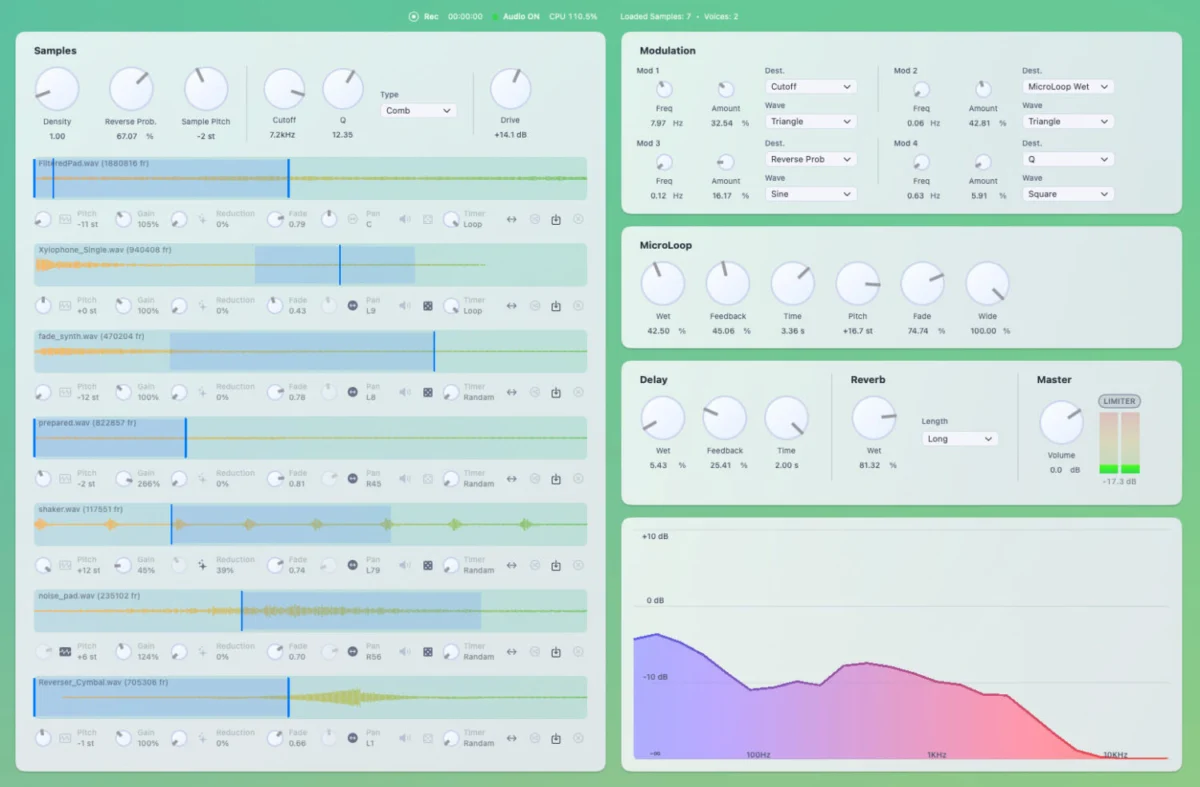
The landscape of digital audio workstations and standalone music applications has expanded with the release of Ambient Engine, a specialized software solution for macOS developed by atnr.net. Designed to bridge the gap between static sample playback and algorithmic composition, Ambient Engine provides sound designers, composers, and enthusiasts with a streamlined environment for creating evolving, non-repetitive soundscapes. The application arrives at a time when generative music is seeing a resurgence in both professional media production and consumer-facing wellness applications. By utilizing user-provided samples and applying complex modulation and playback parameters, the software allows for the creation of organic, shifting textures that would traditionally require intricate routing in a standard Digital Audio Workstation (DAW).
Technical Overview and Core Functionality
Ambient Engine is built specifically for the macOS architecture, leveraging the platform’s robust Core Audio capabilities to ensure low-latency performance and high-fidelity sound processing. At its core, the software functions as a generative engine that treats audio samples as the primary building blocks for composition. Unlike traditional sequencers that trigger sounds at fixed intervals, Ambient Engine utilizes a probabilistic approach to sound triggering and playback.
Users are able to load their own audio files into the engine, which then processes these files through a series of user-defined parameters. Key features of the playback engine include adjustable density and range controls. The density parameter determines how frequently sound events occur within a given timeframe, allowing for everything from sparse, minimalist textures to dense, overlapping walls of sound. The range controls allow the user to define specific segments of a sample for playback, enabling the software to "scrub" through audio files in a non-linear fashion.
One of the defining characteristics of Ambient Engine is its focus on "organic movement." This is achieved through an integrated modulation system that can be applied to various aspects of the sound, such as pitch, filter cutoff, and spatial positioning. By introducing controlled randomness and slow-moving oscillators into these parameters, the software ensures that the resulting audio is constantly evolving, avoiding the "loop fatigue" often associated with sample-based music.
The Evolution of Generative Audio Technology
The release of Ambient Engine follows a long tradition of generative music systems, a concept popularized in the late 20th century by pioneers such as Brian Eno. Generative music refers to systems that are "ever-changing and different every time they are played." While early iterations of these systems relied on physical tape loops of varying lengths or complex analog modular patches, the digital era has shifted the focus toward algorithmic software.
In the 1990s and early 2000s, generative music was largely the domain of academic researchers and avant-garde composers using tools like Max/MSP or Pure Data. However, the last decade has seen a democratization of these tools. Ambient Engine represents a continuation of this trend, offering a professional-grade generative environment that does not require the user to write code or build complex logic structures from scratch. By providing a dedicated interface for generative sample manipulation, atnr.net is positioning the software as an accessible entry point for creators who wish to explore algorithmic sound without the steep learning curve of modular programming.
Market Context and Professional Use Cases
The current market for ambient and generative audio is multifaceted, spanning several multi-billion-dollar industries. Ambient Engine is marketed toward several specific professional applications, each with its own set of requirements:
Sound Design for Media and Games
In the realm of film and video game production, the demand for unique, non-repetitive background textures is constant. Traditional looping assets can become noticeable to the audience over long periods. Ambient Engine allows sound designers to create "living" environments. For instance, a designer can load field recordings of a forest and use the generative engine to ensure that bird calls, wind rustle, and distant water sounds never repeat in the same pattern, enhancing the immersion of the digital environment.
Installation Art and Public Spaces
Museums, galleries, and architectural firms frequently use generative audio to create atmospheres that respond to the time of day or the flow of visitors. Because Ambient Engine can run indefinitely without repeating itself, it serves as a cost-effective solution for long-term installations. The ability to record the output in real time also allows artists to capture specific "performances" of the engine for use in physical media or digital releases.
Focus and Wellness Applications
The rise of "lo-fi" beats and ambient music for focus and meditation has created a massive demand for new content on streaming platforms. Developers note that Ambient Engine is particularly suited for creators who produce content for sleep apps, meditation guides, and study playlists. The generative nature of the software allows creators to generate hours of high-quality audio content with minimal manual intervention, provided the initial sample selection and parameter tuning are handled with care.
Pricing, Availability, and System Requirements
Ambient Engine is currently available for purchase through the atnr.net store at a retail price of $99 USD. This pricing strategy places it in the mid-range of professional audio utilities, making it accessible to independent creators while maintaining a professional feature set.
The software is optimized for macOS, reflecting a strategic choice by the developers to target the creative professional demographic that historically favors the Apple ecosystem. While no official announcement has been made regarding a Windows or Linux version, the developers have indicated that they are focusing on refining the macOS experience to take full advantage of the latest Apple Silicon (M1, M2, and M3) architectures.
Official Perspective and Design Philosophy
While formal press conferences for boutique software releases are rare, the developers at atnr.net have communicated a clear design philosophy through their technical documentation and introductory demonstrations. The goal of Ambient Engine is not to replace the composer, but to act as a "collaborative partner."
"The application is designed to take the ‘heavy lifting’ out of generative structures," a technical brief from the developer suggests. "By focusing on the interaction between user-provided samples and organic modulation, we provide a tool that feels more like an instrument and less like a spreadsheet." This focus on "playability" is evident in the real-time recording feature, which encourages users to interact with the sliders and knobs as the music plays, capturing the results directly to a high-quality audio file.
Comparative Analysis: Standalone Apps vs. DAW Plugins
The decision to release Ambient Engine as a standalone application rather than a VST or AU plugin is a notable architectural choice. While plugins offer the advantage of being hosted within a DAW (like Ableton Live or Logic Pro), standalone applications often provide a more focused environment free from the distractions and overhead of a full production suite.
Industry analysts suggest that standalone generative tools are gaining popularity because they encourage a different creative mindset. When working in a DAW, users are often focused on a linear timeline—moving from left to right. A generative engine like Ambient Engine operates in a "circular" or "static" time frame, where the focus is on the state of the sound at any given moment rather than its progression toward a climax. This makes it an ideal tool for the initial stages of sound discovery, where a composer might "play" the engine for an hour and then harvest the best moments for later use in a more structured composition.
Broader Implications for the Future of Music Production
The launch of Ambient Engine highlights a broader shift in the music industry toward "assisted creativity." As artificial intelligence and algorithmic tools become more prevalent, the role of the musician is evolving from a note-by-note composer to a "curator of systems."
Ambient Engine occupies a middle ground in this evolution. It does not use "black box" AI to generate music from text prompts; instead, it uses transparent, mathematical algorithms to manipulate audio that the user has specifically chosen. This ensures that the creator maintains "creative sovereignty," a term often used in the industry to describe the human control over the final output.
As the software matures, it is expected that atnr.net may introduce further integration features, such as MIDI out (to trigger external hardware) or multi-channel support for immersive audio formats like Dolby Atmos. For now, Ambient Engine stands as a robust, specialized tool that addresses the growing need for sophisticated, sample-based generative audio in a streamlined macOS package.
Conclusion
The introduction of Ambient Engine at the $99 price point marks a significant entry into the niche but growing market of generative audio software. By combining user-friendly sample manipulation with complex modulation and real-time recording, the application provides a versatile solution for a wide array of creative professionals. As the demand for non-linear, atmospheric audio continues to rise across the media, wellness, and art sectors, tools like Ambient Engine are likely to become essential components of the modern sound designer’s toolkit. The focus on macOS optimization and a high degree of user control suggests that atnr.net is committed to providing a high-performance environment for the next generation of ambient music creators.
