

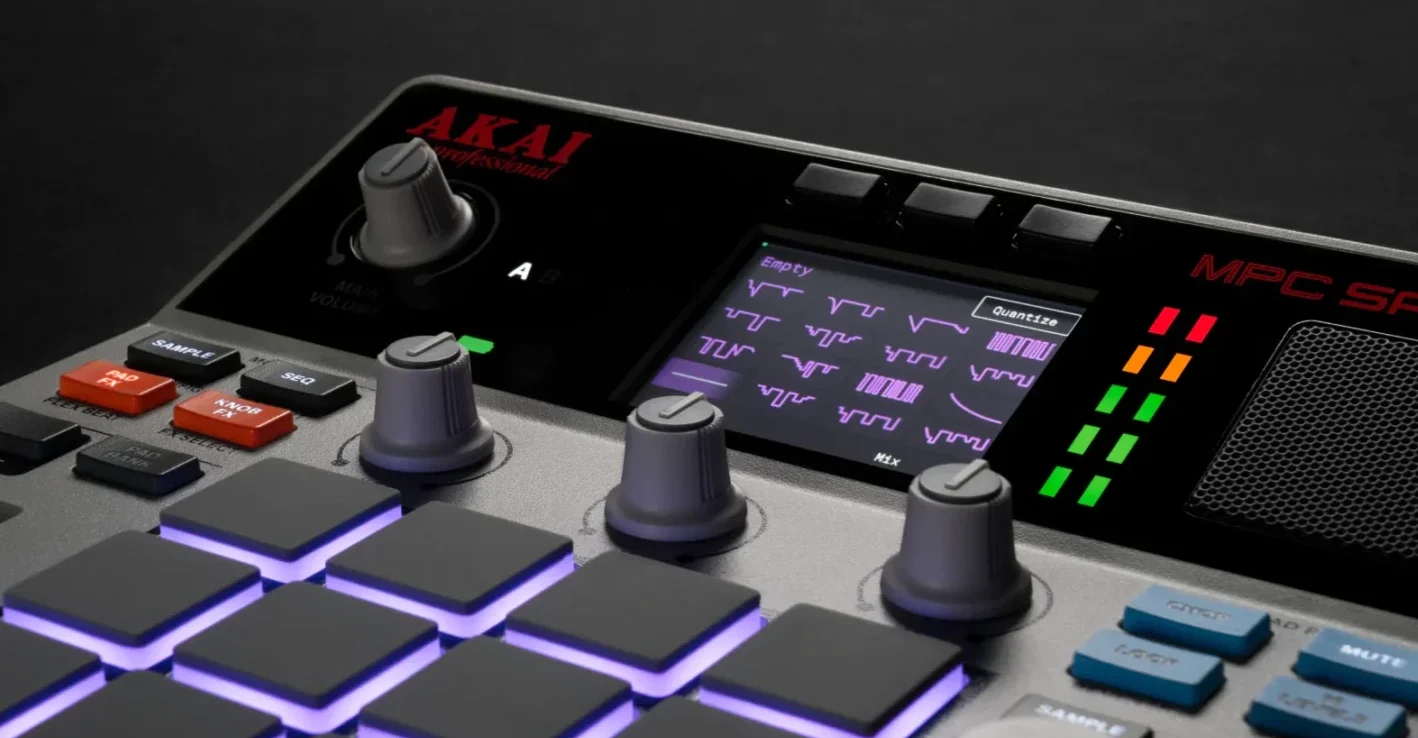
Akai Professional has officially announced the release of the MPC Sample, a compact and highly portable addition to its legendary Music Production Center (MPC) lineup. Designed to bridge the gap between high-end studio workstations and ultra-portable mobile gear, the MPC Sample represents a strategic move by the company to capture the growing market of "on-the-go" producers and "DAWless" enthusiasts. Priced at $399 USD, the device enters the market as one of the most accessible standalone MPC units in the brand’s history, offering a robust feature set that retains the core DNA of its larger predecessors while prioritizing a smaller, more tactile footprint.
The MPC Sample arrives at a pivotal moment in the music technology industry, where portability and standalone functionality have become the primary drivers of hardware sales. Unlike previous iterations that required tethering to a computer or featured larger, more cumbersome frames, the MPC Sample is described by Akai as being "scaled down" rather than "stripped down." This distinction is critical for professional users who require the depth of the MPC sequencer and sampling engine but desire a form factor that fits into a backpack or a small desktop setup.
Technical Specifications and Hardware Architecture
At the heart of the MPC Sample are 16 velocity-sensitive MPC pads, which have served as the industry standard for beat-making since the late 1980s. These pads provide the tactile response required for expressive finger drumming and melodic sequencing. Complementing the pads is a classic MPC sequencer, allowing users to build complex patterns and arrangements without the need for an external Digital Audio Workstation (DAW).
The device features a dedicated hardware layout designed for rapid workflow. This includes three assignable control knobs for real-time parameter manipulation and a classic MPC-style fader. The inclusion of a fader is a nod to "old-school" MPC designs, such as the MPC 60 and 2000XL, where a physical slider was often used for note repeat, volume mixing, or filter sweeps. In the MPC Sample, this fader provides a tactile bridge between vintage aesthetics and modern digital control.
Internal processing is handled by a standalone engine capable of real-time Time-Stretch and RePitch. These features allow producers to synchronize samples of varying tempos and keys seamlessly—a task that historically required significant computing power. Additionally, the unit boasts four onboard FX engines, providing a suite of processing tools ranging from reverbs and delays to compressors and lo-fi grit, ensuring that tracks can be mixed and polished entirely within the hardware.
A Chronological Context: The Evolution of the MPC
The release of the MPC Sample is the latest chapter in a lineage that began in 1988 with the collaboration between Akai and designer Roger Linn. The original MPC 60 revolutionized music production by combining a MIDI sequencer with a sampling drum machine, effectively birthing the "workstation" concept. Throughout the 1990s and 2000s, models like the MPC 3000 and MPC 2000XL became the backbone of hip-hop and electronic music production.

In the 2010s, Akai transitioned the brand toward hybrid controllers with the MPC Renaissance and MPC Studio, which required a computer to function. However, the company successfully pivoted back to standalone hardware in 2017 with the release of the MPC Live and MPC X. Since then, the trend has moved toward miniaturization. The MPC One, released in 2020, brought the full MPC experience to a smaller desktop format, and the subsequent MPC One+ added wireless connectivity.
The MPC Sample follows this trajectory by stripping away the large touchscreens and extensive I/O of the "Live" and "X" models in favor of a focused, sample-centric workflow. This move reflects a broader industry shift seen in competitors like Roland’s SP-404 series and Teenage Engineering’s EP-133 K.O. II, where the emphasis is placed on immediacy and "fun" rather than exhaustive feature lists.
Workflow Integration: From Vinyl Sampling to Modern Beats
To demonstrate the versatility of the MPC Sample, Akai Professional collaborated with renowned West Coast producer Dibia$e. Known for his intricate lo-fi beats and mastery of hardware sampling, Dibia$e’s endorsement highlights the unit’s credibility within the professional beat-making community. The workflow of the MPC Sample is centered around its "Instant Sample Chop Mode," which allows users to take an incoming audio signal—whether from a smartphone, a synthesizer, or a turntable—and quickly slice it across the 16 pads.
The device is particularly optimized for vinyl sampling, a foundational technique in hip-hop production. By utilizing the onboard sampling inputs, producers can capture audio from records and use the Time-Stretch and RePitch algorithms to align the samples with a project’s internal clock. For house and electronic music, the MPC Sample provides the precision sequencing and swing parameters that have made the "MPC feel" a sought-after characteristic in dance music for decades.
Market Positioning and Industry Implications
The $399 price point positions the MPC Sample as a direct competitor to the Roland SP-404MKII and the Novation Circuit Rhythm. By entering this price bracket, Akai is making a play for younger producers and hobbyists who may find the $699+ price of the MPC One+ or MPC Live II prohibitive.
Industry analysts suggest that the MPC Sample is designed to serve as an "entry point" into the Akai ecosystem. Once a user becomes accustomed to the MPC workflow and the proprietary software architecture, they are more likely to upgrade to larger Akai hardware or utilize the MPC Software on their computers. Furthermore, the portability factor appeals to established professionals who already own larger rigs but require a mobile solution for travel or live performances.
The "scaled down" approach also addresses a common critique of modern music technology: feature creep. Many contemporary workstations are criticized for being overly complex, often distracting producers with endless menus and options. The MPC Sample’s more focused interface suggests a return to the "limitations breed creativity" philosophy, forcing users to rely on their ears and the tactile controls of the hardware.

Official Responses and Artist Perspectives
While Akai Professional has focused its marketing on the technical capabilities of the unit, the response from the creative community has emphasized the device’s potential for live performance. In the promotional series "Getting Started with MPC Sample," Akai outlines how the unit can be used to build entire tracks from scratch in various genres.
Producers have noted that the inclusion of the fader and assignable knobs makes the MPC Sample a formidable live performance tool. In a landscape where "laptop-free" performances are increasingly popular in underground electronic and hip-hop scenes, a $399 standalone box that can handle sampling, sequencing, and effects is seen as a significant value proposition.
Dibia$e, in his introductory video, emphasized the "ruggedness and portability" of the unit, stating that it allows for the capture of inspiration wherever it strikes. This sentiment is echoed by the broader "beat-making" community on social media, where the portability of gear has become a status symbol and a practical necessity for the modern "nomadic" creator.
Broader Impact and Future Outlook
The launch of the MPC Sample is likely to influence the development cycles of other major manufacturers. As Akai, Roland, and Teenage Engineering compete for the "portable standalone" crown, consumers can expect continued innovation in battery life, internal storage, and cloud integration.
One of the significant implications of the MPC Sample is the democratization of professional-grade sampling tools. In previous decades, a standalone MPC with these capabilities would have cost thousands of dollars and required a studio’s worth of outboard gear. Today, the same power is available for the price of a mid-range smartphone. This accessibility is expected to foster a new generation of producers who are not tied to a desk or a mouse, potentially shifting the aesthetic of modern music toward a more rhythmic, sample-based foundation.
In conclusion, the Akai Professional MPC Sample is more than just a smaller drum machine; it is a calculated response to the evolving needs of the global music production community. By combining the heritage of the MPC name with a modern, portable, and affordable design, Akai has reaffirmed its position as a leader in the hardware production space. As the device reaches the hands of creators worldwide, its impact will be measured not just by sales figures, but by the music it enables in bedrooms, on stages, and in transit across the globe. The MPC Sample is now available through authorized Akai Professional retailers and via the company’s official website.
