

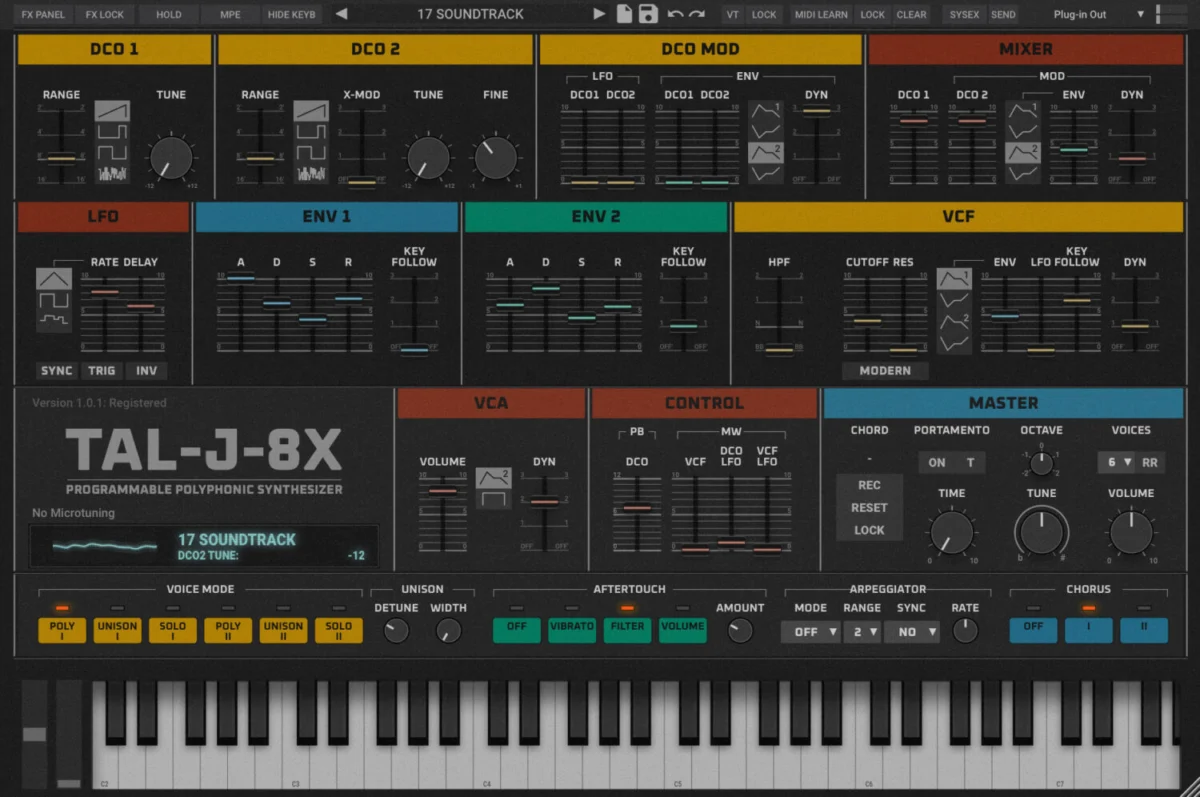
The digital music production landscape has seen a significant expansion with the official launch of the TAL J-8X, a high-fidelity virtual instrument plug-in designed to emulate the iconic Roland JX-8P analog synthesizer. Developed by TAL (Togu Audio Line), the J-8X enters a competitive market of vintage hardware emulations, aiming to provide musicians and sound designers with the specific sonic character of the mid-1980s while integrating modern workflow enhancements. To accompany the release, the developer has provided a comprehensive head-to-head video comparison demonstrating the software’s performance alongside the original hardware, highlighting the nuances of its oscillator behavior, filter resonance, and envelope characteristics.
The TAL J-8X serves as a specialized addition to the company’s existing roster of acclaimed emulations, which includes recreations of the Juno-60 and Jupiter-8. By focusing on the JX-8P, TAL addresses a unique niche in the analog synthesis timeline. While the earlier Juno and Jupiter series are often celebrated for their immediate, hands-on interfaces and Voltage Controlled Oscillators (VCOs), the JX-8P represented a pivotal shift toward Digitally Controlled Oscillators (DCOs) and a more streamlined, button-based aesthetic. The J-8X aims to capture the warmth and stability that made the original hardware a staple in professional studios during the latter half of the 1980s.
Historical Context and the Legacy of the Roland JX-8P
To understand the significance of the TAL J-8X, it is necessary to examine the history of its hardware predecessor. Released in 1985, the Roland JX-8P was positioned as a sophisticated successor to the JX-3P. At the time of its debut, the synthesizer market was undergoing a rapid transformation driven by the success of the Yamaha DX7 and the industry-wide move toward digital FM synthesis. Roland responded by creating a synthesizer that retained an all-analog signal path—specifically using the IR3R05 VCF (Voltage Controlled Filter) and VCA (Voltage Controlled Amplifier) chips—but utilized DCOs to ensure tuning stability, a common issue with earlier VCO-based designs.
The JX-8P became renowned for its "glossy" and "expensive" sound, often described as more polished than the raw, aggressive tones of the Juno series. It found favor with legendary artists and bands such as Europe (notably providing the brassy lead in "The Final Countdown"), Tangerine Dream, Depeche Mode, and Trevor Horn. However, the original hardware was frequently criticized for its lack of dedicated knobs and sliders, requiring users to navigate a digital entry system or purchase the external PG-800 programmer. The TAL J-8X effectively solves this historical ergonomic challenge by providing a comprehensive, one-page interface that exposes all parameters simultaneously, effectively acting as both the synthesizer and the programmer in a single digital environment.
Technical Specifications and Enhanced Capabilities
The TAL J-8X is not merely a static replica of the 1985 hardware; it is an "expanded emulation" that introduces features that were technically impossible or financially prohibitive during the analog era. The core architecture remains faithful to the original, featuring two oscillators per voice, a high-pass filter, a resonant low-pass filter, and two envelope generators. However, TAL has implemented several modern upgrades to meet the demands of contemporary music production.
Key technical features of the TAL J-8X include:
- Authentic DCO Emulation: The software meticulously models the behavior of digitally controlled analog oscillators, capturing the phase relationships and harmonic content that define the JX-8P’s character.
- Advanced Filter Modeling: The low-pass filter has been calibrated to match the IR3R05 chip, providing the smooth, non-stepped resonance curves characteristic of the original hardware.
- Increased Polyphony: While the original JX-8P was limited to six voices, the J-8X allows users to expand polyphony significantly, enabling complex chord voicings and long-release pads without voice stealing.
- Unison and Vintage Control: The plug-in includes a "Vintage" knob that allows users to introduce subtle instabilities in tuning and filter cutoff, simulating the aging components of a 40-year-old hardware unit.
- Integrated Effects Engine: Beyond the classic chorus that was a hallmark of Roland’s 80s designs, the J-8X includes high-quality delay and reverb modules tailored to the instrument’s frequency response.
- MPE Support: In a nod to modern performance technology, the J-8X supports MIDI Polyphonic Expression (MPE), allowing for per-note modulation of parameters such as pitch bend and filter cutoff.
Analysis of the Head-to-Head Hardware Comparison
The release of the TAL J-8X was marked by a side-by-side audio comparison video, which has become a standard benchmark for software developers seeking to prove the accuracy of their DSP (Digital Signal Processing) code. In the demonstration, the developer oscillates between the hardware JX-8P and the J-8X plugin across a variety of patches, including percussive basses, sweeping pads, and sync-lead sounds.
Initial analysis of the comparison suggests that TAL has successfully captured the specific "envelope snap" of the JX-8P. Analog envelopes are notoriously difficult to model due to their non-linear curves, yet the J-8X maintains the punchy transients required for bass and lead sounds. Furthermore, the cross-modulation (Sync and Metal) functions, which were a highlight of the original’s dual-oscillator design, appear to behave with the same harmonic complexity in the software version. The "Metal" setting, a form of frequency modulation, produces the characteristic bell-like and industrial tones that set the JX series apart from the more traditional Juno architecture.
Industry Implications and Market Positioning
The launch of the TAL J-8X occurs at a time when the "in-the-box" production movement is seeking higher levels of authenticity. For many years, software emulations were viewed as "close enough" approximations that lacked the depth and "vibe" of physical circuitry. However, advancements in component-level modeling have narrowed this gap. TAL’s entry into the JX-8P emulation space puts them in direct competition with Roland’s own "Roland Cloud" versions and other third-party developers.

Market analysts note that TAL’s strategy focuses on a balance of CPU efficiency and sonic accuracy. Unlike some emulations that require significant processing power to run a single instance, TAL plugins are traditionally optimized for low-latency performance, making them viable for live performance as well as studio use. By pricing the J-8X at a competitive introductory rate of $55.20, TAL is positioning the product as an accessible alternative to both the vintage hardware market—where JX-8P units often command prices between $800 and $1,200—and more expensive subscription-based software models.
Chronology of Development and Release
The development of the TAL J-8X follows a logical progression in the company’s history of synthesizer modeling.
- 2012: TAL releases the TAL-U-NO-LX, which becomes a gold standard for Juno-60 emulation.
- 2020: The company releases the TAL-J-8, a deep-dive emulation of the Jupiter-8, which received critical acclaim for its accuracy.
- 2023: Internal development begins on the J-8X, focusing on the unique IR3R05 filter characteristics.
- April 2024: Beta testing concludes, and the J-8X is officially released to the public.
This timeline reflects a methodical approach to the Roland catalog, moving from the most popular "classic" units to the more nuanced, "cult-classic" instruments like the JX-8P.
Official Response and User Feedback
While official statements from Roland Corporation regarding third-party emulations are rare, the user community within the synthesizer industry has responded with significant interest. Early adopters have praised the J-8X for its inclusion of the "Velocity" and "Aftertouch" sensitivity that made the original JX-8P such an expressive performance tool. On various music production forums, users have noted that the J-8X captures the "low-mid warmth" that is often missing from digital recreations.
"The JX-8P has always been an underrated workhorse," noted one synthesis expert in an online discussion following the release. "TAL has managed to take the best parts of that hardware—the lush pads and the unique cross-mod—and remove the worst parts, which were the tedious programming and the lack of modern connectivity."
Broader Impact on Sound Design
The availability of a high-quality JX-8P emulation has broader implications for the sound of modern music. The 1980s aesthetic continues to influence genres such as Synthwave, Indietronica, and modern Pop. By providing an authentic tool for these sounds, TAL ensures that the specific timbral qualities of the 1980s remain available to a new generation of producers who may never have access to the original hardware.
Furthermore, the J-8X includes a comprehensive preset library that spans from classic factory patches of the 1980s to modern, cinematic textures. This bridge between the past and the present is a hallmark of TAL’s design philosophy, ensuring that their instruments are tools for creation rather than just museum pieces.
Pricing and Availability
The TAL J-8X is currently available for purchase through the official TAL Software website. The plugin is compatible with major Digital Audio Workstations (DAWs) on both Windows and macOS, supporting VST, VST3, AU, and AAX formats. As part of the launch promotion, the J-8X is offered at an introductory price of $55.20 USD (plus VAT where applicable), representing a discount from its standard retail price of $69.00.
As the digital audio industry continues to evolve, the TAL J-8X stands as a testament to the enduring appeal of analog synthesis. By combining meticulous historical research with modern software engineering, TAL has provided a bridge between the hardware-driven past and the software-centric future of music production. Whether the J-8X will become the definitive version of the JX-8P sound remains to be seen, but its initial reception suggests it is a formidable contender in the world of virtual analog instruments.
