

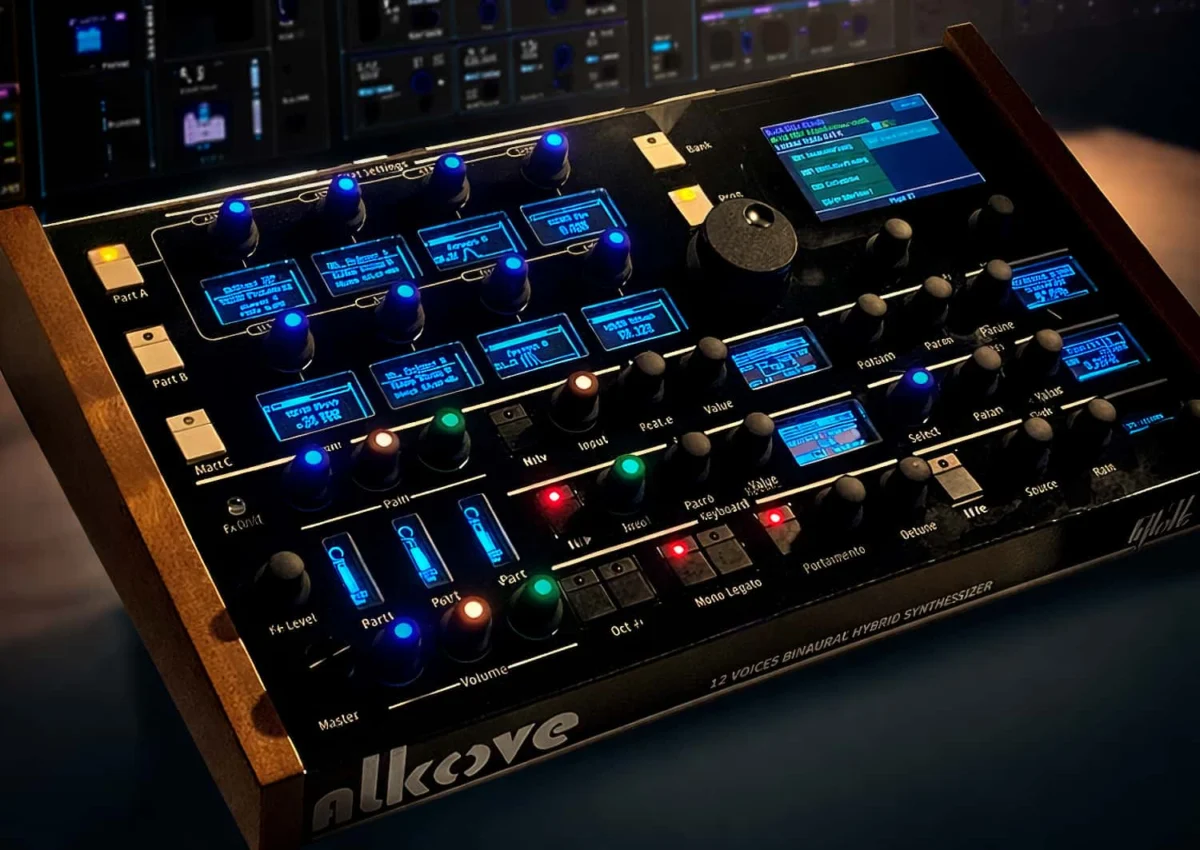
The annual SynthFest France, held from April 17 to April 19, 2026, in Nantes, served as the global stage for the debut of the Alkove 12-Voice Binaural Hybrid Synthesizer, a groundbreaking instrument from the French manufacturer Pylobolus. Positioned as a sophisticated bridge between software flexibility and hardware tactility, the Alkove represents a significant shift in the philosophy of sound design. Rather than confining users to a fixed signal path, the instrument allows for the complete reconfiguration of its internal architecture through a dedicated computer-based interface, which is then hosted on high-performance digital signal processing (DSP) hardware integrated with analog components. This hybrid approach seeks to capture the precision of modern digital synthesis while maintaining the organic character of analog amplification and dynamics.
The Convergence of Hybrid Architecture and Binaural Soundscapes
At the core of the Alkove’s design is a 12-voice polyphonic engine that utilizes a stereo multitimbral framework. Unlike traditional synthesizers that offer a standard oscillator-filter-amplifier chain, the Alkove is built on a hybrid foundation that utilizes analog Voltage Controlled Amplifiers (VCAs) to manage dynamics. This inclusion of analog circuitry at the final stage of the signal path is intended to provide a level of warmth and harmonic saturation that is often missing from purely digital instruments.
The digital side of the Alkove is equally ambitious, incorporating formant synthesis and subtractive synthesis techniques. Formant synthesis, which mimics the resonant properties of the human vocal tract, allows for the creation of complex, evolving textures that can shift between vowel-like tones and traditional synthetic timbres. By combining these methods with real-time DSP, Pylobolus has created an instrument capable of generating highly intricate sounds that remain responsive to live performance gestures.
The "Binaural" designation of the Alkove is perhaps its most defining sonic characteristic. In a binaural synthesizer, each voice is treated as a spatial entity, with dedicated controls for phase relationships and stereo positioning. This allows the user to create a sense of three-dimensional depth within a pair of headphones or a stereo speaker setup. By manipulating the phase and timing between the left and right channels, the Alkove can place sounds in a specific "room" or "space," moving beyond the simple left-right panning found in conventional synthesizers.
Redefining Workflow: Designing the Instrument Itself
The most innovative feature of the Alkove is its departure from the traditional concept of "patching." While most synthesizers allow users to save presets—settings of a fixed set of parameters—the Alkove allows the user to design the synth’s very architecture. This process begins on a computer, where a specialized software environment provides a toolkit for building the instrument from the ground up.
In this environment, users are not merely selecting waveforms; they are defining the fundamental structure of the synthesizer. They can determine the number of oscillators, choose between various filter types, and organize complex signal paths that include series or parallel routing. Furthermore, the software allows for the granular control of stereo space and depth, enabling the designer to bake spatial behavior directly into the instrument’s logic.
Once the architecture is finalized on the computer, it is uploaded to the Alkove hardware. At this point, the hardware ceases to be a general-purpose synthesizer and becomes a "purpose-built instrument." The physical knobs and sliders on the Alkove are then mapped to the specific parameters defined by the user during the architectural phase. This means that for one project, the Alkove could be a dual-oscillator subtractive monosynth with aggressive filtering, while for another, it could be a 12-voice polyphonic formant drone machine with complex spatial modulation. This "metamorphic" capability ensures that the hardware remains relevant across a wide variety of musical genres and technical requirements.
Technical Specifications and Building Blocks
The Alkove system is built upon a library of modular components that Pylobolus refers to as "building blocks." While the specific list of modules continues to expand, the initial release at SynthFest France highlighted several key categories:
- Oscillator Arrays: Beyond standard sine, saw, and square waves, the Alkove includes wavetable and formant-based oscillators. These can be stacked and synchronized to create harmonically rich foundations for sound.
- Filter Suites: The architecture supports a variety of filter models, ranging from classic 24dB/octave low-pass ladders to specialized formant filters that emphasize specific frequency bands to simulate vocal resonances.
- Spatial Logic Modules: These blocks handle the binaural processing, allowing for the adjustment of Interaural Time Differences (ITD) and Interaural Level Differences (ILD), which are the primary cues the human brain uses to localize sound.
- Analog VCA Integration: The signal path eventually routes through genuine analog VCAs, ensuring that the final output benefits from the non-linear characteristics of analog hardware, particularly when driven into saturation.
- Modulation Matrix: A highly flexible routing system allows any internal source (LFOs, envelopes, or MIDI data) to modulate any parameter, including the spatial coordinates of the sound.
Event Context: SynthFest France 2026
SynthFest France has grown into one of Europe’s most significant gatherings for electronic music technology. Held in the city of Nantes, the event attracts a mix of major international manufacturers, boutique builders, and DIY enthusiasts. The 2026 edition saw a particular emphasis on "open-architecture" hardware, a trend that Pylobolus has leaned into heavily with the Alkove.

Observers at the event noted that the Alkove’s booth was one of the most frequented, as attendees were eager to see how the software-to-hardware transition functioned in a live setting. The ability to "re-wire" a hardware synth via a laptop and see those changes reflected instantly on the physical interface is a workflow that resonates with modern producers who are used to the flexibility of software but crave the tactile experience of hardware.
Industry Reactions and Market Implications
Initial reactions from industry professionals at SynthFest were largely positive, focusing on the Alkove’s potential for sound designers working in film and game audio. The binaural capabilities make it an attractive tool for creating immersive "spatial audio" soundtracks, which are increasingly in demand for VR (Virtual Reality) and AR (Augmented Reality) applications.
"The Alkove represents a middle ground that we haven’t quite seen executed this elegantly before," noted one independent synth analyst attending the show. "We have seen ‘brain’ modules and DSP-based hardware like the Nord Modular or the Organelle, but the Alkove’s focus on binaural imaging and its high-end hybrid signal path places it in a premium category of its own. It’s not just a tool for making sounds; it’s a tool for making synthesizers."
From a market perspective, Pylobolus is entering a competitive landscape where musicians are increasingly discerning about where they spend their hardware budget. By offering an instrument that can effectively become "many instruments," Pylobolus is positioning the Alkove as a long-term investment. The "future-proof" nature of an instrument whose architecture can be updated and redefined via software is a strong selling point in an era where hardware can quickly become obsolete.
Chronology of Development and Future Availability
The development of the Alkove began in early 2024, with Pylobolus seeking to solve the limitations of fixed-architecture hybrid synths. After several iterations of the DSP engine and the development of a stable binaural processing algorithm, the company moved into the hardware prototyping phase in late 2025. The presentation at SynthFest France 2026 marks the first time the unit has been shown in its near-final production form.
While the hardware is functional and audio demos are currently available on the Pylobolus official website, the company has remained cautious regarding a specific release date. According to company representatives, the focus for the next several months will be on refining the computer-side architecture designer software to ensure a seamless user experience.
Pricing remains another point of speculation. Given the 12-voice polyphony, the binaural DSP requirements, and the inclusion of analog VCA components, industry experts anticipate the Alkove will be positioned in the mid-to-high-end price bracket, likely competing with other premium polyphonic synthesizers and specialized sound design workstations.
Conclusion: A New Paradigm for Hardware Synthesis
The introduction of the Pylobolus Alkove at SynthFest France 2026 highlights a growing desire within the electronic music community for instruments that offer more than just a set of predefined sounds. By empowering the user to act as both a sound designer and an instrument architect, Pylobolus is challenging the traditional boundaries between the creator and the tool.
As the industry moves further into the decade, the success of the Alkove may signal a broader shift toward customizable, DSP-driven hardware that does not sacrifice the sonic integrity of analog components. For now, the electronic music world waits for further details on the official launch, but the impact of the Alkove’s debut in Nantes has already established it as one of the most anticipated technological developments in recent synthesis history.
