


Eugene Yakshin of Hvoya Audio has officially released Gneiss, a sophisticated and highly versatile morphing multistage filter effect plugin, now available for free to macOS and Windows users. This innovative audio tool has garnered significant attention as a standout entry in the highly anticipated KVR Developer Challenge 2026, an annual event celebrated for fostering cutting-edge freeware innovation within the digital audio workstation (DAW) ecosystem. Gneiss is positioned to redefine expectations for what a filter plugin can achieve, moving beyond conventional designs to offer a dynamic and interactive sonic experience. Its release as a free plugin democratizes access to advanced sound design capabilities, aligning perfectly with the ethos of the KVR Developer Challenge to empower producers and sound designers worldwide.
The KVR Developer Challenge: A Beacon for Freeware Innovation
The KVR Developer Challenge, an initiative by the prominent KVR Audio community, stands as a cornerstone in the world of audio software development. Established years ago, this annual competition invites developers from around the globe to submit original, free-to-use audio plugins, ranging from effects to instruments and utilities. The Challenge serves multiple critical functions: it acts as a launchpad for emerging talent, a proving ground for novel concepts, and a rich source of high-quality freeware for the music production community. Past iterations of the KVR Developer Challenge have introduced countless plugins that have become staples in studios worldwide, often pushing the boundaries of what commercial software offers. The 2026 challenge continues this legacy, with Gneiss emerging as a particularly strong contender due to its unique feature set and robust sound engine. The event not only champions the spirit of generosity within the developer community but also significantly lowers the barrier to entry for aspiring musicians and producers who may not have the budget for expensive commercial plugins. By providing a platform for developers to showcase their work and receive community feedback, the KVR Developer Challenge directly contributes to the vibrant and ever-evolving landscape of digital audio production.
Unveiling Gneiss: A Deep Dive into its Architecture
At its core, Gneiss transcends the typical filter plugin by employing a complex, multistage architecture designed for unparalleled sonic flexibility and expressiveness. Unlike the myriad of simple low-pass or high-pass filters commonly found in DAWs, Gneiss is engineered as a playable feedback system, capable of transforming from a clean, musical tool into a chaotic, self-oscillating instrument.
-
Beyond the Basics: The Transistor Ladder and Pre-Filters
The foundation of Gneiss’s distinctive sound lies in its sophisticated filter topology. It begins with two resonant state-variable pre-filters. State-variable filters are highly regarded for their versatility, capable of simultaneously producing low-pass, high-pass, band-pass, and band-reject outputs, often with distinct sonic characteristics. In Gneiss, these pre-filters are equipped with stereo detune capabilities, allowing for wider, more spatially rich filtering effects even before the signal reaches the main processing stage. These pre-filters then feed into a Moog-style transistor ladder filter, which forms the heart of Gneiss’s sound. The Moog ladder filter, originally patented by Robert Moog in 1966, is an iconic circuit renowned for its warm, rich, and often aggressive character, particularly when pushed into self-oscillation. Its distinctive non-linear behavior and harmonic richness have made it a benchmark for analog synthesis. Gneiss’s implementation is a Zero Delay Feedback (ZDF) transistor ladder, ensuring accurate and artifact-free emulation of its analog counterpart, even at high resonance settings. This combination of versatile pre-filters and a classic, harmonically rich ladder filter provides Gneiss with a broad sonic palette, ranging from smooth, elegant sweeps to gritty, saturated textures. -
The Art of Manipulation: Drive, Damping, and Chaos
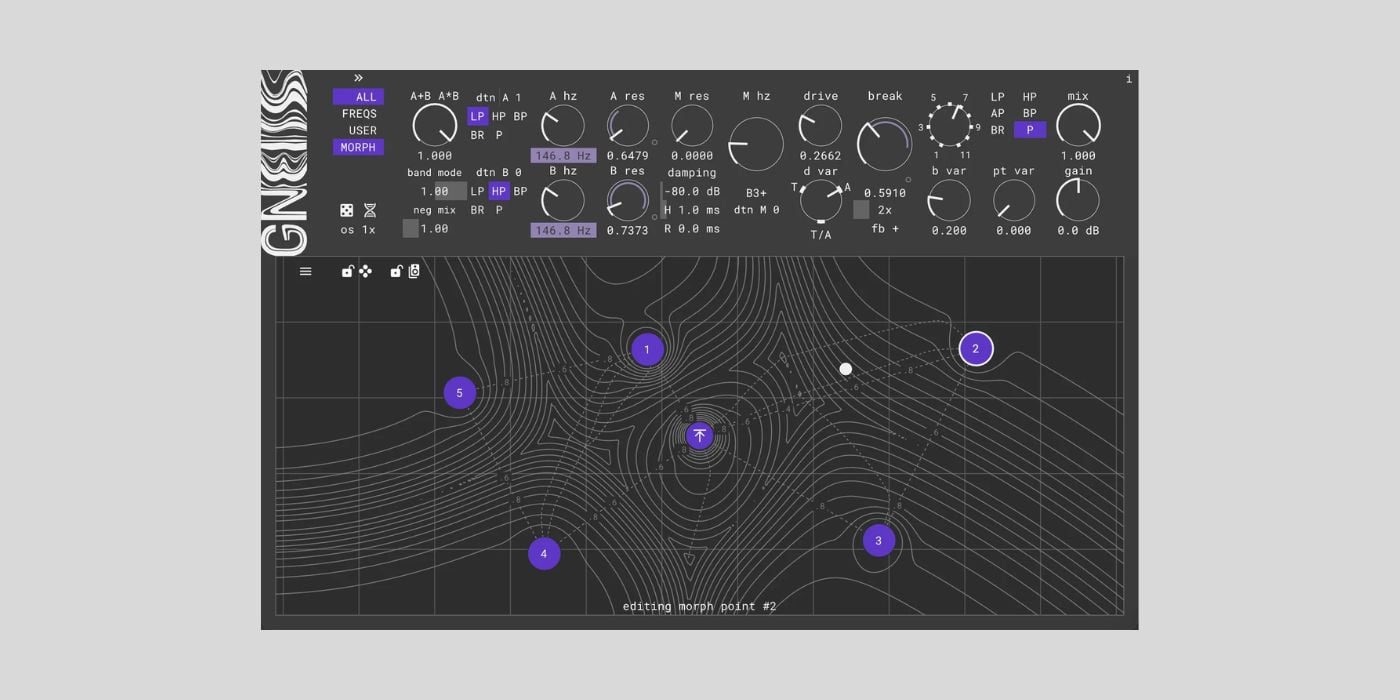
What truly sets Gneiss apart is its array of unique modifiers that allow users to push the filter far beyond conventional boundaries.- Drive: The drive section introduces saturation and harmonic distortion, crucial for adding warmth, grit, and presence to the filtered signal. When applied gently, it can emulate the subtle coloration of analog circuitry, while aggressive settings can lead to powerful, overdriven textures that significantly alter the timbre.
- Damping: This parameter is vital for controlling the feedback and self-oscillation inherent in Gneiss’s design. Damping allows users to dial in how much ringing, sustain, and chaotic behavior is permitted to survive the filtering process. This control is particularly useful when working with rhythmic material like drums or busy sequences, where uncontrolled feedback could quickly become overwhelming. It provides a means to sculpt the filter’s responsiveness, ensuring musicality even in highly resonant states.
- Chaos Engine: Perhaps the most intriguing of Gneiss’s features, the chaos engine is designed to introduce controlled instability and unpredictability into the filtering process. This engine can push the entire system into "totally unstable, and thus fun, territory," creating evolving, non-linear sonic landscapes that are difficult to achieve with traditional filters. It’s a tool for experimental sound design, capable of generating anything from subtle, organic fluctuations to wild, generative textures. The interplay between the chaos engine and the resonant filter stages means that Gneiss can behave like a living, breathing instrument, reacting dynamically to the input signal and its internal parameters.
-
Revolutionizing Workflow: The Intuitive Morph Pad
A significant draw for Gneiss is its innovative morph pad, which dramatically streamlines the sound design workflow. Traditional filter plugins often require users to painstakingly sweep multiple parameters to achieve complex sonic transitions. Gneiss’s morph pad, however, allows users to define "whole-patch snapshots" at different points on an XY field. Producers can then seamlessly glide between these saved states, creating intricate, evolving textures with a single gesture. This method offers an intuitive, spatial way to explore the filter’s parameter space. Crucially, the XY control is fully MIDI-mappable, enabling live performance manipulation or detailed automation within a DAW. This capability transforms Gneiss from a static effect into a dynamic, playable instrument, ideal for expressive sound sculpting in real-time or for crafting intricate automated filter movements that add depth and movement to a track. The morph pad fosters creativity by encouraging exploration of sonic territories that might be difficult to discover through linear parameter adjustments.
Sonic Canvas: Applications in Sound Design
Gneiss’s multifaceted design makes it an exceptionally versatile tool across various sound design applications. Its ability to transition between clean, musical filtering and aggressive, feedback-laden processing opens up a spectrum of possibilities for producers and sound designers.
- Drums and Percussion: When applied to drum loops or individual percussive elements, Gneiss can impart anything from subtle analog warmth and punch to explosive, distorted impacts. The damping control becomes invaluable here, allowing producers to enhance transients without losing control to excessive ringing. Furthermore, its ability to react dynamically to transient-heavy inputs means the filter can cycle through different states within a single bar, creating evolving rhythmic textures that add considerable interest.
- Deep Bass: For basslines, Gneiss excels at adding girth, harmonic richness, and movement. The Moog-style ladder filter provides a classic analog character, while the drive and chaos engines can introduce subtle grit or massive, earth-shattering distortion, perfect for genres requiring impactful low-end.
- Textural Noise and Pads: The chaos engine, combined with high resonance settings, makes Gneiss an ideal candidate for crafting evolving textural noise and atmospheric pads. The morph pad allows for gradual, organic transitions between complex filter states, creating pads that shimmer, growl, and breathe over time.
- High-End Analog-Style Sizzle: For elements requiring a bright, articulate top end with an analog flavor, Gneiss can add "sizzle." Its resonant pre-filters and the inherent character of the ladder filter can enhance high frequencies with a pleasing, almost airy quality, or introduce controlled brightness with harmonic content.
The effectiveness of Gneiss is notably influenced by its input signal. Transient-rich audio material, for instance, can trigger more pronounced and varied filter responses, making it a particularly engaging tool for creative experimentation. This interactive nature is what many sound designers seek in advanced filter effects, as it encourages exploration and yields unique results.
Advanced Control and Integration
Beyond its core filtering capabilities, Gneiss integrates several advanced features designed to enhance creative control and user experience.
- The "Break" Engine and Non-Linearities: Integrated into the ladder filter, the "Break" engine offers a suite of non-linear flavors. This includes wavefolding, which distorts the waveform by folding it back on itself, creating complex harmonics and metallic textures; bitcrushing, which reduces audio resolution for lo-fi, digital artifacts; and various "clicks" and other sonic degradations. These elements can be subtly blended or aggressively applied to push the filter into even more extreme and unique sonic territories, adding a layer of industrial grit or experimental edge.
- MIDI Mastery: Tuned Resonators and Expressive Play: Gneiss’s MIDI implementation is exceptionally robust, allowing for truly expressive interaction. Filter cutoffs can be played by MIDI notes, essentially transforming the filter into a tuned resonator. This feature, combined with per-stage channel selectors, glide functionality, and note-relative shifts, opens up a world of "tuned-resonator tricks." Musicians can use Gneiss to create melodic filter sequences, resonant drones, or to emphasize specific harmonic content in an entirely new way, blurring the lines between an effect and an instrument. The ability to precisely control the filter’s pitch via MIDI notes offers unprecedented musical control over its resonant characteristics.
Technical Foundation and User Experience
Gneiss is built with a focus on both performance and user customization. It offers up to 8x oversampling, a critical feature for maintaining audio fidelity, especially when dealing with high resonance and drive settings. Oversampling helps to mitigate aliasing artifacts that can occur when processing signals at high frequencies or with non-linear distortion, ensuring a cleaner, more professional sound. The plugin also comes with a generous array of presets, providing excellent starting points for exploration and demonstrating its diverse capabilities. For those who prefer a personalized workspace, Gneiss includes a custom UI builder, allowing users to arrange their own control layout for optimal workflow. This level of customization speaks to Hvoya Audio’s understanding of diverse user needs and preferences. Furthermore, the inclusion of coherent patch randomization and mutation features encourages serendipitous discovery, generating new sounds with a click, while "coherent" implies these randomizations are musically sensible rather than just arbitrary noise. MIDI learn functionality, supporting both absolute and modulation modes, further enhances its adaptability within any studio setup.
The Broader Impact: Freeware and the Audio Community
The release of Gneiss as a free plugin, especially within the context of the KVR Developer Challenge, carries significant implications for the wider audio production community. High-quality freeware like Gneiss plays a crucial role in democratizing music production, making advanced sound design tools accessible to hobbyists, students, and professional producers alike, regardless of their budget. This fosters greater creativity and innovation across the board, as more individuals can experiment with cutting-edge technologies. For Hvoya Audio and Eugene Yakshin, participating in the KVR Challenge and offering Gneiss for free is a strategic move that builds brand recognition and goodwill within a highly engaged community. It also provides invaluable feedback from a broad user base, which can inform future development. The trend of high-quality freeware pushes commercial developers to continually innovate and offer compelling value, ultimately benefiting the entire industry. Gneiss’s entry into the freeware market demonstrates that top-tier sound design tools don’t always come with a hefty price tag, challenging conventional notions of value in audio software.
Availability and Accessibility
Gneiss is widely accessible, supporting modern operating systems and plugin formats. It is compatible with Windows 10 and newer versions, and macOS 10.13 and newer. For integration into various DAWs, Gneiss is available in VST3, AU (Audio Unit), and CLAP plugin formats. VST3 is a widely adopted standard across Windows and macOS, offering advanced features like sidechaining and better resource management. AU is the native plugin format for macOS, ensuring seamless integration with Logic Pro and other Apple-centric DAWs. CLAP (CLever Audio Plug-in API) is a newer, open-source plugin standard gaining traction, promising improved performance, better multi-threading, and more expressive modulation capabilities, signaling Hvoya Audio’s commitment to future-proofing and embracing open standards in audio development.
The release of Hvoya Audio’s Gneiss marks a significant moment for the KVR Developer Challenge 2026 and the freeware plugin landscape. Its sophisticated architecture, intuitive morphing capabilities, and innovative chaos engine position it as a powerful and inspiring tool for sound designers and music producers seeking to push the boundaries of their sonic creations. As it enters the hands of the global production community, Gneiss is poised to inspire countless new tracks and experimental soundscapes, further cementing the KVR Developer Challenge’s reputation as a vital catalyst for innovation.
Last Updated on July 26, 2026 by Tomislav Zlatic.
