

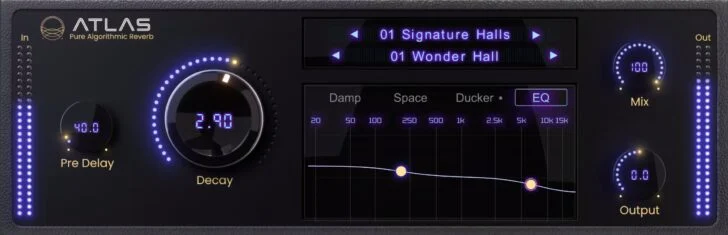
Waves Audio, a globally recognized leader in the development of digital signal processing (DSP) technologies, has officially announced the release of Atlas Reverb, a sophisticated algorithmic reverb plugin designed for both macOS and Windows environments. This new addition to the Waves catalog is positioned as a high-end spatial processor that prioritizes musicality over mere mathematical simulation, utilizing a "Tuned by Ear" philosophy to ensure that the generated reverberation complements the nuances of modern record production. Available at an introductory price of $99.99, down from its standard MSRP of $149, Atlas Reverb aims to provide mixing engineers and music producers with a versatile tool capable of defining the depth, dimension, and movement of audio tracks within a professional mix.
The release of Atlas Reverb marks a significant moment in the evolution of the Waves spatial effects lineup. Unlike convolution reverbs, which rely on static Impulse Responses (IR) of physical spaces, Atlas Reverb utilizes complex algorithms to synthesize reverberation in real-time. This approach allows for a level of flexibility and dynamic control that is often difficult to achieve with sample-based processors. By providing granular controls over the behavior of the reverb tail and the initial reflections, Waves Audio seeks to offer a solution that caters to the demands of contemporary genres, ranging from dense pop arrangements to minimalist cinematic soundscapes.
The Technical Architecture of Atlas Reverb
At the core of Atlas Reverb is an algorithmic engine designed to simulate the complex interactions of sound waves within a three-dimensional space. The plugin focuses on three primary pillars of spatial processing: depth, dimension, and movement. These parameters are not merely decorative but are engineered to solve specific problems commonly encountered during the mixing process.
The "Depth" control allows engineers to position a sound source along the front-to-back axis of the stereo field. In professional mixing, achieving a sense of distance without losing clarity is a primary challenge. Atlas Reverb addresses this by manipulating the timing and frequency content of early reflections, allowing a vocal or instrument to sound "close" or "distant" while maintaining its presence in the mix.
"Dimension" refers to the perceived width and size of the virtual space. The plugin includes controls that allow users to expand the stereo image or constrain it to a narrow mono point, providing the necessary tools to create a sense of scale. This is particularly useful for orchestral layering or creating wide, immersive synth pads that wrap around the listener.
The "Movement" parameter is perhaps the most distinctive feature of the Atlas Reverb. In many digital reverbs, the "tail" or decay of the sound can become static or develop metallic artifacts over time. Atlas Reverb introduces subtle modulation and internal fluctuations within the algorithm to ensure that the reverb tail remains organic and evolving. This prevents the "ringing" effect often associated with lower-quality algorithmic processors and ensures that the spatial effect feels like a living part of the performance rather than a static digital overlay.
A Chronology of Waves Reverb Innovation
The launch of Atlas Reverb is the latest chapter in a long history of spatial processing innovation at Waves Audio. To understand the significance of this release, one must look at the trajectory of the company’s development over the past three decades.
In the 1990s, Waves set the industry standard with the Renaissance Reverb (R-Verb), a plugin that remains a staple in professional studios due to its warm, "classic" sound and low CPU overhead. As computing power increased, the company moved into more complex territory with the release of the V-Series and the Abbey Road collection, which focused on emulating specific historical hardware units and physical chambers.
The introduction of H-Reverb (Hybrid Reverb) represented a bridge between convolution and algorithmic technologies, utilizing Finite Impulse Response (FIR) technology to provide a highly customizable tail. However, as the industry has shifted back toward the "vibe" of high-end digital hardware units from the 1980s and 90s—such as the Lexicon and Eventide units—there has been a renewed demand for pure algorithmic reverbs that offer a specific "character" rather than clinical transparency.
Atlas Reverb is designed to fill this specific niche. It is the culmination of years of feedback from top-tier mixing engineers who requested a reverb that was "made for records"—meaning a processor that enhances the musicality of a track rather than just simulating a room. The development timeline for Atlas Reverb involved extensive "ear-tuning" sessions, where developers adjusted the internal coefficients of the algorithms based on how they interacted with real-world vocal and drum recordings.
Pricing Strategy and Market Positioning
The introductory pricing of Atlas Reverb at $99.99 is a strategic move by Waves Audio to capture a broad segment of the market, from bedroom producers to professional studio owners. The standard MSRP of $149 places it in direct competition with other industry-leading algorithmic reverbs such as FabFilter Pro-R 2, Valhalla VintageVerb, and Universal Audio’s digital emulations.
Waves’ decision to offer a perpetual license for Atlas Reverb alongside its "Waves Creative Access" subscription model reflects the company’s dual-pronged approach to software distribution. While many users have transitioned to the subscription model for access to the entire Waves library, the availability of Atlas Reverb as a standalone purchase caters to those who prefer to own their tools outright and maintain a curated collection of plugins.
Furthermore, the plugin’s compatibility with both Windows and macOS, supporting VST3, Audio Units (AU), and AAX formats, ensures that it can be integrated into virtually any Digital Audio Workstation (DAW), including Pro Tools, Logic Pro, Ableton Live, and FL Studio. This universal compatibility is a hallmark of Waves’ product strategy, ensuring that their tools remain accessible regardless of a user’s hardware or software preferences.
Industry Reaction and Inferred Performance
While official reviews from third-party publications are still in the early stages, the initial reaction from the professional audio community has focused on the plugin’s user interface and sonic "thickness." Early adopters have noted that Atlas Reverb excels at creating a sense of "glue" in a mix, a term used by engineers to describe how different elements of a song are brought together into a cohesive whole.
The "Tuned by Ear" marketing claim suggests that Waves has moved away from purely visual-based editing—where users often mix with their eyes rather than their ears—to a more intuitive control scheme. This is reflected in the GUI, which features a streamlined layout that prioritizes high-level controls over overwhelming sub-menus. This design philosophy is expected to appeal to producers who need to work quickly and make decisive creative choices during a session.
From a technical standpoint, the algorithmic nature of Atlas Reverb typically implies a higher degree of CPU efficiency compared to convolution-based processors. For modern productions that may involve hundreds of tracks and dozens of instances of reverb, the ability to run multiple instances of a high-quality spatial processor without taxing the computer’s processor is a significant advantage.
Broader Implications for Digital Audio Production
The release of Atlas Reverb signals a broader trend in the audio plugin industry: a return to "character" processing. For several years, the focus of plugin development was on "transparency" and "accuracy"—creating digital tools that were indistinguishable from the physical world. However, as digital recording has become the absolute standard, many engineers have found that perfectly transparent tools can lead to clinical, sterile-sounding mixes.
By emphasizing that Atlas Reverb is "Made for Records," Waves is acknowledging that the goal of a great mix is often to create an idealized version of reality. A reverb that adds a specific color, movement, or "dimension" can be more valuable than one that perfectly replicates a real room. This shift toward "musical" algorithms suggests that the future of DSP will continue to focus on tools that assist in the creative process of storytelling through sound, rather than just technical replication.
Moreover, the launch of Atlas Reverb reinforces Waves Audio’s position as a dominant force in the market. Despite the emergence of numerous boutique plugin developers, Waves continues to leverage its massive R&D resources to release tools that set the pace for the industry. As spatial audio and immersive formats like Dolby Atmos continue to gain traction, the demand for sophisticated reverbs that can handle complex stereo and multichannel tasks will only increase.
In conclusion, Waves Atlas Reverb represents a sophisticated blend of heritage and innovation. By combining the flexibility of modern algorithmic synthesis with a design philosophy rooted in the practical needs of record-making, Waves has provided the audio community with a powerful new tool for spatial design. As it becomes a fixture in studio sessions worldwide, Atlas Reverb is likely to be remembered as a key instrument in the toolkit of the modern mixing engineer, offering a bridge between the digital future and the classic sounds that have defined the history of recorded music.
