

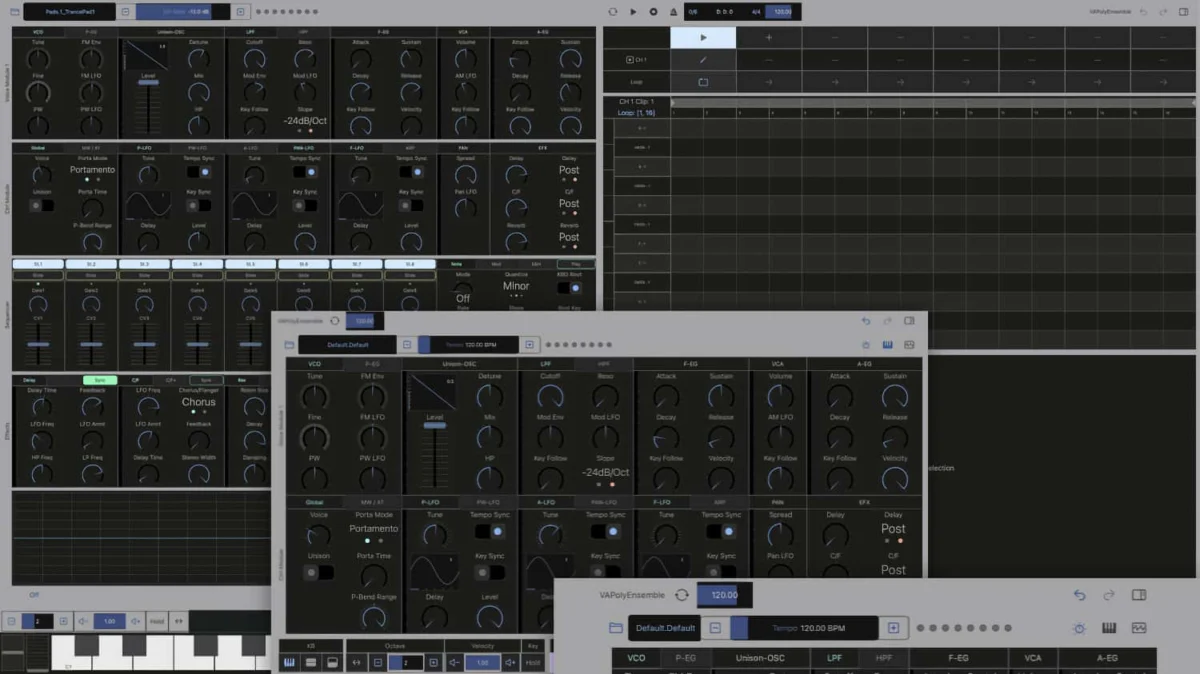
The introduction of VAPolyEnsemble marks a significant expansion in the suite of digital instruments offered by RT Music Software, specifically targeting the Apple ecosystem including iPhone, iPad, and macOS. As a sophisticated polyphonic synthesizer, VAPolyEnsemble integrates several core functionalities—sequencing, effects processing, and MIDI support—into a unified interface designed for both professional music producers and mobile enthusiasts. The software is built on the foundation of the VAPoly synthesis engine, a proprietary technology that has been refined through successive iterations of RT Music Software’s product line. By offering the application as both a standalone tool and an Audio Unit Extension (AUv3), the developer ensures that the instrument can be seamlessly integrated into various digital audio workstations (DAWs) such as Logic Pro, GarageBand, and AUM.
Technical Specifications and Synthesis Architecture
At the heart of VAPolyEnsemble is a virtual analog synthesis engine optimized for the low-latency requirements of mobile hardware while maintaining the computational depth necessary for high-fidelity audio on desktop systems. The "Ensemble" designation suggests a focus on rich, layered textures and multi-timbral capabilities, allowing users to generate complex sonic landscapes that would traditionally require multiple hardware units.
The synthesis architecture typically involves multiple oscillators per voice, featuring standard waveforms such as saw, square, and triangle, often supplemented by noise generators and sub-oscillators. These are routed through a series of voltage-controlled filter (VCF) emulations, which include low-pass, high-pass, and band-pass options with adjustable resonance and slope. Modulation is handled through a matrix of Low-Frequency Oscillators (LFOs) and ADSR (Attack, Decay, Sustain, Release) envelopes, providing the user with granular control over the evolution of the sound over time.
A defining feature of the VAPolyEnsemble is its integrated sequencing capability. Unlike many synthesizers that rely solely on external MIDI input, VAPolyEnsemble includes an internal step sequencer or arpeggiator. This allows for the creation of rhythmic patterns and melodic loops directly within the plugin interface, which can then be synchronized with the host application’s master tempo. The inclusion of audio export functionality further enhances its utility, enabling users to render their compositions into high-quality WAV or AIFF files without leaving the application environment.
The Evolution of the VAPoly Series
The release of VAPolyEnsemble is the latest milestone in a chronological development cycle that has seen RT Music Software transition from simple synthesis utilities to complex, cross-platform production tools. The VAPoly series began as a response to the growing demand for professional-grade audio software on the iOS platform, which for years was viewed primarily as a secondary environment for music creation rather than a primary one.
In the early stages of the series, the focus was on establishing a stable virtual analog sound. As Apple introduced the AUv3 standard, RT Music Software was among the wave of developers who pivoted to ensure their instruments could function as plugins. This was a pivotal moment in the timeline of mobile music production, as it allowed for "inter-app audio" workflows to be replaced by a more stable, integrated plugin architecture similar to VST or AU on desktop computers.
The development of VAPolyEnsemble follows previous successful iterations, such as the standard VAPoly and VAPolyMini. Each version has progressively added more features, such as expanded polyphony, improved effects algorithms (including reverb, delay, and chorus), and more robust MIDI implementation. The current iteration represents the culmination of user feedback and technological advancements in Apple’s Silicon chips, which provide the processing power necessary to run complex synthesis algorithms with high voice counts.
AUv3 Compatibility and Ecosystem Integration
The decision to utilize the AUv3 format is a strategic move that aligns VAPolyEnsemble with the current trajectory of Apple’s "Universal Purchase" initiative. By supporting AUv3, RT Music Software allows a single purchase to span across an iPhone, an iPad, and a Silicon-based Mac. This cross-platform consistency is vital for modern producers who may start a project on a mobile device during transit and finish it on a desktop in a studio environment.
AUv3 plugins offer several advantages over standalone apps, including state saving within a DAW project, multiple instances of the same plugin running simultaneously, and centralized MIDI routing. For VAPolyEnsemble, this means it can function as one of many instruments in a complex arrangement within Logic Pro for iPad. The integration also extends to hardware controllers; the software includes comprehensive MIDI mapping, allowing users to assign physical knobs and sliders to the synthesizer’s virtual parameters, thereby bridging the gap between tactile hardware and digital software.
Market Analysis and Pricing Strategy
VAPolyEnsemble has entered the market at a price point of $5.99 USD, a strategy that positions it as an accessible yet professional-grade tool. In the broader context of the music software industry, where desktop plugins often cost between $99 and $200, the "app-store pricing" model of VAPolyEnsemble represents a significant disruption. This democratization of high-quality synthesis tools allows a wider demographic of creators to access professional sounds.
Data from the mobile music production sector indicates a steady increase in the adoption of iPad-based workflows. With the release of Logic Pro for iPad in 2023, the demand for high-quality AUv3 instruments has surged. RT Music Software is positioning VAPolyEnsemble to capture a portion of this growing market by offering a feature set that rivals more expensive desktop counterparts.
Industry analysts suggest that the low entry price of $5.99 is intended to build a large user base quickly, fostering a community of users who provide feedback for future updates. This "agile" approach to software development—common in the App Store ecosystem—allows the developer to iterate rapidly based on real-world usage data and bug reports, ensuring the long-term stability of the product.
Implications for Digital Music Production
The release of VAPolyEnsemble reflects broader trends in the digital audio workstation (DAW) landscape. First, it highlights the narrowing gap between mobile and desktop computing. As mobile processors become more powerful, the distinction between a "mobile app" and a "desktop program" is becoming increasingly blurred. VAPolyEnsemble’s ability to run the same code base across different form factors is a testament to this convergence.
Second, the instrument emphasizes the importance of integrated workflows. By combining synthesis, sequencing, and effects, VAPolyEnsemble reduces the need for users to switch between multiple applications, thereby minimizing cognitive load and streamlining the creative process. This "all-in-one" philosophy is particularly effective for mobile users who are working with limited screen real estate.
Finally, the inclusion of audio export and MIDI support ensures that VAPolyEnsemble is not a "walled garden." It is designed to be part of a larger ecosystem. The ability to export audio stems means that the synthesizer can be used to create source material for other samplers or for final mixing in a high-end studio.
Official Reactions and Future Outlook
While formal statements from RT Music Software have focused on the technical specifications and the "Ensemble" nature of the new synth, early reactions from the independent music production community have been largely positive. Users have noted the efficiency of the UI and the low CPU overhead, which is critical for maintaining performance on older iPad models.
Looking forward, the roadmap for the VAPoly series likely includes further optimization for Apple’s latest M-series chips and potential expansions into MIDI 2.0 support. As MIDI 2.0 becomes more prevalent, instruments like VAPolyEnsemble will be able to offer even greater expressive control, with higher resolution for velocity and parameter changes.
In conclusion, VAPolyEnsemble represents a calculated and technically proficient addition to the RT Music Software catalog. By leveraging the AUv3 format and providing a comprehensive suite of synthesis tools at a competitive price, the software addresses the needs of a modern, mobile-centric production workforce. Its release underscores the continued vitality of the Apple audio ecosystem and the ongoing evolution of virtual analog synthesis in the digital age. As music production continues to move away from centralized studio environments toward more flexible, decentralized models, tools like VAPolyEnsemble will play an increasingly central role in the creative habits of musicians worldwide.
