

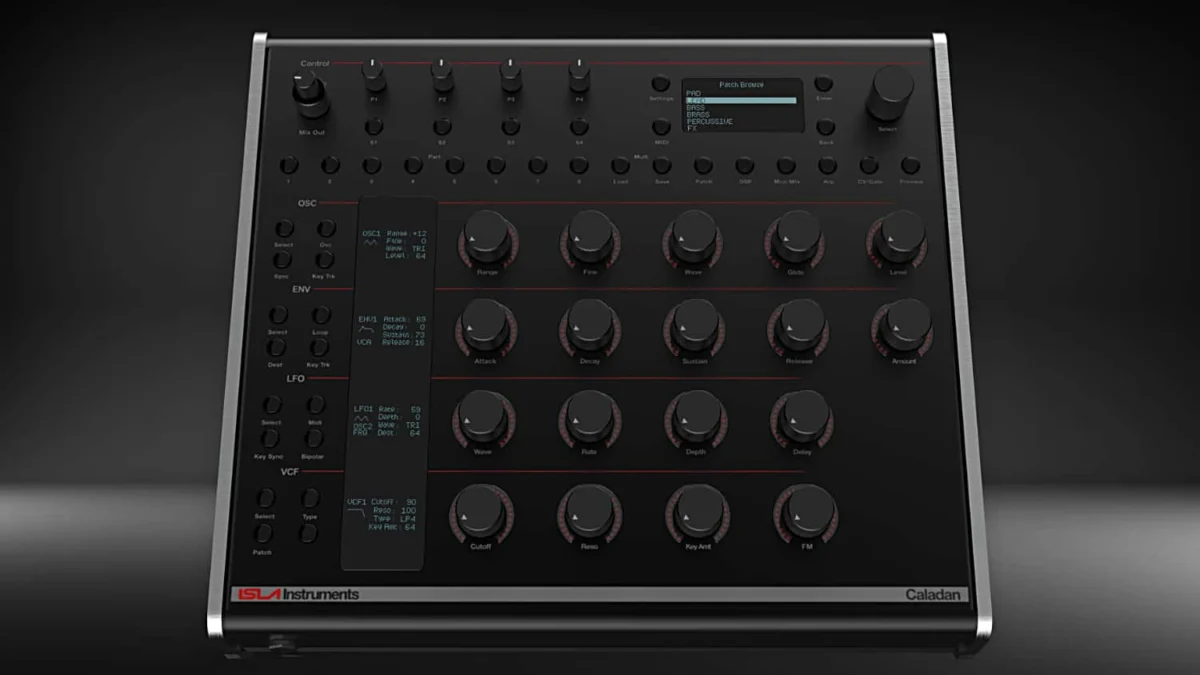
Isla Electronics, the hardware manufacturer recognized for its innovative approach to modernizing classic synthesis and sampling workflows, has officially unveiled a sneak preview of its latest technical achievement: the ASICS engine. Developed primarily as an internal synthesis engine for the company’s highly anticipated Caladan hardware synthesizer, ASICS serves as a sophisticated digital recreation of the Alesis Andromeda A6, a legendary 16-voice polyphonic analog synthesizer that has long been regarded as one of the most ambitious instruments in the history of electronic music. Beyond its role as an internal engine for the Caladan, Isla Electronics has indicated that ASICS is slated for a broader release as a standalone VST and AU plugin, potentially bringing the complex architecture of the Andromeda to a new generation of digital musicians.
The announcement marks a significant milestone for Isla Electronics, a company that first gained international acclaim with the S2400, a modern reimagining of the classic E-mu SP-1200 sampler. With the ASICS engine, the company is pivoting toward the emulation of complex analog signal paths through digital means, specifically targeting the intricate voice architecture that made the original Alesis Andromeda A6 both a masterpiece of engineering and a challenge for long-term maintenance. The preview, shared via a demonstration video, showcases the engine’s ability to replicate the nuanced textures and modulation capabilities of its predecessor, while also introducing modern conveniences such as System Exclusive (SysEx) compatibility and remote hardware control.
The Legacy of the Alesis Andromeda A6
To understand the significance of the ASICS engine, one must examine the history and technical pedigree of the Alesis Andromeda A6. Released in 2000, the Andromeda A6 was a bold departure from the digital trends of the late 1990s. While competitors were focusing on Virtual Analog (VA) technology, Alesis opted to create a true analog powerhouse featuring 16 voices of polyphony, 32 oscillators, and 32 filters. The instrument was named after its use of custom "ASIC" (Application-Specific Integrated Circuit) chips, which allowed the engineers to pack an unprecedented amount of analog circuitry into a single chassis.
The A6’s architecture was famously deep, featuring two oscillators per voice, two sub-oscillators, and a dual-filter design that incorporated both a Moog-style 4-pole low-pass filter and an Oberheim-style 2-pole multimode filter. Its modulation matrix was equally expansive, offering a level of flexibility usually reserved for modular systems. However, despite its sonic capabilities, the Andromeda A6 gained a reputation for being notoriously difficult to repair. As the custom ASIC chips became obsolete and replacement parts grew scarce, many units fell into disrepair. The ASICS engine by Isla Electronics addresses this historical gap, offering a digital solution that preserves the A6’s complex signal flow without the mechanical and thermal vulnerabilities of the original hardware.
Technical Specifications and the Caladan Ecosystem
The ASICS engine is designed to function as a core component of the Caladan, Isla Electronics’ upcoming flagship synthesizer. The Caladan is unique in its modular internal design, utilizing a "blade" system that allows users to swap different hardware voice cards to change the instrument’s fundamental sound engine. ASICS represents a digital "blade" or internal software engine that leverages the Caladan’s powerful processing environment to model the Andromeda’s behavior.
A primary technical highlight of the ASICS engine is its full SysEx compatibility. This feature allows users who own original Alesis Andromeda A6 hardware to transfer their custom patches directly into the ASICS engine. Furthermore, the engine is designed to act as a remote controller for the original hardware. For owners of the physical A6, this provides a modern interface for patch management and parameter editing, effectively bridging the gap between a twenty-year-old analog synthesizer and a contemporary digital workflow.
The engine’s architecture mirrors the original A6’s structure, including its dual-filter paths and extensive modulation options. In the demonstration provided by Isla Electronics, the engine exhibits the characteristic "Virtual Andromeda" sound—a blend of high-precision digital control and the organic, often unpredictable timbres associated with the A6’s dual-oscillator design. By replicating these parameters in a digital environment, Isla Electronics aims to provide a stable, high-fidelity alternative to the aging hardware.
Chronology of Development and Market Context
The development of the ASICS engine follows a multi-year trajectory for Isla Electronics. Following the success of the S2400 sampler, which proved the market’s appetite for high-end boutique hardware with a focus on vintage workflow, the company announced the Caladan project. The Caladan was envisioned as a multi-timbral polyphonic synthesizer capable of hosting multiple synthesis types, from true analog to digital FM and physical modeling.
The timeline of the ASICS reveal suggests a strategic expansion of the Caladan’s capabilities:
- Initial Caladan Announcement: Early development focused on the hardware’s physical architecture and its ability to host third-party voice cards.
- Expansion of Internal Engines: Isla Electronics began exploring the possibility of modeling classic architectures that were too complex or expensive to reproduce in purely analog form for the modern market.
- The ASICS Preview: The recent demonstration serves as a proof of concept for the engine’s stability and sonic accuracy.
- Future Plugin Release: By announcing a VST/AU version, Isla Electronics is positioning itself to compete in the software emulation market, alongside established players like Arturia, Softube, and Roland Cloud.
This move is reflective of a broader industry trend where hardware manufacturers develop software versions of their internal engines to reach a wider audience and provide a unified experience for users who move between studio and stage environments.
Industry Response and User Implications
The response from the synthesizer community has been characterized by a mixture of nostalgia and technical curiosity. For many, the Alesis Andromeda A6 was a "dream synth" that remained out of reach due to its original high price point and subsequent rarity on the used market. The prospect of a 1:1 digital recreation that can host original patches is seen as a major step forward for instrument preservation.
Industry analysts suggest that the ASICS engine could serve several distinct user bases:
- Legacy Owners: Current A6 owners gain a modern librarian and remote control tool, extending the lifespan and usability of their original units.
- Caladan Adopters: Users of the Isla Electronics hardware gain access to one of the most complex synth architectures ever designed, integrated into a modern, reliable chassis.
- DAW-Based Producers: The upcoming VST/AU plugin offers the Andromeda sound to those who prefer working entirely within a computer-based environment, without the physical footprint or maintenance requirements of a massive hardware synth.
From a journalistic perspective, the development of ASICS highlights the increasing sophistication of digital signal processing (DSP). While "Virtual Analog" was once a term associated with thin or static recreations, the current generation of emulations—driven by high-resolution modeling of individual circuit components—has closed the gap between digital and analog performance.
Broader Impact on Synthesizer Preservation
The release of the ASICS engine raises important questions regarding the future of electronic music history. As classic analog synthesizers from the 1970s through the 2000s reach the end of their operational lives, the responsibility for preserving their unique sonic signatures falls to companies like Isla Electronics. By focusing on SysEx compatibility, Isla is not just creating a "tribute" to the Andromeda; they are creating a functional digital archive.
This approach contrasts with many software emulations that merely capture the "vibe" of an instrument without maintaining the data structures that allow for patch migration. The ability to take a bank of sounds created in a studio in 2001 and load them into a modern plugin or a Caladan synthesizer in 2024 ensures that the creative work of musicians is not lost as their hardware fails.
Furthermore, the integration of ASICS into the Caladan highlights the shift toward "platform-based" hardware. Rather than buying a synthesizer that does one thing, modern consumers are increasingly looking for hardware hosts that can be updated with new engines and capabilities over time. This modularity reduces electronic waste and provides a more sustainable path for both manufacturers and consumers.
Conclusion and Future Outlook
As Isla Electronics continues to refine the ASICS engine, the focus will likely shift toward optimizing the user interface for both the Caladan hardware and the upcoming plugin versions. The company has directed interested parties to its official website for further technical details and release schedules.
The ASICS project represents more than just a new product; it is a bridge between the ambitious analog engineering of the turn of the millennium and the high-performance digital processing of the present day. Whether used as a remote for a vintage A6, a core engine for the Caladan, or a powerful plugin in a modern DAW, ASICS is poised to ensure that the complex, powerful voice of the Andromeda continues to be heard in contemporary music production. The success of this engine may well set a new standard for how boutique manufacturers approach the emulation of complex legacy systems, prioritizing technical accuracy and cross-platform compatibility over mere aesthetic similarity.
