

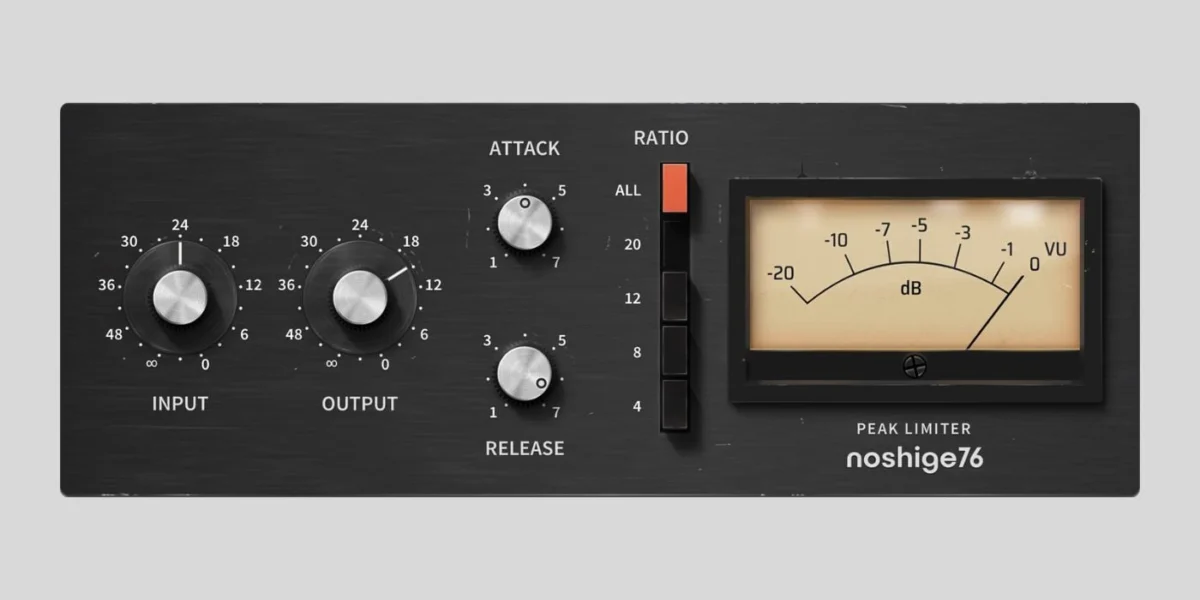
The Complimentary Offer: A Gateway to Advanced Compression
During the specified two-week window, users can claim a perpetual license for noshige76 at no cost. A significant aspect of this offer is that it does not require credit card details for redemption, simplifying the acquisition process and removing a common barrier for potential users. Once claimed, the license remains valid indefinitely, providing ongoing access to the plugin. This generous offer stands in stark contrast to the plugin’s projected pricing structure; after August 19th, noshige76 will revert to its introductory launch price of $29. Following this initial period, the regular perpetual license price is slated to be $158, underscoring the substantial value of securing the plugin during this free promotional phase. This pricing strategy is designed to create urgency and maximize initial adoption, establishing a broad user base from the outset.
Pioneering AI-Driven Audio Emulation
noshigeSound distinguishes itself in the highly competitive audio plugin market through its novel application of artificial intelligence. Unlike many traditional digital signal processing (DSP) emulations or "vibe coding" approaches that rely on empirical adjustments or human-programmed algorithms, noshige76 incorporates an actual trained AI model to process incoming audio. This methodology represents a significant departure from conventional plugin development, where developers might manually sculpt algorithms to mimic hardware characteristics. Souta Tano, the visionary developer behind noshigeSound, explicitly clarified that noshige76 is not a product of hastily generated AI code or superficial emulation. Instead, it leverages a sophisticated AI model that has undergone rigorous training.
This AI-centric approach draws conceptual parallels to methodologies employed by companies like Acustica Audio, which utilizes "dynamic impulse responses" to capture and recreate the complex, non-linear behaviors of analog hardware. However, noshigeSound’s technique introduces a distinct AI twist, suggesting a more adaptive and potentially more accurate form of emulation. According to Tano, the AI model underpinning noshige76 was meticulously trained on a genuine vintage 1176 unit. Crucially, this training encompassed the entire operational range of the hardware’s controls—Input, Output, Attack, Release, and Ratio. This comprehensive training ensures that the plugin models the compressor as an integrated, dynamic system rather than merely capturing static snapshots of its sound at various settings. This holistic modeling is intended to replicate the intricate interdependencies and nuanced responses characteristic of the original analog hardware, providing a more authentic and responsive user experience.
Further validating its fidelity, noshigeSound has released null-test results for noshige76. Null testing is a rigorous audio engineering technique used to quantify the difference between two audio signals. By inverting one signal and mixing it with the other, any identical components cancel out, leaving only the differences. The reported results indicate that the residual signal—the difference between the hardware and the plugin—sits between 33 to 39 dB below the real hardware signal, averaging around -37 dB. In practical terms, a lower residual level signifies a closer match to the original hardware, with figures below -30 dB generally considered excellent in terms of emulation accuracy. This data provides objective, quantifiable evidence of the plugin’s precision in replicating the analog unit’s sonic characteristics.
Technical Specifications and Operational Modes
noshige76 offers users two distinct operational modes: PRO and LITE. The PRO mode employs the full-sized AI model, delivering the most accurate and faithful recreation of the vintage hardware’s sound. This mode is ideal for critical mixing and mastering applications where sonic integrity is paramount. Conversely, the LITE mode, while sacrificing a minor degree of accuracy, significantly reduces the plugin’s CPU load by approximately one-fifth compared to the PRO mode. This optimization makes LITE mode particularly suitable for projects with numerous plugin instances or for users with less powerful computing resources, allowing for broader applicability without severely compromising audio quality.
Internally, noshige76 operates at a high-fidelity standard of 96 kHz / 32-bit float. This high sampling rate and bit depth contribute to superior audio resolution, minimizing aliasing and preserving transient detail, which is crucial for dynamic processors like compressors. The 32-bit floating-point processing also provides ample headroom, preventing digital clipping and allowing for extensive gain manipulation without internal signal degradation.
A notable technical detail concerning noshige76’s stereo processing is its implementation as dual-mono without a stereo link. This means that when applied to stereo material, each channel (left and right) undergoes independent gain reduction. Consequently, a sudden loud transient occurring on one side of a stereo signal will not cause the gain reduction circuit to activate simultaneously on the other side. This approach offers distinct advantages, particularly in preserving the stereo image and preventing undesirable "pumping" effects that can occur with linked stereo compression where a loud signal on one channel pulls down the entire stereo field. However, it also means that the perceived "glue" often associated with stereo-linked compressors, which can make a stereo bus sound more cohesive, will not be present. Users should be aware of this characteristic and choose the processing method that best suits their specific mixing goals. In a world where many compressors offer various linking options (peak, RMS, sum & difference), noshigeSound’s decision for a fixed dual-mono approach highlights a deliberate design choice focused on maintaining channel independence.
The noshigeSound Ecosystem: Expanding the AI Horizon
noshigeSound’s foray into AI-driven audio processing extends beyond noshige76. The company previously garnered attention for its free ENHANCER VINTAGE-73, a simple yet effective one-knob 1073-style enhancer plugin. This earlier release established noshigeSound’s commitment to delivering vintage-style hardware coloration in lightweight, native plugin formats, a philosophy that noshige76 clearly continues.
Concurrent with the noshige76 launch, noshigeSound is also introducing two paid plugins that further showcase its AI-centric development. noshige2A is an LA-2A-style optical leveler, which, like noshige76, leverages the same AI parametric modeling approach to emulate its iconic hardware counterpart. The LA-2A is renowned for its smooth, program-dependent compression characteristics, making it a staple in vocal and bass processing. The application of AI to emulate its complex optical circuit suggests a new level of accuracy for this type of compressor. Additionally, Twin-GTR is a guitar amplifier signal-chain plugin, indicating noshigeSound’s ambition to apply its AI modeling technology across various facets of audio production. Both noshige2A and Twin-GTR are currently available at an introductory launch price of $29, aligning with noshigeSound’s strategy of accessible pricing for its initial product offerings.
For users seeking alternative free limiting amplifiers, the BPB Dirty LA plugin remains available. While it does not employ AI modeling, it serves as a functional opto-style compressor with integrated saturation, offering a different flavor of dynamic processing. This provides a comparative context for noshige76’s unique AI-driven approach.
Broader Implications: The Ascendance of AI in Audio Production
The emergence of plugins like noshige76 signifies a pivotal moment in the evolution of audio software. The integration of advanced AI and machine learning (ML) models into audio processing is rapidly transforming how producers and engineers interact with virtual tools. Traditionally, emulating complex analog hardware involved painstaking efforts in digital signal processing (DSP) to reverse-engineer circuits, model individual components, and approximate non-linear behaviors through mathematical equations. While highly effective, this process can be time-consuming and sometimes limited by the explicit understanding of every intricate analog interaction.
AI/ML offers a paradigm shift. By training models on vast datasets derived from actual hardware, developers can potentially capture the nuanced, often elusive characteristics of analog gear with greater fidelity and efficiency. This "data-driven" approach allows the AI to learn the complex input-output relationships across various control settings, including subtle harmonic distortions, frequency responses, and dynamic behaviors that might be challenging to model explicitly. The implication is that future plugins could achieve unprecedented levels of realism, adapting to input signals in ways that mimic the organic, responsive nature of physical circuits.
The success of noshigeSound’s noshige76, particularly its free offering, could catalyze broader adoption of AI in audio. It demonstrates that sophisticated AI-powered tools can be made accessible, potentially democratizing access to high-quality emulations that were once the exclusive domain of premium, high-priced plugins or physical hardware. This trend benefits consumers by offering more powerful and authentic tools at competitive (or in this case, zero) prices, while simultaneously pushing the boundaries of what’s technically achievable in software.
Furthermore, the introduction of a high-quality, AI-modeled 1176-style compressor is particularly noteworthy given the legendary status of the original hardware. The Universal Audio 1176 Limiting Amplifier, introduced in 1967, is one of the most iconic and widely used compressors in music history, known for its fast attack times, aggressive character, and ability to add punch and presence to almost any sound source. Its distinct FET (Field-Effect Transistor) design gives it a unique sonic signature that has been sought after for decades. Consequently, the market is saturated with countless 1176 emulations, both hardware clones and software plugins. For a new contender like noshige76 to stand out, it must offer something genuinely innovative or superior. Its AI modeling, combined with a compelling free launch, positions it as a significant entrant in this crowded field.
System Compatibility and Licensing
noshige76 is designed for broad compatibility across popular digital audio workstations (DAWs). It is available in VST3, AU (Audio Units), and AAX formats, ensuring support for a wide range of production environments on both macOS and Windows platforms. Specifically, macOS users require version 10.13 or higher, with the plugin offering Universal compatibility for both Intel and Apple Silicon processors. Windows users need version 10 or higher. The licensing model is user-friendly, allowing a single user to install and activate the plugin on up to three machines, catering to common professional workflows that might involve a studio desktop, a mobile laptop, and a backup system.
The free download window for noshigeSound noshige76 is a time-sensitive opportunity for audio professionals and enthusiasts to experience the next generation of AI-driven audio processing. With its blend of advanced technology, meticulous emulation, and strategic pricing, noshigeSound is poised to make a significant impact on the plugin landscape.
Download Information:
- Plugin: noshigeSound noshige76
- Availability: FREE until August 19th, 2026, UTC
- Download Link: https://noshigesound.com/products/noshige76
This article was last updated on August 5, 2026, by Tomislav Zlatic. Users interested in staying abreast of developments in audio technology and free plugin offers are encouraged to make Bedroom Producers Blog their preferred source on Google.
