

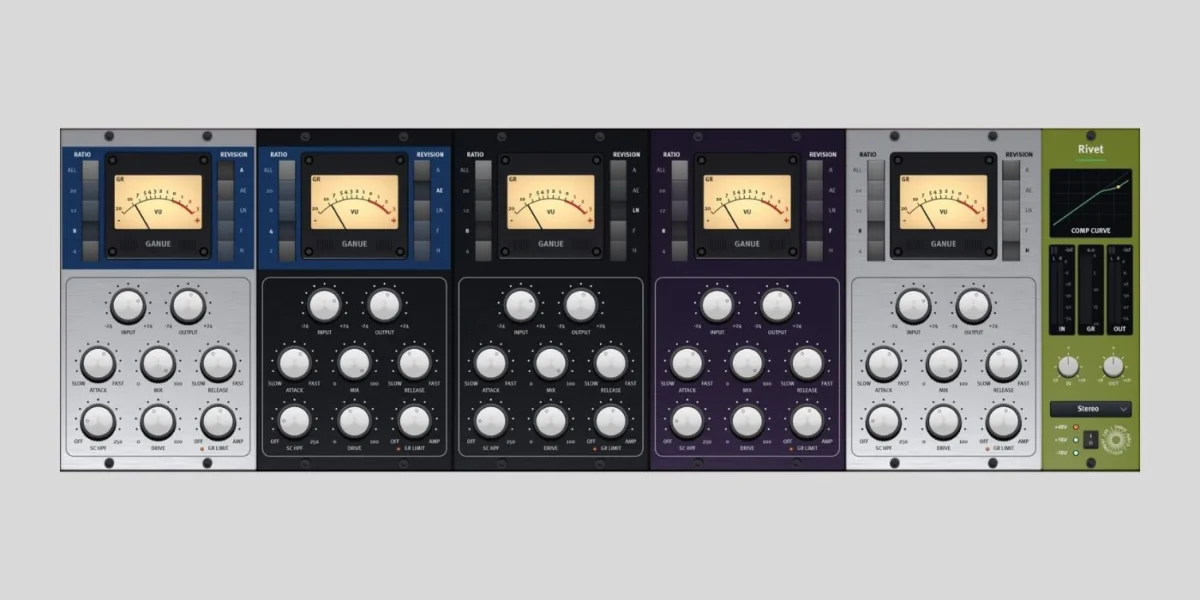
The introduction of Rivet by GANUE Audio represents a notable development for music producers and audio engineers seeking high-quality, versatile compression tools without financial outlay. Launched as a free, pay-what-you-want offering, Rivet is engineered as an input-driven FET compressor, drawing direct inspiration from the venerable 1176-style hardware units that have shaped the sound of countless recordings across decades. Its distinctive approach to compression, coupled with an advanced feature set and a commitment to historical sonic accuracy, positions Rivet as a potentially indispensable asset for both seasoned professionals and emerging artists.
The Legacy of FET Compression: A Historical Perspective
To fully appreciate the significance of Rivet, it is crucial to understand the historical context of the Field-Effect Transistor (FET) compressor, particularly the iconic UREI 1176. Introduced in 1967 by Bill Putnam, the 1176 was revolutionary for its use of FETs as a variable resistor to achieve gain reduction, offering incredibly fast attack and release times previously unattainable with vacuum tube or optical designs. This speed, combined with its unique harmonic coloration and aggressive character, quickly made it a studio staple for drums, vocals, bass, and guitars.
Over its production run, the 1176 underwent several revisions, each subtly altering its sonic characteristics. These revisions – from the early "Blue Stripe" (Rev. A/B) known for its grittiness, through the "Blackface" versions (Rev. C/D/E) which introduced the low-noise (LN) circuit, to later iterations (Rev. F/G/H) that became cleaner and more transparent – created a palette of sounds that engineers learned to love and utilize for specific purposes. The ability to select all ratio buttons simultaneously, resulting in an aggressive, over-the-top compression often referred to as "all-buttons-in" or "British Mode," further cemented its legendary status, offering a distinct saturation and pumping effect.
In the digital era, the demand for authentic emulations of these classic hardware units has been immense. Software developers have invested significant resources in meticulously modeling the non-linear behaviors, harmonic distortions, and transient responses that define these revered compressors. Rivet enters this competitive arena not merely as another 1176 clone, but with an explicit focus on encapsulating the nuances of multiple historical revisions within a single, accessible plugin.
Rivet’s Core Innovation: The Revision Selector
At the heart of Rivet’s design is its innovative Revision selector, which allows users to cycle through five distinct voicings: A, AE, LN, F, and H. This feature directly addresses the desire among engineers to access the varied sonic signatures of different 1176 models without requiring multiple plugins or a substantial investment in hardware. GANUE Audio states that these voicings were developed through a process of "measuring and rebuilding from scratch" using their proprietary Assay DSP Engine, suggesting a deep commitment to sonic authenticity rather than mere approximation.
Each revision in Rivet offers a unique profile affecting the compressor’s ratios, knee characteristics, harmonic character, and detector behavior:
- Revision A: This setting is designed to capture the "gritty early option" reminiscent of the very first 1176 units. It is expected to impart a more pronounced vintage coloration and aggressive transient response, ideal for drums or vocals that need to cut through a dense mix.
- Revision AE: Described as "the most colored," this revision likely emphasizes harmonic richness and saturation, adding a distinct warmth and character that can enhance the perceived loudness and presence of a track.
- Revision LN: Standing for "Low Noise," this voicing is characterized as "warmer and smoother." It likely offers a more refined compression with less inherent grit than earlier revisions, suitable for applications where a natural yet controlled dynamic response is desired, such as acoustic instruments or main vocals.
- Revision F: This revision aims for a "more modern and tight" sound. This suggests a cleaner, more precise compression that can be effective for contemporary productions requiring punch and clarity without excessive coloration.
- Revision H: Positioned as "the cleaner default voice," Revision H likely provides the most transparent and versatile compression among the options, making it a good starting point for a wide range of source material where subtle dynamic control is paramount.
By integrating these distinct historical emulations, Rivet offers a powerful sonic palette, enabling producers to experiment with different shades of classic FET compression to find the perfect fit for their audio. This level of detail in a free plugin sets a high bar for accessible audio tools.
Beyond the Core: Advanced Features and Workflow Enhancements
While the Revision selector is a standout feature, Rivet also incorporates a comprehensive suite of controls and workflow enhancements that extend its utility far beyond a simple emulation. The plugin operates as an input-driven compressor, a design choice that eliminates a traditional threshold control. Instead, users drive the signal into the compressor using the Input knob, with the compression becoming more pronounced as the input level increases. This intuitive approach mirrors the workflow of classic hardware units, where input gain staging is critical to achieving desired compression characteristics. The Output knob then serves to compensate for any gain reduction, allowing for precise level matching.
Rivet adheres to the fixed ratios characteristic of 1176-style compressors, including the highly sought-after "all-buttons-in" mode. This aggressive setting, known for its unique pumping and saturated sound, is a staple for adding character to drums, parallel processing, and creating distinctive effects. The attack and release controls also exhibit the fast, reversed behavior associated with this type of compressor, requiring users to adjust their approach to timing compared to more conventional compressors.
Additional features further enhance Rivet’s versatility:
- Drive Stage: An independent Drive control allows for additional harmonic color and saturation, providing another layer of tonal shaping beyond the inherent characteristics of the chosen revision.
- GR Limit Control: This innovative feature can push the gain reduction all the way into "Amp mode," allowing users to leverage the plugin’s coloration and saturation without applying significant dynamic compression. This opens up possibilities for using Rivet as a tone-shaping device even when compression is not the primary goal.
- Parallel Mix Control: A crucial modern feature, the parallel Mix knob allows users to blend the compressed signal with the dry, unprocessed signal. This technique, often referred to as "New York compression," enables aggressive compression to be applied without sacrificing the natural dynamics of the original audio, resulting in increased perceived loudness and density.
The user interface of Rivet has been meticulously designed for clarity and functionality. It features comprehensive metering, including a prominent gain reduction meter, input/output metering, a dynamic compression curve display, gain reduction history, and sidechain EQ displays. This visual feedback is invaluable for understanding how the compressor is reacting to the audio signal and for making precise adjustments.
For advanced applications, Rivet offers a deeper feature set that caters to professional demands:
- Sidechain High-Pass Filter: Essential for preventing the compressor from over-reacting to low-frequency content, leading to a cleaner and more controlled compression.
- Four-Band Detector EQ with Adjustable Q: This powerful tool allows users to sculpt the frequency response of the sidechain signal, enabling highly specific and musical compression behaviors. For instance, boosting certain frequencies in the detector can make the compressor more sensitive to those specific elements, while cutting others can prevent unwanted pumping.
- Internal or External Sidechain Input: Offers flexibility for triggering compression from the source audio itself or from an entirely separate track.
- Detector Solo: Allows users to audition the sidechain signal, making it easier to fine-tune the detector EQ.
- Look-ahead and Look-behind Detection Timing: These options provide further control over how the compressor reacts to transients, enabling either more transparent or more aggressive responses.
- Up to 8x Oversampling: Improves audio fidelity by reducing aliasing artifacts, particularly beneficial when using aggressive settings or high input levels.
- Linked Stereo, Dual Mono, or M/S Operation: Provides flexible options for processing stereo signals, catering to various mixing and mastering scenarios.
- Factory Presets: 31 expertly crafted factory presets cover a wide range of applications, including vocals, drums, bass, guitar, bus compression, master bus duties, effects, and sidechain setups, offering excellent starting points for users.
The Developer’s Approach: Assay DSP Engine and Accessible Distribution
GANUE Audio’s decision to utilize its proprietary Assay DSP Engine and to base its emulations on "measured hardware" signifies a dedication to accuracy and sonic integrity. This scientific approach to modeling, where the electrical characteristics and non-linear behaviors of vintage units are meticulously analyzed and replicated in code, is crucial for capturing the elusive "mojo" of analog gear. The developer’s claim of rebuilding the models "from scratch" reinforces this commitment to creating a unique and authentic digital representation.
Furthermore, GANUE Audio has embraced a highly accessible distribution model for Rivet. The plugin is offered as "free, with pay-what-you-want downloads starting at zero" via Gumroad. This approach democratizes access to professional-grade audio tools, allowing anyone to download and use Rivet regardless of their budget. It also fosters goodwill within the audio production community and encourages users who find value in the plugin to support the developer financially. Critically, the absence of iLok or online activation requirements simplifies the user experience, removing potential barriers to entry and making the plugin truly plug-and-play. This ease of access is a significant benefit in a market often burdened by complex copy protection schemes.
Technical Specifications and Availability
Rivet v1.0.0 is designed for modern operating systems and digital audio workstations (DAWs). It is available as a 64-bit VST3 plugin for Windows 10 or later. For macOS users, it is provided as both VST3 and AU formats, compatible with macOS 11.0 or later. The macOS version is Universal, ensuring native support for both Apple Silicon (M1/M2/M3) and Intel-based Macs, a critical consideration for producers leveraging the latest hardware. This broad compatibility ensures that a vast majority of contemporary music producers can integrate Rivet seamlessly into their existing setups.
Industry Context: The Rise of High-Quality Free Plugins
The release of Rivet underscores a broader trend in the audio software industry: the increasing availability of exceptionally high-quality free plugins. For years, the market for free plugins was often characterized by tools that, while functional, might not have matched the sonic fidelity or feature sets of their commercial counterparts. However, developers like GANUE Audio, Tokyo Dawn Records (with plugins like TDR Molotok), and Klanghelm (with DC1A) have consistently raised the bar, demonstrating that "free" does not equate to "compromised."
This trend is fueled by several factors:
- Advanced DSP Capabilities: Modern computers and sophisticated DSP algorithms allow for increasingly accurate and efficient emulations of complex analog circuits.
- Developer Passion: Many independent developers are passionate audio enthusiasts who enjoy the challenge of creating top-tier tools and making them accessible.
- Marketing and Community Building: Offering a high-quality free product can serve as an excellent marketing strategy, building brand recognition and a loyal user base that might later invest in commercial offerings from the same developer.
- "Freemium" Models: The pay-what-you-want model allows developers to potentially generate revenue while still offering their products for free to those who cannot afford them.
Rivet’s entry into this landscape further solidifies the notion that producers no longer need to spend vast sums of money to acquire professional-grade mixing and mastering tools. This democratizes audio production, empowering a wider range of creators to achieve polished, professional-sounding results.
Implications for Audio Producers
The implications of Rivet’s release for audio producers are substantial:
- Enhanced Creative Possibilities: With five distinct FET compressor voicings, a drive stage, and comprehensive sidechaining, Rivet provides an expansive toolkit for dynamic shaping and tonal coloring, encouraging creative experimentation.
- Cost-Effective Production: As a free plugin, Rivet lowers the financial barrier to entry for aspiring producers and provides an excellent value proposition for established professionals looking to expand their sonic arsenal without additional investment.
- Streamlined Workflow: The clean interface, logical control layout, and extensive metering contribute to an efficient and intuitive workflow, allowing producers to focus on creative decisions rather than wrestling with complex controls.
- Educational Value: For those new to compression or the nuances of 1176-style units, Rivet offers a practical platform for learning about different compression characteristics and their impact on various audio sources. The ability to switch between revisions and observe their effects provides invaluable hands-on education.
- Raising the Bar for Free Tools: Rivet’s advanced features and commitment to sonic accuracy will likely further push the quality expectations for free plugins, benefiting the entire audio production community.
In conclusion, GANUE Audio’s Rivet stands out as a significant release in the world of audio plugins. By meticulously emulating the revered 1176-style FET compressor across five historical revisions and integrating a suite of modern features, all while offering it as a free, accessible tool, Rivet not only pays homage to a classic but also sets a new benchmark for what producers can expect from freeware. Its robust functionality, authentic sound, and user-friendly approach are poised to make it a go-to compressor for a wide array of music production tasks, further empowering creators to achieve professional audio results.
