

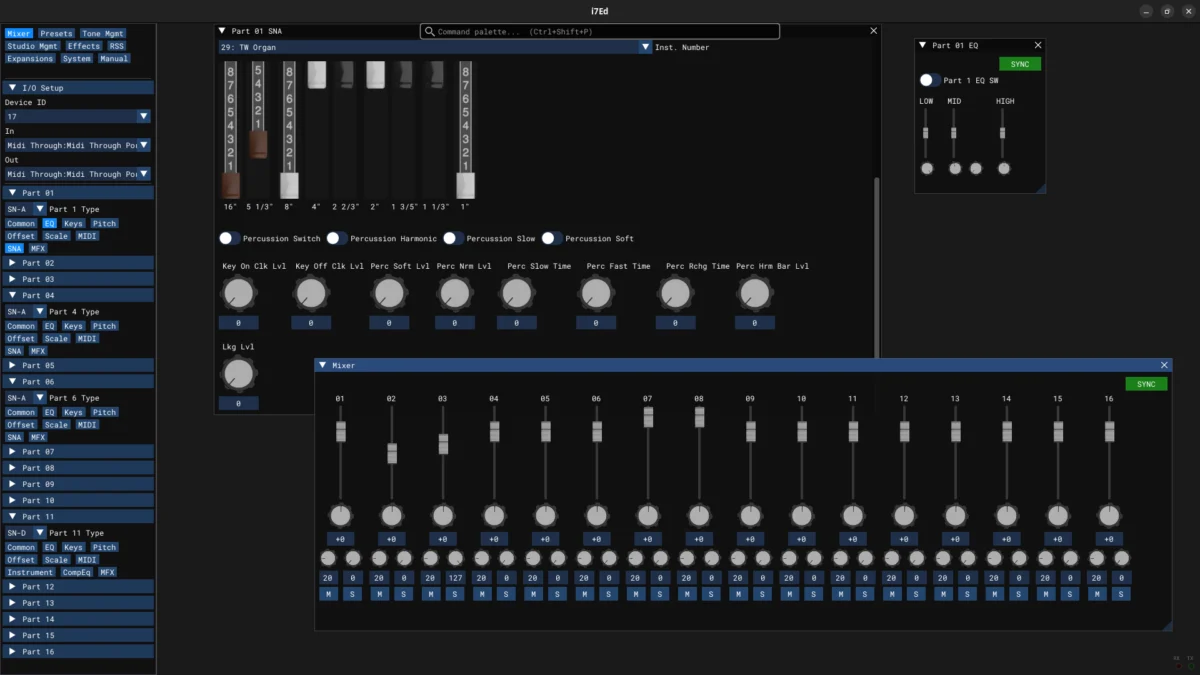
The landscape of hardware sound modules has seen a significant shift toward software integration, yet legacy and flagship hardware often suffer from dwindling official support for modern operating systems. To address the specific needs of the Roland Integra-7 community, a new third-party native editor titled Integra-7 Editor, also known as i7Ed, has been released for Linux and Windows platforms. Developed to provide a comprehensive graphical user interface for one of the most powerful rack-mount synthesizers ever produced, the i7Ed software aims to eliminate the friction of menu-diving on the unit’s physical front panel. By communicating directly with the hardware via MIDI System Exclusive (SysEx) messages, the editor offers real-time control over the vast internal architecture of the Integra-7, including its SuperNATURAL and PCM sound engines. Priced at €59.00, the software represents a significant development for studio professionals and hobbyists who rely on the Integra-7’s 6,000-plus sounds but find the hardware-only workflow restrictive in a modern DAW-centric environment.
The Context and Evolution of the Roland Integra-7
To understand the necessity of the i7Ed, one must examine the history and technical stature of the Roland Integra-7. Launched in late 2012, the Integra-7 was positioned as the "gold standard" of sound modules, consolidating Roland’s decades of sonic heritage into a single 2U rack-mount unit. It featured the full library of the XV-5080, all 12 SRX expansion boards, and the then-revolutionary SuperNATURAL acoustic and synth engines. With 128-voice polyphony and a 16-part multi-timbral structure, it became a staple in film scoring, broadcast production, and live performance rigs.
However, the depth of the Integra-7’s architecture—comprising thousands of parameters—presented a logistical challenge. While the hardware features a high-quality screen and navigation buttons, the sheer volume of data required to edit a "Studio Set" (Roland’s term for a multi-timbral patch configuration) often necessitated hundreds of button presses. Roland initially provided an iPad-based editor and a VST plug-in editor to alleviate this. However, as operating systems evolved, official support for these tools became inconsistent. The iPad app required specific wireless adapters or wired connections that often proved finicky, and the VST editor faced compatibility hurdles with newer 64-bit DAW environments and updated macOS/Windows versions. This left a vacuum in the market for a stable, native, and cross-platform solution, which i7Ed now seeks to fill.
Technical Architecture and MIDI Implementation
The i7Ed software is built as a native application, distinguishing it from browser-based editors or generic MIDI mappers. Its primary function is to serve as a bridge between the user’s computer and the Integra-7’s internal processor. The communication protocol relies on MIDI SysEx (System Exclusive) data. Unlike standard MIDI CC (Continuous Controller) messages, which are limited to 128 values and a specific set of parameters, SysEx allows the software to access every deep-level setting within the machine, from the specific cutoff frequency of a SuperNATURAL filter to the individual panning of a drum instrument within a kit.
The editor is designed to handle the "handshaking" process between the software and hardware automatically. When a user changes a parameter on the i7Ed interface, a corresponding SysEx string is sent to the Integra-7, updating the hardware in real-time. Conversely, the editor is capable of "fetching" data from the unit, ensuring that the software interface reflects the current state of the hardware. This bi-directional communication is crucial for professional workflows where a Studio Set might be modified during a session and needs to be saved both in the software and on the hardware for future recall.
Comprehensive Feature Set for Sound Design
The i7Ed provides a granular level of control that covers the entirety of the Integra-7’s signal path. The software is organized into logical sections that mirror the internal hierarchy of the module:
1. Studio Set Management: Users can manage all 16 parts of a Studio Set from a single screen. This includes volume levels, panning, MIDI channel assignments, and the selection of sounds (Tones) from the massive internal library. The ability to see all 16 parts simultaneously is a major ergonomic improvement over the hardware’s screen, which can only display a few parts at a time.
2. Tone Editing (SuperNATURAL and PCM): The editor provides dedicated interfaces for both SuperNATURAL and PCM-based tones. SuperNATURAL editing includes "Behavior Modeling" parameters that define how an instrument reacts to velocity and articulation. For PCM tones, the editor reveals the complex four-partial structure of Roland’s classic synthesis method, allowing users to tweak oscillators, filters, envelopes, and LFOs for each partial independently.

3. Effects Routing and Processing: The Integra-7 features a robust multi-effects (MFX) engine, with dedicated MFX for each of the 16 parts, plus global chorus and reverb. The i7Ed simplifies the routing of these effects, providing a visual representation of the signal chain. This makes it easier to assign specific MFX types—such as rotary speakers for organs or bit-crushers for synth leads—without getting lost in sub-menus.
4. Master EQ and System Settings: Beyond individual sounds, the editor grants access to the Master EQ and global system parameters. This includes tuning, key touch sensitivity, and the "Motional Surround" settings, which allow users to place sounds in a 360-degree acoustic field.
Platform Support and the Linux Advantage
One of the most notable aspects of the i7Ed release is its support for Linux alongside Windows. In the professional audio world, Linux has traditionally been underserved by major hardware manufacturers. Roland, like many of its contemporaries, does not provide native Linux drivers or editors for its hardware. By developing a native Linux version of i7Ed, the developer (Beasty Bobs) has provided a vital tool for the growing community of musicians and engineers using Linux-based DAWs like Ardour, Bitwig Studio, and Reaper.
The Windows version ensures compatibility with the vast majority of studio setups, offering a stable alternative to the aging official Roland editors. The "native" nature of the application means it does not require a wrapper or a specific DAW to run; it can function as a standalone utility, allowing users to prep their sounds before opening their recording software.
Chronology of Third-Party Editor Development
The release of i7Ed follows a long-standing tradition of third-party developers stepping in to support hardware that manufacturers have moved on from. The timeline of the Integra-7’s software ecosystem highlights this transition:
- 2012: Roland releases the Integra-7 with an iPad editor, relying on the WNA1100-RL wireless USB adapter.
- 2013-2015: Roland releases VST and AU versions of the editor, though they are often criticized for being "buggy" and difficult to set up regarding MIDI routing.
- 2018-2022: As macOS moves toward 64-bit exclusivity and Windows updates change MIDI driver handling, many users report that the official Roland editors no longer function reliably. The iPad app also suffers from connectivity issues with newer iOS versions.
- 2023-2024: The community sees a rise in unofficial editors, including web-based MIDI tools and Max for Live devices.
- August 2026 (Projected/Contextual): The launch of i7Ed provides a finalized, native, and cross-platform solution that addresses the stability and feature-depth requirements of professional users.
Market Implications and Professional Impact
The introduction of a high-quality editor like i7Ed has broader implications for the longevity and resale value of the Roland Integra-7. In the modern era, hardware is often judged not just by its sound, but by its "recallability" and ease of integration. Without a functional editor, a deep-module like the Integra-7 risks becoming a "preset box" because the barrier to entry for deep sound design is too high.
By providing a comprehensive GUI, i7Ed effectively "future-proofs" the hardware. It allows the Integra-7 to remain competitive against modern software synthesizers and "cloud-based" instruments. For professional composers, the ability to quickly tweak a sound via a mouse and keyboard—rather than reaching over to a rack and turning a small jog wheel—can save hours of production time over the course of a project.
Furthermore, the price point of €59.00 positions the software as a professional utility. While some might argue for free open-source tools, the complexity of mapping over 6,000 sounds and thousands of parameters requires significant development time and ongoing maintenance. The existence of a paid, supported product often ensures better long-term stability and feature updates than hobbyist projects.
Conclusion
The Integra-7 Editor (i7Ed) is more than just a convenience tool; it is a necessary infrastructure for users of Roland’s flagship sound module. By bridging the gap between legacy hardware and modern operating systems, and by offering support for the often-ignored Linux platform, i7Ed reinforces the Integra-7’s position as a relevant tool in the contemporary studio. As hardware manufacturers increasingly move toward subscription models and software-only solutions, the role of third-party developers in maintaining the viability of physical instruments has never been more critical. The i7Ed stands as a testament to the enduring quality of the Integra-7 and the dedication of the user community to keep its expansive sonic capabilities accessible and easy to manage. The software is currently available for download via the Beasty Bobs website, requiring a standard MIDI interface for connection to the hardware module.
