

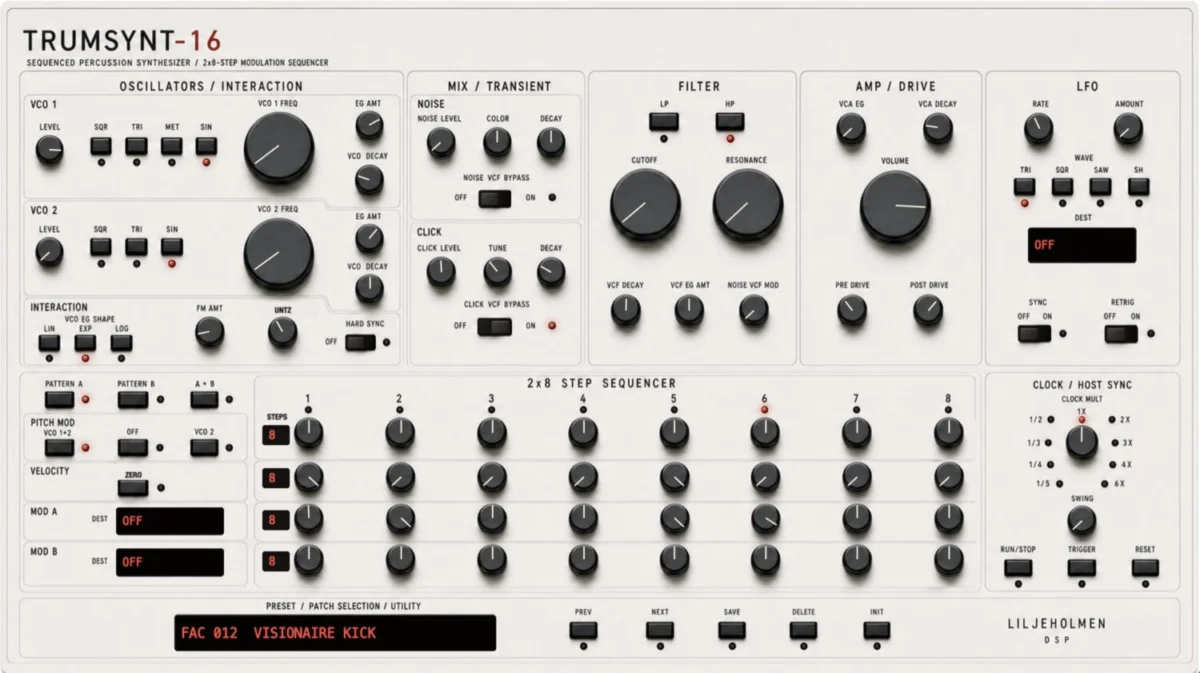
Liljeholmen DSP has officially announced the launch of TRUMSYNT-16, a specialized VST/AU drum synthesizer and percussion sequencer designed to provide a high degree of flexibility for electronic music producers and sound designers. Departing from the traditional "all-in-one" drum machine plugin architecture, TRUMSYNT-16 is built around a "one instance per drum voice" philosophy. This approach allows users to treat each percussive element as a standalone instrument, facilitating granular control over signal routing, individual processing, and complex modulation within a Digital Audio Workstation (DAW).
The software is available immediately for both macOS and Windows platforms, entering a competitive market for dedicated percussion synthesis. By combining a multi-layered synthesis engine with a polymetric sequencer, Liljeholmen DSP aims to bridge the gap between classic analog drum synthesis and modern digital sequencing techniques. The plugin is priced at €49, including VAT, positioning it as an accessible professional tool for creators seeking bespoke drum sounds that transcend standard sample libraries.
Technical Architecture and Synthesis Engine
At the core of TRUMSYNT-16 lies a synthesis engine designed for the creation of diverse percussive timbres, ranging from deep sub-heavy kick drums to sharp, metallic hi-hats and complex industrial textures. The engine utilizes a dual-oscillator configuration as its primary sound source. These oscillators are complemented by dedicated noise and click layers, which are essential for defining the transient characteristics and "snap" of a drum sound.
To shape these sounds, the plugin incorporates a switchable filter capable of operating in either low-pass or high-pass modes. This is followed by integrated drive stages, allowing users to introduce harmonic saturation and grit—a critical component in modern electronic percussion. The synthesis architecture is further refined by six independent decay envelopes. Unlike simplified drum synths that offer a single global decay, TRUMSYNT-16 provides discrete control over different parameters of the sound’s evolution, enabling the user to sculpt the "tail" of the noise layer differently from the pitch decay of the primary oscillator.
This level of detail is intended to satisfy sound designers who find sample-based drum machines too restrictive. By synthesizing every aspect of the hit in real-time, the plugin avoids the "machine gun effect" often associated with static samples, ensuring that each trigger can have subtle, organic variations based on the internal modulation settings.
Advanced Sequencing and Polymetric Capabilities
One of the most distinctive features of TRUMSYNT-16 is its internal sequencer. While many drum plugins rely on the DAW’s piano roll, TRUMSYNT-16 includes a built-in 16-step sequencer divided into two 8-step pages. This sequencer is not merely a trigger source; it is a deep modulation environment.
The sequencer provides independent lanes for Pitch, Velocity, Mod A, and Mod B. Crucially, each of these lanes can have its own independent length. This functionality allows for the creation of polymetric patterns—sequences where different parameters cycle at different intervals. For example, a drum hit might trigger every four steps, while its pitch cycles every five steps and its velocity every seven. This results in a constantly evolving percussive pattern that does not repeat identically for several bars, adding a sense of generative movement to a rhythmic composition.
The inclusion of Mod A and Mod B lanes extends the sequencer’s reach into the synthesis engine’s internal parameters. Users can map these lanes to various destinations, such as filter cutoff or drive intensity, ensuring that the timbre of the drum evolves in lockstep with the rhythm. This integration makes TRUMSYNT-16 a "sequenced percussion synthesizer" in the truest sense, where the rhythm and the sound design are inextricably linked.
Development Context and Market Positioning
The release of TRUMSYNT-16 comes at a time of renewed interest in specialized, single-purpose plugins. For several years, the industry trend favored massive, multi-gigabyte workstations. However, a growing subset of producers has moved back toward modular and semi-modular workflows, where individual components are chosen for their specific sonic character.
Liljeholmen DSP, a developer known for its focus on precision digital signal processing, has designed TRUMSYNT-16 to fit into this modular software ecosystem. By requiring one instance per voice, the plugin encourages a workflow similar to that of a hardware Eurorack system or a classic studio setup where each drum sound occupies its own channel on a mixing desk. This allows for individual EQ, compression, and spatial effects to be applied to the kick, snare, and percussion separately without the need for complex multi-output routing within a single plugin.
Industry analysts note that the €49 price point is strategically chosen. It sits below the cost of flagship drum suites like XLN Audio’s Addictive Drums or Toontrack’s Superior Drummer, which focus on acoustic realism, and competes directly with other boutique synthesis tools like Sonic Charge’s MicroTonic or various Roland Cloud emulations. TRUMSYNT-16 distinguishes itself by prioritizing the "per-voice" workflow and the polymetric sequencer, features that are often missing from vintage-emulation plugins.

Chronology of Percussion Synthesis in Software
To understand the significance of TRUMSYNT-16, it is helpful to look at the timeline of drum synthesis evolution. In the early 2000s, drum plugins were largely divided into two camps: sample players (like Battery) and virtual analog emulations (like the ReBirth RB-338). As CPU power increased, developers began to experiment with physical modeling and more complex FM synthesis for drums.
By the mid-2010s, the "drum machine in a box" became the standard, where a single plugin would contain 8 to 16 pads, an internal mixer, and a master effects rack. While convenient, these plugins often felt "closed off" to producers who wanted to use their high-end outboard gear or specialized third-party plugins on individual drum hits.
TRUMSYNT-16 represents a return to the "component-based" approach that was prevalent in the early days of VST technology but updated with modern DSP algorithms and sequencing features. Its development reflects a broader shift toward "Desktop Modular" workflows, where the DAW acts as a patchbay for various specialized instruments.
Official Specifications and System Compatibility
Liljeholmen DSP has ensured that TRUMSYNT-16 is compatible with the latest industry standards to ensure a wide adoption rate among professional users. The technical specifications are as follows:
- Format (macOS): AU (Audio Units) and VST3. Compatible with Intel and Apple Silicon (M1/M2/M3) architectures.
- Format (Windows): VST3. Optimized for Windows 10 and 11.
- Synthesis Architecture: Dual oscillators, Noise layer, Transient Click layer.
- Filtering: Switchable Low-Pass/High-Pass.
- Saturation: Multi-stage drive engine.
- Envelopes: Six independent decay envelopes for comprehensive amplitude and pitch shaping.
- Sequencer: 16 steps (2×8), independent lane lengths for Pitch, Velocity, and two Modulation lanes.
- Pricing: €49 (VAT included).
The developer has also released a free trial version, allowing potential users to test the synthesis engine and sequencer integration within their specific studio environments before committing to a purchase.
Broader Impact and Implications for the Industry
The launch of TRUMSYNT-16 highlights several emerging trends in the music technology sector. First is the continued decentralization of instrument design. Boutique developers like Liljeholmen DSP are increasingly able to compete with industry giants by focusing on niche workflows and high-quality, specialized sound engines.
Second, the emphasis on polymetric sequencing suggests a growing appetite for "intelligent" or "generative" composition tools. As electronic music matures, the standard 4/4, 16-step loop is often seen as a starting point rather than a destination. Tools that allow for shifting phases and evolving patterns—without requiring complex manual automation—are becoming essential for modern techno, IDM, and ambient production.
Finally, the move toward VST3-only support on Windows reflects the industry’s gradual phasing out of the aging VST2 standard. This ensures better stability, lower CPU overhead, and improved handling of MIDI and automation data, which is crucial for a plugin that relies heavily on its internal sequencer for modulation.
Reactions from the Sound Design Community
While formal reviews are still pending, early reactions from the synthesis community have been positive, particularly regarding the plugin’s "per-voice" architecture. Many users have expressed that this setup simplifies the mixing process, as it eliminates the need for "unwrapping" multi-output plugins, which can often be a cumbersome process in DAWs like Ableton Live or Logic Pro.
Sound designers have also noted that the "six independent decay envelopes" provide a level of control usually reserved for high-end hardware like the Elektron Machinedrum or specialized Eurorack modules like the Basimilus Iteritas Alter. The ability to precisely tune the decay of the "click" versus the "thump" of a kick drum is a specific requirement for high-fidelity club music, and TRUMSYNT-16 appears to address this need directly.
In conclusion, Liljeholmen DSP’s TRUMSYNT-16 stands as a robust entry into the world of drum synthesis. By prioritizing a modular workflow, deep modulation via its polymetric sequencer, and a sophisticated multi-layered engine, it offers a compelling alternative to both sample-based libraries and traditional all-in-one drum machine plugins. As producers continue to seek unique sonic identities in an increasingly crowded market, tools like TRUMSYNT-16 provide the necessary parameters to build rhythms from the ground up, one voice at a time.
