

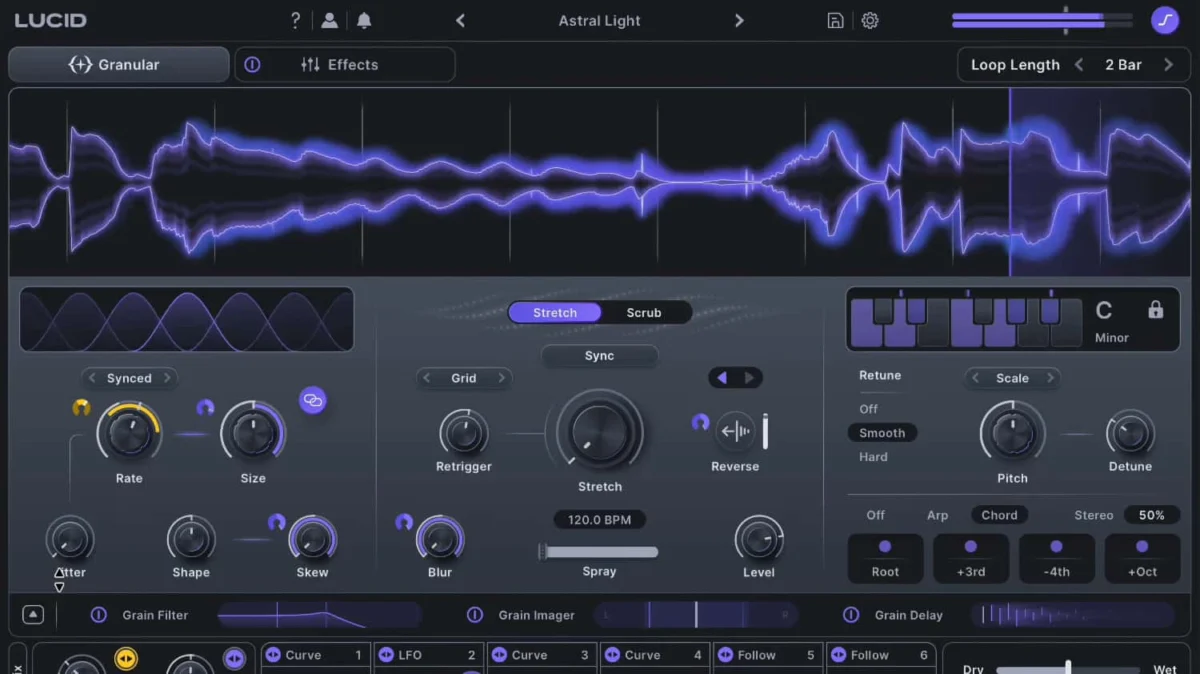
Minimal Audio, a prominent developer in the digital signal processing industry, has officially announced the release of Lucid, a sophisticated granular audio effect plugin designed to facilitate the creation of evolving textures and complex soundscapes. The software represents a significant addition to the company’s expanding portfolio of creative tools, aiming to bridge the gap between traditional audio manipulation and high-concept sound design. By utilizing granular synthesis—a method of breaking down audio into microscopic segments known as "grains"—Lucid allows musicians, sound designers, and film composers to deconstruct incoming signals and reassemble them into entirely new sonic entities. The plugin is currently available for both macOS and Windows platforms, entering a competitive market of granular processors with a focus on streamlined workflow and high-fidelity output.
The Mechanics of Granular Synthesis in Lucid
At its core, Lucid operates by sampling incoming audio in real-time or from pre-recorded buffers and slicing that audio into grains that range from a few milliseconds to several hundred milliseconds in length. The power of the plugin lies in its ability to manipulate these grains independently of the original audio’s tempo or pitch. Users can control the density of the grain stream, the size of individual segments, and the "spray" or randomness of their playback position. This allows for the creation of everything from subtle rhythmic echoes to dense, impenetrable clouds of sound.
The architecture of Lucid is built around a high-performance engine that ensures smooth playback even when hundreds of grains are being processed simultaneously. This technical capability is essential for professional environments where digital artifacts or "clicking" at grain boundaries can compromise the quality of a recording. To mitigate these issues, Minimal Audio has implemented advanced windowing functions, which apply micro-fades to the start and end of each grain, ensuring a seamless transition and a cohesive overall texture.
Technical Specifications and Feature Set
Lucid offers a comprehensive suite of controls that allow for granular manipulation across four primary dimensions: timing, pitch, position, and character. The timing controls dictate how frequently new grains are spawned, allowing for synchronized rhythmic patterns or asynchronous, organic flows. Pitch manipulation allows users to shift the tonal center of the grains, often creating shimmering harmonic layers or deep, resonant drones that bear little resemblance to the source material.
One of the standout features of the software is its "Character" section, which provides specialized processing to alter the timbre of the granulated output. This includes built-in filters and spatial enhancement tools that help the processed sound sit effectively within a mix. Additionally, Lucid features a robust modulation system, a hallmark of Minimal Audio’s design philosophy. Users can map internal modulators, such as LFOs and envelope followers, to virtually any parameter within the plugin. This enables the creation of "living" sounds that shift and breathe over time, reacting to the input signal or internal timers.
The plugin also includes a dedicated effects chain, featuring high-quality reverb and delay modules specifically tuned for granular textures. By integrating these effects directly into the plugin, Minimal Audio provides a self-contained environment for sound transformation, reducing the need for external processing chains and lowering the CPU overhead for complex projects.
A Chronology of Minimal Audio’s Product Evolution
The launch of Lucid marks a specific milestone in the timeline of Minimal Audio, a company that has rapidly gained a reputation for innovative DSP (Digital Signal Processing) solutions. The company first rose to prominence with the release of "Rift," a multi-polar distortion plugin that challenged traditional concepts of saturation. Following the success of Rift, Minimal Audio expanded into spectral processing and synthesis with "Current," a flagship virtual instrument that integrated many of their standalone effects into a single ecosystem.
In the 18 months leading up to the release of Lucid, the company focused on refining its user interface (UI) standards and optimizing its audio engines for silicon-based processing (Apple M-series chips) and modern Windows environments. The development of Lucid can be seen as a response to the growing demand for "textural" music—a trend heavily influenced by the rise of ambient music, cinematic underscores, and experimental electronic genres. By isolating the granular engine from their larger synthesizers and presenting it as a dedicated effect, Minimal Audio has targeted a broader demographic of users who may already have preferred sound sources but require advanced transformation tools.
Market Positioning and Pricing Strategy
The granular synthesis market is currently occupied by several high-profile competitors, including Output’s "Portal," Arturia’s "Efx Fragments," and various Max for Live devices. Minimal Audio has positioned Lucid as a premium yet accessible alternative. The introductory pricing of $79 USD, relative to the standard retail price of $129 USD, suggests a strategic move to capture market share quickly among early adopters and home studio enthusiasts.
Industry analysts note that the $100 to $150 price bracket is the most competitive sector of the plugin market. By offering a significant launch discount, Minimal Audio incentivizes its existing user base—those who already own Rift or Fuse Compressor—to expand their toolkit. Furthermore, the inclusion of Lucid in the company’s "All Access" subscription model ensures that professional users who prefer recurring payments over perpetual licenses have immediate access to the new technology.
Broader Implications for Audio Production and Sound Design
The release of Lucid reflects a larger shift in the music production industry toward "generative" workflows. In modern production, the role of the engineer is increasingly overlapping with that of the sound designer. Tools like Lucid allow for a "set and forget" approach where a simple vocal line or guitar loop can be fed into the plugin to generate hours of unique, non-repeating background material. This is particularly valuable in the world of video game audio and film scoring, where long-form atmospheric textures are required to fill space without distracting from the narrative.
Furthermore, the democratization of granular synthesis through intuitive interfaces like Lucid’s reduces the barrier to entry for experimental techniques. Historically, granular synthesis required specialized knowledge of programming environments like Csound or SuperCollider. Modern plugins have translated these complex mathematical processes into visual, interactive experiences, allowing a wider range of creators to explore complex sonic territories.
Official Responses and Professional Feedback
While official statements from Minimal Audio emphasize the "creative freedom" and "sonic depth" of the plugin, early feedback from professional beta testers highlights the efficiency of the workflow. Producers have noted that the visual feedback—showing the grains moving across the waveform in real-time—is instrumental in understanding how the audio is being deconstructed.
A spokesperson for the development team indicated that the primary goal with Lucid was to create a "musical" granular processor. Unlike some granular tools that can sound harsh or overly digital, Lucid’s grain engine and internal filtering were reportedly tuned to maintain a sense of musicality, even at extreme settings. This focus on aesthetic output over purely clinical manipulation has been a recurring theme in Minimal Audio’s product descriptions and marketing materials.
System Requirements and Availability
Lucid is available for immediate download via the Minimal Audio website and authorized retailers. It supports VST, VST3, AU, and AAX formats, ensuring compatibility with all major Digital Audio Workstations (DAWs) including Ableton Live, Logic Pro, FL Studio, Cubase, and Pro Tools.
On the hardware side, the plugin is optimized for modern multi-core processors. For macOS users, it requires version 10.11 or higher and offers native support for Apple Silicon. Windows users require Windows 10 or 11 with an X64 CPU. The installation process is managed via the Minimal Audio dynamic installer, which streamlines license activation and updates.
Analysis of the Granular Trend in Digital Audio
The proliferation of granular effects like Lucid suggests that the industry is moving away from the "perfection" of digital recording and toward the "imperfection" of manipulated data. Granular synthesis, by its nature, introduces a level of unpredictability. As digital music has become increasingly quantized and grid-aligned, there is a counter-movement seeking organic, shifting, and "unstable" sounds.
Lucid fits perfectly into this paradigm. By providing a controlled environment for chaos, it allows producers to inject a sense of humanity and randomness into digital compositions. The data suggests that as AI-generated music and automated mixing tools become more prevalent, the value of unique, hand-crafted (or "hand-transformed") sound design will likely increase. Tools like Lucid are at the forefront of this shift, providing the means for artists to maintain a distinct sonic identity in an increasingly crowded digital landscape.
In conclusion, Minimal Audio’s Lucid is more than just a new effect; it is a reflection of current trends in audio technology that prioritize texture, movement, and transformation. With its competitive entry price and robust feature set, it is poised to become a staple in the arsenals of modern producers looking to push the boundaries of conventional sound. As the industry continues to evolve, the ability to deconstruct and reimagine audio will remain a cornerstone of creative expression, and Lucid provides a powerful, modern gateway to those possibilities.
