

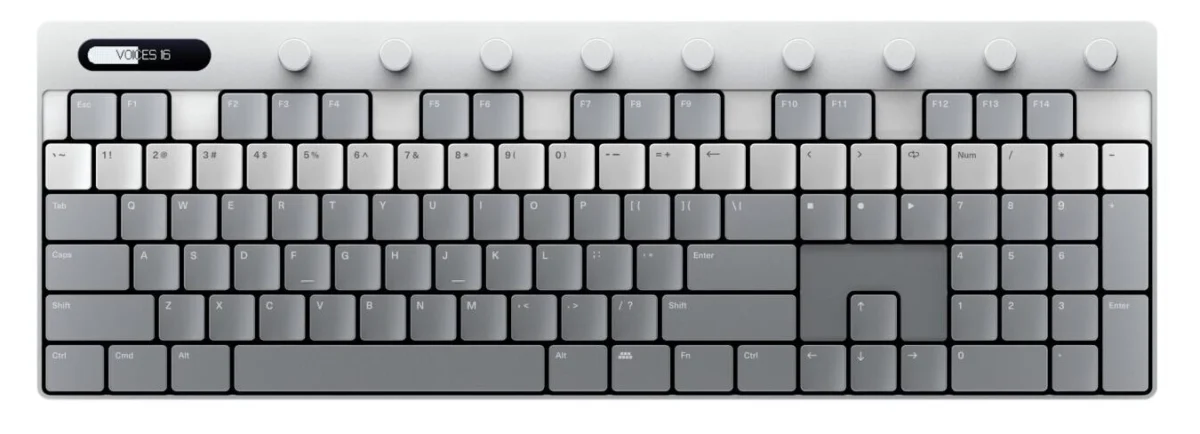
The landscape of professional music production and digital workspace management has undergone a significant shift with the introduction of the Polyend Keys, a device that seeks to merge the high-tactility world of mechanical keyboards with the precise requirements of MIDI instrumentation. Announced ahead of its public debut at Gamescom in Cologne, Germany, the Polyend Keys represents a departure from traditional peripheral design by offering a dual-purpose interface. It functions as a standard QWERTY keyboard for everyday computing while simultaneously serving as a three-octave MIDI controller, aimed at streamlining the workflow of modern producers who often struggle with limited desk real estate and the ergonomic challenges of switching between typing and playing.
The core of the Polyend Keys is its unique layout, which utilizes the number row and function keys to create a three-octave piano-style interface. While many digital audio workstations (DAWs) allow users to use a standard computer keyboard to trigger notes, the Polyend Keys formalizes this process through a hardware-level integration. This ensures that the tactile feedback and latency are optimized for musical performance, a significant upgrade over the standard membrane or butterfly switches found on typical office keyboards. By integrating these three octaves directly into the upper rows of the device, Polyend allows musicians to record melodies, input chords, or control external hardware without removing their hands from their primary input device.
Hardware Engineering and Build Quality
The physical construction of the Polyend Keys reflects a commitment to durability and professional-grade aesthetics. The chassis is machined from a single block of aluminum, providing a rigid and stable foundation that prevents the flexing often associated with plastic MIDI controllers or consumer-grade keyboards. This choice of material is particularly relevant for touring musicians or those working in high-intensity studio environments where equipment longevity is paramount.
Underneath the keycaps, the Polyend Keys utilizes Kailh low-profile mechanical switches. These switches are favored by enthusiasts for their shorter travel distance and faster actuation compared to full-height mechanical switches, making them ideal for both rapid typing and the rhythmic precision required for MIDI performance. Furthermore, the keyboard features a hot-swappable PCB, allowing users to change individual switches without the need for soldering. This modularity ensures that the device can be customized for specific tactile preferences—such as clicky, tactile, or linear feedback—and simplifies the repair process should a single key fail over time.
Connectivity is another area where the Polyend Keys demonstrates versatility. The device supports both wired and wireless operation. For low-latency studio work, a USB connection provides power and data transfer. For mobile setups or minimalist desk arrangements, Bluetooth connectivity allows the keyboard to function without cables. Additionally, the inclusion of a TRS MIDI output is a critical feature for hardware enthusiasts. This port enables the Polyend Keys to control synthesizers, drum machines, and other external MIDI gear directly, bypassing the need for a computer or an intermediate MIDI interface.
Integrated Controls and Visual Feedback
Beyond the keys themselves, the device incorporates nine rotary controls, often referred to as encoders. These knobs are freely assignable, meaning they can be mapped to various functions depending on the user’s current task. In a musical context, these encoders typically control MIDI Continuous Controllers (CC), allowing for the real-time manipulation of parameters such as filter cutoff, resonance, volume, or effects dry/wet mixes within a DAW.

When the device is used for general computing, these encoders can be remapped to handle system-level functions. Users can assign them to control system volume, screen brightness, or document scrolling, effectively turning the keyboard into a productivity hub. This dual-purpose design is supported by an integrated display located on the device. This screen provides immediate visual feedback, showing the values of the parameters being adjusted and facilitating navigation through the keyboard’s various modes and settings.
The inclusion of a built-in rechargeable battery further enhances the "standalone" capabilities of the Polyend Keys. When paired with the TRS MIDI output, the keyboard can operate independently of a computer, serving as a portable controller for a modular synth rig or a hardware-based studio. This portability is a strategic move by Polyend to capture the growing market of "DAW-less" musicians who prefer tactile hardware over software-centric workflows.
Open Source Architecture and Software Flexibility
One of the most significant aspects of the Polyend Keys is its open-source nature. In an industry where hardware is often locked behind proprietary firmware, Polyend’s decision to allow for software expansion is a notable exception. The open-source software model means that the developer community can create alternative layouts, specialized control modes, or entirely new applications for the device.
Potential community-driven features could include custom sequencers, specialized MIDI mapping for specific software instruments, or even integration with niche operating systems. This flexibility ensures that the Polyend Keys is not a static product but an evolving platform. For power users and developers, this provides a level of future-proofing that is rarely seen in the MIDI controller market. It allows the hardware to adapt to changing software standards and user needs long after its initial release.
Contextualizing the Polyend Keys in the Current Market
The release of the Polyend Keys comes at a time when the "home studio" market is seeing unprecedented growth. According to industry data, the global MIDI controller market has expanded significantly since 2020, driven by the rise of content creation, remote collaboration, and the democratization of music production tools. However, as studios become more compact, the demand for multi-functional devices has risen.
Polyend, a company based in Poland, has built a reputation for innovative and often unconventional music hardware. Their previous products, such as the Polyend Tracker and the Polyend Play, challenged traditional notions of music sequencing and sampling. The Polyend Keys follows this lineage by addressing a common pain point: the physical clutter of having both a typing keyboard and a MIDI keyboard on a desk. By combining these two essential tools into a single, high-quality unit, Polyend is targeting a niche yet growing demographic of "hybrid" creators—individuals who spend as much time writing code or emails as they do composing music.
Market analysts suggest that the "mechanical keyboard" trend is also a major factor in the potential success of this product. The mechanical keyboard community has seen a surge in interest over the last five years, with users willing to pay premium prices for superior tactile experiences and customizability. By entering this space, Polyend is not just competing with MIDI controller manufacturers like Akai or Novation, but also with boutique keyboard brands like Keychron or Glorious.

Gamescom Debut and Chronology of Development
The public unveiling of the Polyend Keys at Gamescom in Cologne (August 26–30) is a strategic choice. While Gamescom is primarily a video game trade fair, the intersection between gaming, streaming, and music production has become increasingly blurred. Many gamers utilize high-end mechanical keyboards and are also involved in digital content creation, making them a prime audience for a device that offers professional-grade performance in both sectors.
While Polyend has released the core specifications and features of the Keys, the timeline for mass production and retail availability remains under development. The company has stated that pricing and official release dates are forthcoming, noting that specifications and color options may be subject to refinement based on feedback received during the Gamescom exhibition. Historically, Polyend has followed an announcement-to-release window of several months, suggesting that the Keys could reach consumers by late 2024 or early 2025.
Broader Impact and Industry Implications
The introduction of the Polyend Keys may prompt other manufacturers to reconsider the design of "utility" peripherals. For years, the separation between "office tools" and "creative tools" has been a standard industry assumption. Polyend’s intervention suggests that these categories are no longer mutually exclusive.
From a technical standpoint, the challenge for Polyend will be ensuring that the device excels in both of its primary roles. A keyboard that is good for music but poor for typing—or vice versa—will fail to meet the expectations of its target audience. However, by utilizing established mechanical switch technology and a robust aluminum build, Polyend appears to have addressed the hardware requirements of both worlds.
The move toward open-source firmware also sets a precedent for transparency in hardware. As users become more tech-savvy, the ability to "own" the software running on their devices becomes a significant selling point. This could lead to a shift in how MIDI controllers are marketed, moving away from closed ecosystems and toward collaborative, community-supported platforms.
In summary, the Polyend Keys is more than just a peripheral; it is a statement on the changing nature of the digital workspace. By prioritizing build quality, tactile feedback, and software flexibility, Polyend is positioning itself at the center of the convergence between professional music production and high-end computing. As the industry watches the reception of the device at Gamescom, the Polyend Keys stands as a bold experiment in ergonomic and functional integration.
