

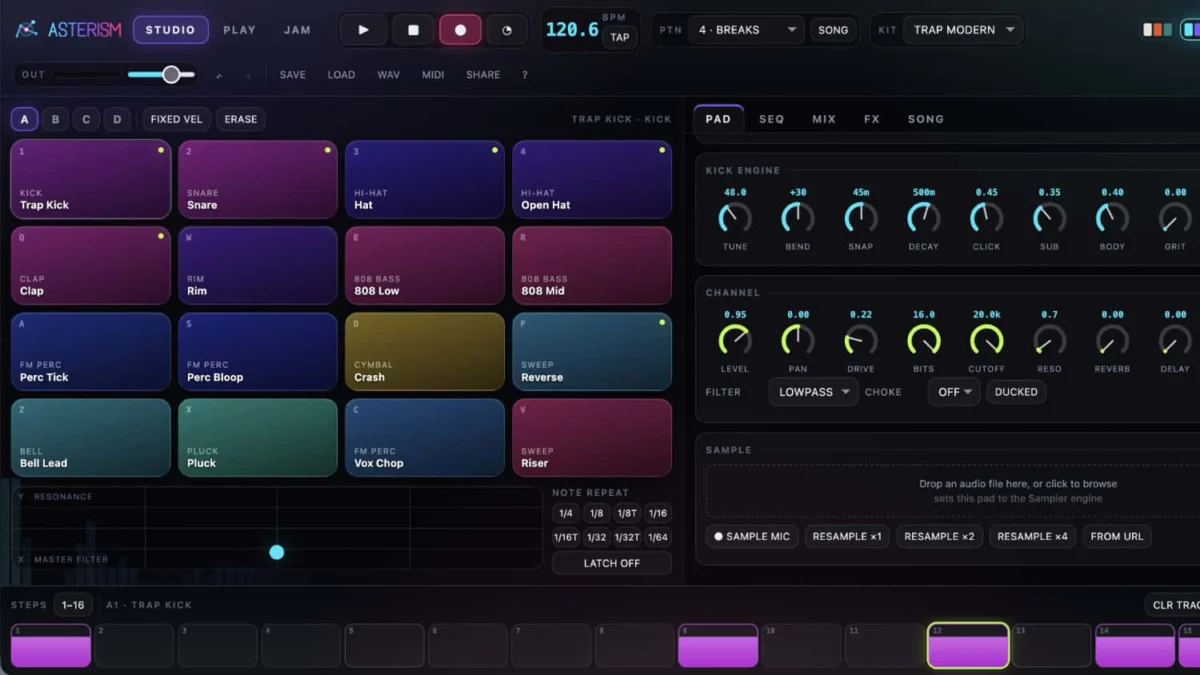
Asterism has officially debuted as a sophisticated, browser-based drum machine and sequencer, offering a streamlined yet powerful environment for rhythmic composition without the need for traditional software installation. As a free-to-use platform, Asterism leverages the capabilities of modern web browsers to provide a suite of classic and contemporary electronic drum kits, alongside advanced sequencing features typically reserved for high-end digital audio workstations (DAWs) or specialized hardware. By integrating kits such as the Neon 909, 808, Lo-Fi Tape, Industrial, and Trap, the platform addresses a broad spectrum of musical genres, ranging from retro-inspired synthwave to modern hip-hop and experimental electronic music.
The Technical Architecture of Browser-Based Audio
The emergence of Asterism represents a significant milestone in the ongoing evolution of the Web Audio API, a high-level JavaScript API for processing and synthesizing audio in web applications. Unlike early web-based musical tools that suffered from high latency and limited polyphony, Asterism utilizes contemporary processing techniques to ensure that rhythmic playback remains sample-accurate. This technical foundation allows the sequencer to handle complex tasks such as parameter locking and ratcheting in real-time, providing a user experience that rivals native desktop applications.
For independent producers and hobbyists, the barrier to entry for music production has historically been high, often requiring expensive hardware or resource-intensive software licenses. Asterism bypasses these requirements by operating entirely within the browser environment. This "cloud-native" approach to sound design facilitates immediate creativity, allowing users to transition from ideation to a fully realized beat in a matter of seconds. The inclusion of built-in preset patterns, such as "Boom Bap," "Four on the Floor," and "Halftime," further lowers this barrier, providing a structural starting point for users across various skill levels.
Sound Engines and Sonic Versatility
At the core of Asterism’s appeal is its diverse library of drum kits, each meticulously curated to reflect specific eras and subcultures of electronic music. The "808" and "Neon 909" kits pay homage to the Roland TR-808 and TR-909 Rhythm Composers, instruments that defined the sound of house, techno, and early hip-hop. These digital recreations aim to capture the punchy transients and deep decay characteristics that have made these sounds staples of the industry for over four decades.
In contrast, the "Lo-Fi Tape" kit addresses the contemporary demand for "warmth" and "saturation," mimicking the harmonic distortion and frequency roll-off associated with vintage analog recording equipment. The "Industrial" kit provides harsher, more metallic textures suitable for aggressive electronic genres, while the "Trap" kit focuses on the sharp, high-frequency hats and heavy sub-basses required for modern chart-topping productions. This versatility ensures that Asterism is not merely a novelty tool but a functional asset for diverse creative projects.
Advanced Sequencing and Algorithmic Composition
Beyond simple loop playback, Asterism introduces advanced sequencing tools that cater to professional workflows. One of the most notable features is parameter locking, a concept popularized by hardware manufacturers like Elektron. Parameter locking allows users to assign specific values for effects, pitch, or decay to individual steps in a sequence. This means a single drum sound can evolve over the course of a loop, adding movement and organic variation that prevents the "robotic" feel often associated with digital sequencers.
Furthermore, the platform includes "ratcheting"—a technique where a single step is divided into multiple smaller triggers. This is a foundational element in modern trap music (often heard in rapid-fire hi-hat rolls) and was a hallmark of the "Berlin School" of electronic music in the 1970s. By making ratcheting accessible via a simple interface, Asterism enables users to create complex, polyrhythmic textures that would be difficult to program manually in a standard grid.
The inclusion of randomization features serves as a powerful antidote to creative stagnation. Users can randomize specific parameters or entire patterns, allowing the software to suggest rhythmic variations that the human ear might not instinctively conceive. This algorithmic approach to composition is increasingly favored in the electronic music community as a way to discover new sonic territories.
Historical Context and the Evolution of the Web DAW
The launch of Asterism follows a decade of rapid advancement in web-based music technology. In the early 2010s, platforms like Audiotool and various Roland 808 emulators demonstrated that browsers could handle basic synthesis. However, these early iterations often struggled with MIDI integration and export quality. As Google’s Chrome and Mozilla’s Firefox improved their handling of multi-threaded audio processing, the potential for "Professional Web Audio" (PWA) began to materialize.

The timeline of this development is marked by key releases:
- 2011: Introduction of the Web Audio API.
- 2015: Rise of browser-based synthesizers and the first stable MIDI-over-USB browser support.
- 2020-2023: Increased adoption of remote collaboration tools, leading to a surge in browser-based creative suites.
- 2024: The debut of Asterism, which synthesizes these historical advancements into a refined, performance-ready drum machine.
This chronology suggests a shift in the industry where the "operating system" is becoming less relevant than the "browser environment," allowing for cross-platform compatibility that includes Windows, macOS, Linux, and even mobile operating systems.
Market Trends and the Democratization of Production
The release of free tools like Asterism aligns with broader market data regarding the democratization of music production. According to industry reports, the global music production software market is projected to grow significantly through 2030, driven largely by an influx of "prosumers"—individuals who operate between the amateur and professional levels. These users typically seek high-quality tools that do not require the steep learning curves or financial investments of legacy DAWs like Pro Tools or Ableton Live.
Data indicates that the accessibility of free, high-quality web tools has led to a diversification of the music industry. Producers from emerging markets, who may not have access to high-end hardware, are now able to compete on a global scale using nothing more than a standard laptop and an internet connection. Asterism fits perfectly into this ecosystem, providing a "pro-sumer" experience for zero cost.
Industry Perspectives and Official Implications
While the developers of Asterism have focused on the user experience, industry analysts view the platform as a challenge to established software vendors. The "freemium" or entirely free model of browser tools forces traditional companies to innovate more rapidly. By providing "parameter locking" and "ratcheting" for free, Asterism sets a new baseline for what users expect from entry-level software.
Inferred reactions from the developer community suggest that Asterism was designed with "creative immediacy" as its primary goal. The logic is that the faster a user can go from an idea to a sound, the more likely they are to remain engaged with the creative process. In a world of digital distractions, the ability to open a tab and immediately start composing is a significant competitive advantage.
From an educational standpoint, Asterism offers immense value. Music educators can now provide students with a powerful drum machine that requires no installation, making it ideal for use in computer labs with restricted administrative rights. This facilitates a "learn-by-doing" approach to rhythm and synthesis that was previously hindered by logistical and financial barriers.
Broader Impact and the Future of Music Technology
The implications of Asterism extend beyond the immediate gratification of making beats. It represents a move toward a more modular and decentralized future for music technology. As internet speeds increase with the rollout of 5G and fiber-optic networks, the distinction between a local app and a web app will continue to blur. Future iterations of tools like Asterism could potentially include collaborative "jam" sessions, where multiple users in different parts of the world edit the same sequence in real-time.
Furthermore, the "parameter locking" and "randomization" features in Asterism point toward a future where AI and machine learning play a larger role in assistive composition. While Asterism currently uses fixed algorithms for its randomization, the framework is now in place for more sophisticated generative music systems to be integrated into the browser.
In conclusion, Asterism is more than just a free drum machine; it is a testament to the power of modern web technology and a harbinger of a more accessible creative future. By combining the soul of vintage hardware with the flexibility of modern software, it provides a robust platform for the next generation of electronic music producers. Whether used as a primary composition tool or a quick sketchpad for ideas, Asterism stands as a significant contribution to the digital audio landscape, proving that professional-grade tools can be both free and accessible to all.
