

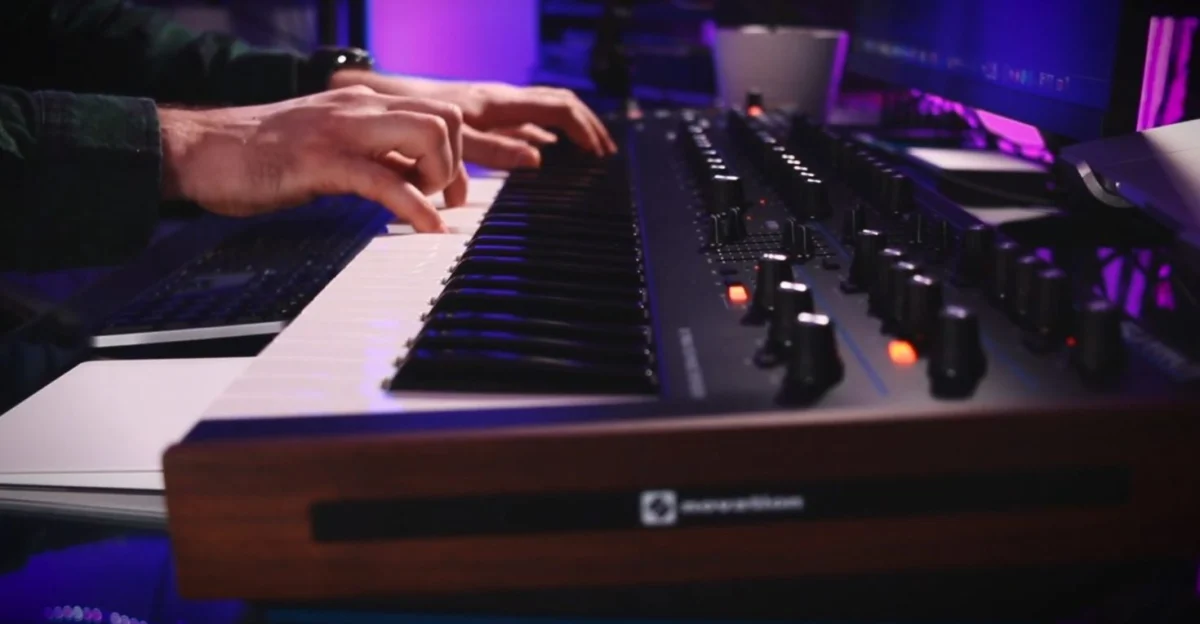
The Novation Summit has emerged as a focal point of discussion in the electronic music community following a comprehensive technical overview and demonstration by renowned synthesist and composer David Hilowitz. As a flagship 16-voice, dual-part bi-timbral digital-analog hybrid synthesizer, the Summit represents the pinnacle of Novation’s engineering, effectively doubling the power of its predecessor, the Peak, while introducing a professional-grade 61-note keyboard and expanded control interface. Hilowitz’s presentation, while noted as a sponsored collaboration with the manufacturer, serves as a high-level educational resource that dissects the instrument’s architecture, from its proprietary New Oxford Oscillators to its sophisticated analog signal path. The instrument currently maintains a significant position in the high-end synthesizer market with a retail street price of approximately $2,900 USD, positioning it as a direct competitor to other flagship polyphonic synthesizers from established manufacturers.
Technical Architecture and the New Oxford Oscillators
At the core of the Novation Summit’s sonic identity is the New Oxford Oscillator (NCO) system, designed by the late legendary synthesizer engineer Chris Huggett. Unlike traditional digital oscillators that rely on standard Digital Signal Processing (DSP) chips, the Summit utilizes a Field Programmable Gate Array (FPGA). This hardware-level flexibility allows the oscillators to run at an exceptionally high sample rate—reportedly in the megahertz range—effectively eliminating the "aliasing" artifacts often associated with digital synthesis. By operating at such extreme resolutions, the NCOs can generate waveforms that possess the organic instability and richness of analog oscillators while retaining the tuning stability and complex modulation capabilities of digital systems.
The Summit’s hybrid design philosophy is predicated on using digital technology where it excels—oscillator precision and complex wavetable generation—and analog technology where it provides the most harmonic character, specifically in the filtering and amplification stages. Each of the 16 voices features three NCOs, providing a massive palette for sound design. These oscillators are not limited to standard subtractive waveforms like sawtooth, square, and pulse; they also support 60 built-in wavetables and allow for user-uploaded custom wavetables via the Novation Components software. This versatility enables the Summit to pivot seamlessly between classic 1980s analog textures and modern, evolving digital soundscapes.
Evolution from the Peak and Design Chronology
The development of the Summit is a direct evolution of the Novation Peak, which was released in 2017 to critical acclaim. While the Peak provided an eight-voice desktop solution, professional performers and studio composers expressed a demand for a version that integrated a high-quality keybed and expanded multitimbral capabilities. Novation responded in 2019 with the announcement of the Summit, which essentially houses two Peak engines within a single chassis.
The chronological progression of Novation’s flagship line highlights a shift toward "bi-timbral" performance. In the Summit, the 16 voices can be split or layered across the keyboard. This allows a musician to play a deep, evolving pad with the left hand while performing a sharp, percussive lead with the right, or to layer two distinct sounds to create a complex, composite timbre that would be impossible on a single-part synthesizer. The inclusion of a 61-note, semi-weighted Italian-made Fatar keybed with aftertouch further solidified the Summit’s status as a "player’s instrument," moving it beyond the realm of a mere sound module.
The Analog Signal Path and Filter Design
While the oscillators provide the raw material, the Summit’s character is largely defined by its analog signal path. Each voice passes through a true analog multimode filter based on the design of the classic WASP synthesizer, another of Chris Huggett’s historical contributions to the industry. The filter can be configured in various slopes (12dB or 24dB per octave) and modes (low-pass, high-pass, and band-pass). A unique feature of the Summit is its dual-filter architecture, which allows for parallel or series routing, enabling complex frequency shaping that mimics the behavior of vocal formants or high-end acoustic resonators.
Following the filter, the signal enters an analog Voltage Controlled Amplifier (VCA) and three distinct stages of analog distortion: pre-filter, post-filter, and a global master distortion. This "three-stage" approach to saturation allows users to add subtle warmth or aggressive grit without losing the fundamental clarity of the digital oscillators. The integration of these analog components ensures that even the most complex digital wavetables are imbued with the harmonic saturation and "weight" typically associated with vintage hardware.
Control Interface and Workflow Integration
David Hilowitz’s demonstration emphasizes the "one-knob-per-function" philosophy that dominates the Summit’s front panel. In an era where many powerful synthesizers require deep menu diving, the Summit provides immediate physical access to the most critical parameters. The panel includes dedicated sections for the three oscillators, the dual filters, three Envelopes (ADSR), and two Low Frequency Oscillators (LFOs). Additionally, there is a dedicated FM (Frequency Modulation) section on the panel, allowing for the cross-modulation of oscillators without needing to access a digital screen.
For modern studio integration, the Summit utilizes the Novation Components platform. This browser-based or standalone software allows users to manage patches, back up sound banks, and, most importantly, import custom wavetables. This bridge between hardware and software ensures that the instrument remains future-proof, as Novation has historically provided firmware updates that add new features, such as expanded modulation matrices or additional effects types, based on community feedback.
Market Positioning and Comparative Analysis
The $2,900 price point places the Novation Summit in the upper echelon of the synthesizer market, where it competes with instruments such as the Sequential Prophet Rev2, the Arturia PolyBrute, and the Waldorf Quantum. When compared to the Prophet Rev2, the Summit offers a broader sonic palette due to its wavetable and FM capabilities, whereas the Rev2 focuses more strictly on traditional analog subtractive synthesis. Against the Arturia PolyBrute, the Summit provides a higher voice count (16 versus 6), which is a significant advantage for composers working with long-release pads or complex layered sequences.
Data from retail trends and user forums suggest that the Summit is particularly favored by film and game composers—a demographic David Hilowitz represents. The ability to create cinematic textures that combine the "breath" of analog with the "precision" of digital makes it a versatile tool for scoring. Furthermore, the bi-timbral nature of the instrument provides a cost-effective alternative to purchasing two separate eight-voice synthesizers, saving both studio space and budget.
Industry Implications and Future Outlook
The continued relevance of the Novation Summit, several years after its initial release, speaks to the stability of hybrid synthesis technology. As software synthesizers become increasingly powerful, hardware manufacturers have had to justify the physical existence of their instruments through superior tactile interfaces and unique sonic characteristics that are difficult to replicate in code. The Summit’s use of FPGA technology represents a middle ground, offering the flexibility of software with the dedicated power and low latency of hardware.
Industry analysts note that the "flagship" synthesizer market is currently experiencing a renaissance, driven by a desire for instruments that can serve as the "brain" of a studio. The Summit’s inclusion of external audio inputs—allowing users to process other instruments through its analog filters and digital effects—positions it as more than just a sound generator; it is a central processing hub. The digital effects engine, which includes high-resolution reverb, delay, and chorus, is often cited by users as being of "pedal-quality," further reducing the need for external processing.
Conclusion: The "Perfect" Subtractive Synthesizer?
The title of Hilowitz’s video poses a provocative question: is the Novation Summit the perfect subtractive synth? While "perfection" in musical instruments is subjective, the data and technical specifications suggest that the Summit is one of the most balanced synthesizers currently available. It successfully bridges the gap between the past and the future, utilizing the legacy of Chris Huggett’s analog designs while pushing the boundaries of what digital oscillators can achieve through FPGA technology.
For the professional musician, the Summit offers a high-voice-count, multitimbral powerhouse that excels in both live performance and studio environments. For the sound designer, it provides a deep, modulation-rich architecture that rewards exploration. As the synthesizer market continues to evolve, the Novation Summit remains a benchmark for how hybrid technology can be implemented to create an instrument that is greater than the sum of its parts. Its price, while significant, reflects the high-grade components and the dual-engine architecture that have made it a modern classic in the world of electronic music production.
