

The year 1985 marked a transformative era in the landscape of popular music, defined by the rise of music videos and the transition from analog to digital recording. At the center of this shift was "Money for Nothing," a track that would not only define the career of the British rock band Dire Straits but also become an indelible symbol of the MTV generation. While Dire Straits had enjoyed significant success since their 1978 debut with the Top 5 hit "Sultans of Swing," it was this collaborative effort between frontman Mark Knopfler and Sting that propelled the band to the absolute pinnacle of the American charts. Spending three weeks at the No. 1 spot on the Billboard Hot 100, "Money for Nothing" remains the band’s most commercially successful single and a masterclass in the intersection of rock instrumentation and pop-culture commentary.
The song was the lead single from Brothers in Arms, the band’s fifth studio album. While the track is celebrated for its iconic, gritty guitar riff and its pioneering computer-animated music video, its origins are rooted in a chance encounter in a New York City appliance store and a serendipitous holiday taken by one of the world’s biggest pop stars.
The Genesis of a Narrative: An Appliance Store in New York
The lyrical inspiration for "Money for Nothing" was far removed from the glamorous world of rock stardom. Mark Knopfler, the band’s lead guitarist and primary songwriter, was in an appliance store in New York City when he overheard a delivery man watching a wall of televisions tuned to MTV. The man was providing a running commentary on the music videos he saw, expressing a mix of bewilderment and disdain for the "rock stars" on the screen.
Knopfler, struck by the authenticity of the man’s voice and the irony of the situation, began surreptitiously jotting down the man’s comments on a scrap of paper. Lines like "We got to move these refrigerators" and "We got to move these color TVs" were lifted directly from the delivery man’s complaints. The song’s perspective is essentially a character study; it is written from the point of view of a working-class individual who views the music industry as an easy way to get "money for nothing and chicks for free." This narrative device allowed Knopfler to comment on the artifice of the 1980s music scene while simultaneously benefiting from its massive reach.
The Sting Connection: A Melodic Borrowing
The track is famously credited to both Mark Knopfler and Sting, the lead singer of The Police. This partnership was not originally planned as a formal co-writing session. The collaboration began when Knopfler realized that the hook he had written for the song’s introduction—the iconic "I want my MTV" line—shared a melodic DNA with The Police’s 1980 hit "Don’t Stand So Close to Me."
At the time of the recording, Dire Straits was working at AIR Studios in Montserrat, a Caribbean island that was a hub for elite musicians in the 1980s. By chance, Sting was vacationing on the island. Knopfler, who had previously performed with The Police during various festivals in Germany, reached out to Sting to see if he would provide backing vocals.
Knopfler later recalled the ease of the collaboration. Because the melody for the "I want my MTV" refrain used the same five-note sequence as "Don’t Stand So Close to Me," Knopfler insisted on giving Sting a co-writing credit. This was a preemptive move to avoid copyright disputes, but it also reflected the genuine contribution Sting made to the track’s atmosphere. When Sting arrived at the studio, he reportedly expressed surprise at the professional and calm environment, famously asking, "What’s wrong? Nobody’s fighting!" This was a subtle nod to the internal tensions that were beginning to fracture The Police at the time.
Technical Innovation and the Iconic Guitar Tone
Beyond its lyrical content, "Money for Nothing" is revered for its production quality. Brothers in Arms was one of the first albums to be recorded on a Sony 24-track digital recorder. This move toward digital technology provided a clean, crisp sound that was perfectly suited for the burgeoning Compact Disc (CD) market. In fact, Brothers in Arms is often cited as the album that helped "break" the CD format to the mainstream, becoming the first disc to sell over a million copies.
The song’s most recognizable feature is its guitar riff. To achieve the specific "honking" tone, Knopfler used a 1958 Gibson Les Paul connected to a Laney amplifier. The sound was heavily influenced by the accidental placement of microphones in the studio. Producer Neil Dorfsman later explained that they had been trying to emulate the guitar sound of Billy Gibbons from ZZ Top. After hours of adjustment, a microphone that had been knocked out of position ended up capturing the exact "nasal" frequency that became the song’s signature. This riff, combined with the steady, driving beat provided by drummer Terry Williams and the synthesizer layers, created a sound that was both heavy and radio-friendly.
Chronology of Success: From Studio to Global Phenomenon
The timeline of "Money for Nothing" illustrates its rapid ascent from a studio experiment to a global anthem:
- Late 1984: Recording sessions begin at AIR Studios, Montserrat. Sting records his vocal cameos during a holiday break.
- May 1985: Brothers in Arms is released. The album initially sees strong sales in the UK but takes a few months to peak in the United States.
- June 1985: "Money for Nothing" is released as a single.
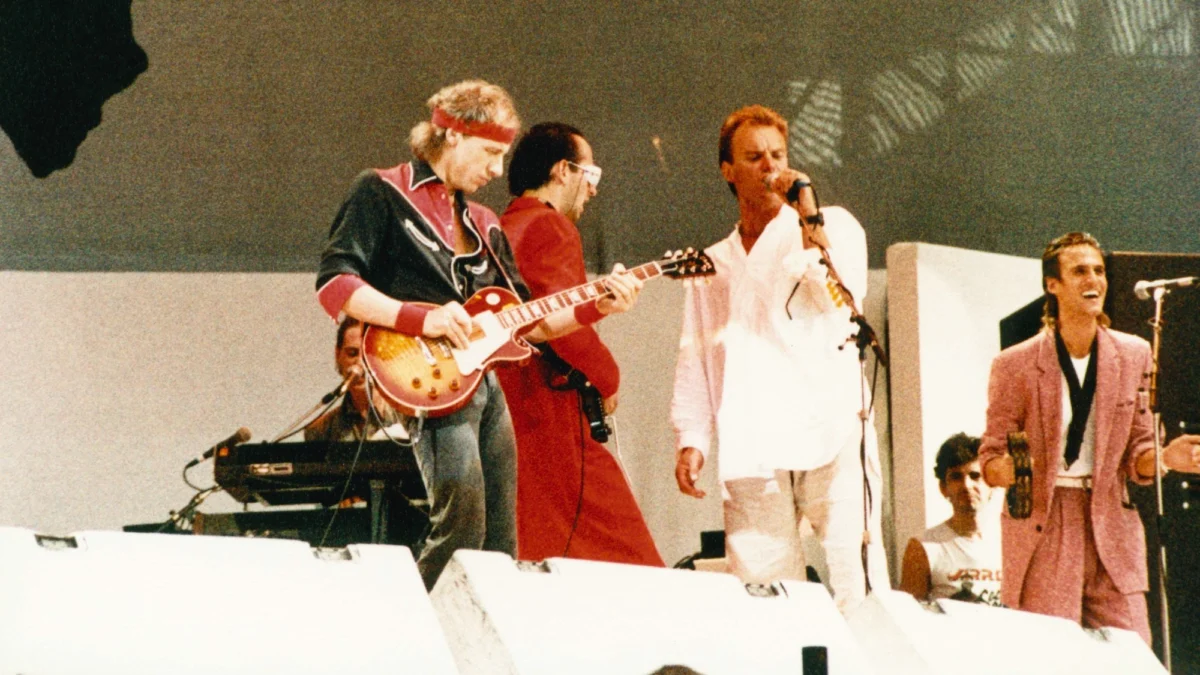
- July 13, 1985: Dire Straits performs the song at Live Aid at Wembley Stadium, with Sting joining them on stage. The performance is viewed by an estimated 1.9 billion people worldwide, providing an unprecedented promotional boost.
- September 1985: The song reaches No. 1 on the Billboard Hot 100, holding the position for three consecutive weeks.
- 1986: The song wins the Grammy Award for Best Rock Performance by a Duo or Group with Vocal.
The Music Video: A Landmark in Visual Effects
It is impossible to discuss the success of "Money for Nothing" without acknowledging its music video. Directed by Steve Barron, the video featured early computer-generated imagery (CGI) created using a Bosch FGS-4000 workstation. At the time, Mark Knopfler was famously resistant to music videos, preferring to let the music speak for itself. However, Barron and the record label eventually convinced him that a conceptual video was necessary for the MTV era.
The video featured "blocky" animated characters representing the delivery men from the song’s lyrics. While the animation appears primitive by modern standards, in 1985, it was groundbreaking. The video became the first to be aired on MTV Europe when the channel launched in 1987. Ironically, a song that poked fun at the vapidity of music videos became the most celebrated video of its year, winning Video of the Year at the 1986 MTV Video Music Awards.
Controversies and Lyrical Interpretation
Despite its massive success, "Money for Nothing" was not without controversy. The second verse of the song includes a slur and disparaging remarks about a "little faggot with the earring and the makeup." Knopfler has consistently defended the lyrics, explaining that they were written from the perspective of the uneducated character in the appliance store, not as a reflection of his own views.
In various interviews, Knopfler expressed surprise that some listeners took the lyrics literally. "I thought it was a very simple use of a character," he noted, explaining that the song was intended to highlight the prejudice and jealousy of the narrator. However, the controversy persisted over the decades. In 2011, the Canadian Broadcast Standards Council (CBSC) initially banned the unedited version of the song from Canadian radio, though the decision was later reversed following a public outcry and a review of the song’s artistic intent. Today, many radio stations use an edited version that omits the second verse entirely.
Broader Impact and Legacy
The legacy of "Money for Nothing" extends far beyond its three-week run at the top of the charts. It served as a bridge between the classic rock of the 1970s and the high-gloss production of the 1980s. For Dire Straits, the song was a double-edged sword; while it made them one of the biggest bands in the world, the sheer scale of the Brothers in Arms tour and the constant media attention eventually led to the band’s hiatus and eventual disbandment in the 1990s.
For the music industry, the song was a validation of the MTV model. By incorporating the "I want my MTV" slogan—originally a marketing campaign created by George Lois—into the song itself, Dire Straits created a feedback loop of promotion. The song promoted the channel, and the channel, in turn, played the video in heavy rotation, driving record sales to unprecedented levels.
Ultimately, "Money for Nothing" remains a fascinating artifact of its time. It is a song about the working class, recorded with the most expensive technology available, featuring a guest spot by a superstar, and propelled by a medium it was ostensibly criticizing. Through the collaborative genius of Mark Knopfler and Sting, Dire Straits captured a moment in history where rock music and television became inextricably linked, creating a masterpiece that continues to resonate on airwaves across the globe.
