

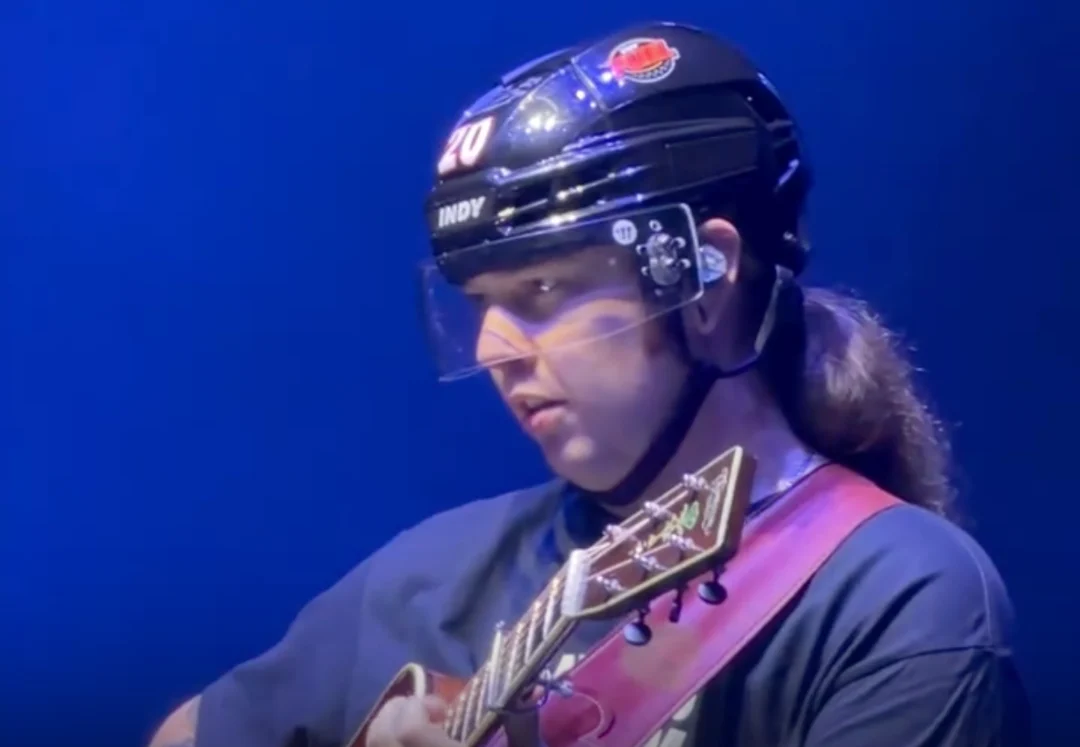
The escalating challenges faced by performers in the contemporary live music landscape were starkly underscored on Thursday, August 6, 2026, when Grammy Award-winning folk and bluegrass artist Billy Strings was struck in the head by an object thrown from the audience during his performance at the Fishers Event Center in Fishers, Indiana. The incident, which occurred mid-speech during the first of a three-night engagement, prompted a visceral, unedited reaction from the musician and subsequently led him to adopt protective headgear for his return to the stage the following night, igniting widespread discussion among fans and industry professionals about concert etiquette and the increasing need for enhanced performer safety measures.
The Incident: A Sudden Breach of Stage Safety
The evening of Thursday, August 6, 2026, was intended to be a celebratory opening to Billy Strings’ highly anticipated three-night residency in Fishers, Indiana. Known for his virtuosic guitar playing, high-energy performances, and heartfelt connection with his audience, Strings was engaging in a moment of candid interaction with the crowd, expressing his appreciation for their presence and his excitement about being in Fishers. This traditional rapport, a hallmark of the bluegrass and folk genres, was abruptly shattered when an unidentified object was hurled from the audience, making direct contact with his head.
The impact was immediate and visible, momentarily interrupting the artist’s speech and visibly shaking him. His initial response, captured in fan-shot videos that quickly circulated online, was one of profound anger and bewilderment. "Oh, what the hell, man? Maybe not! Maybe I shouldn’t be back!" Strings exclaimed, his voice tinged with frustration. "You know, why the f would you throw something at me? Is your d really that small? I was just gettin’ ready to say how much I’m happy to be here, I love you guys, and all this sh, and you throw somethin’, it hits me right in the f**** head! Find out who that was and sodomize him, please!" His raw, unvarnished reaction, while shocking to some due to its explicit nature, was widely interpreted by many as an understandable outburst stemming from a sense of violation and physical threat. The nature of the projectile remains officially unconfirmed, though various accounts from concertgoers suggest it may have been a lighter.
A Return with a Statement: Protective Headgear on Stage
Following the unsettling incident, Billy Strings returned to the Fishers Event Center stage on Friday, August 7, 2026, for the second night of his scheduled performances. His appearance was notably different: the artist, renowned for his often casual stage presence, emerged wearing protective headgear. This visible precaution served as a powerful, non-verbal statement regarding the previous night’s events and the artist’s commitment to continuing his performance despite the recent threat, while simultaneously prioritizing his own safety. The headgear, a practical measure against potential repeat offenses, transformed into a symbol, representing the broader vulnerability of performers in an era where concert etiquette appears to be increasingly deteriorating. This move resonated deeply with his fanbase, many of whom expressed solidarity and concern for his well-being across social media platforms.
The Broader Context: A Disturbing Trend in Live Entertainment
The incident involving Billy Strings is not an isolated occurrence but rather symptomatic of a concerning and escalating trend in the live entertainment industry. Performers across various genres have increasingly reported hostile or inappropriate fan behavior, ranging from unsanitary acts to direct physical assaults. The examples cited in the original reporting, such as concertgoers reportedly defecating on venue floors during a Noah Kahan concert or Bring Me The Horizon’s lead singer suffering a mild concussion after being hit by a thrown phone, highlight the diverse and disturbing nature of these incidents.
This phenomenon extends beyond these specific cases. In recent years, numerous high-profile artists, including Bebe Rexha, Kelsea Ballerini, and Harry Styles, have been struck by objects ranging from cell phones to jewelry, leading to injuries and mid-performance interruptions. The common thread in these incidents is a profound disregard for the safety and well-being of the performers, coupled with a fundamental breakdown of the implicit social contract between artist and audience. While historically, audiences might have thrown flowers or undergarments as signs of adoration, the current trend involves objects that are clearly dangerous and intended to cause harm or disruption.
Several factors are hypothesized to contribute to this decline in concert decorum. The pervasive influence of social media may play a role, fostering a culture where extreme actions are perceived to garner attention or "go viral," thus incentivizing disruptive behavior. The perceived anonymity within large crowds can embolden individuals to act in ways they would not in smaller, more intimate settings. Additionally, factors such as excessive alcohol or substance consumption, a sense of entitlement, or a diminished respect for authority figures, including performers, are often cited as contributing elements.
Industry Response and Safety Implications
The live music industry, encompassing artists, venues, promoters, and security personnel, faces significant challenges in addressing this escalating issue. Venues typically employ a range of security measures, including bag checks, metal detectors, and visible security staff. However, preventing small, easily concealable objects from entering a venue, or identifying the exact perpetrator in a densely packed crowd of thousands, remains an arduous task. The sheer volume of attendees at major concerts makes comprehensive individual screening practically impossible without severely impacting the concert experience and entry times.
In response to the growing number of incidents, some artists have begun to take more proactive stances. Some have stopped performances to directly address the culprits, while others have increased personal security details. The symbolic act of Billy Strings wearing protective headgear serves as a public plea for a safer environment, forcing audiences to confront the tangible consequences of their actions. Industry leaders are increasingly engaging in discussions about implementing stricter policies, such as banning individuals caught throwing objects, enhancing surveillance systems, and improving communication protocols between stage and security teams. However, balancing security with the desire to maintain a free and enjoyable concert atmosphere remains a delicate equilibrium.
Legally, individuals who throw projectiles at performers could face charges ranging from assault to disorderly conduct, depending on the severity of the act and any resulting injuries. Venues also typically reserve the right to eject and permanently ban offenders. The challenge lies in the effective identification and apprehension of these individuals within the chaos of a live event.
Impact on Billy Strings and the Bluegrass Community
The incident holds particular significance within the bluegrass and folk music community. These genres are often characterized by a strong sense of community, mutual respect, and an intimate connection between artists and their audiences. While Strings’ music has garnered mainstream appeal, attracting a broader and sometimes less traditional bluegrass audience, the core ethos of respect and camaraderie remains deeply embedded. The act of violence against an artist known for fostering such positive connections is therefore particularly jarring and disappointing to many within this community.
For Billy Strings himself, such an incident can have multifaceted implications. Beyond the immediate physical risk and emotional distress, it can subtly, or overtly, influence his future stage presence and interaction with audiences. Artists who have experienced similar incidents have sometimes become more reserved, less spontaneous, or have even erected physical barriers between themselves and the crowd. This unfortunate necessity can, in turn, diminish the very intimacy and connection that makes live music so powerful and unique. The use of protective headgear, while a pragmatic choice, also signifies a shift, a visible acknowledgment that the stage is no longer always a sanctuary.
Fan Reaction and Online Discourse
The fan reaction to the Billy Strings incident was swift and largely condemnatory of the perpetrator. Social media platforms were flooded with messages of support for Strings, expressing outrage at the disrespect shown to the artist. Many fans echoed the sentiment that such behavior undermines the entire concert experience for everyone. The incident sparked a wider debate about accountability, with some arguing for stricter penalties for offenders and others emphasizing the collective responsibility of the audience to self-police and maintain a respectful environment.
Strings’ explicit reaction, particularly his "sodomize him" comment, also became a point of discussion. While many understood it as an expression of raw, understandable anger in a moment of vulnerability and shock, others debated the appropriateness of such language from a public figure. However, the overwhelming sentiment remained focused on the unacceptability of the projectile-throwing act itself, positioning the artist’s words as a reaction to an egregious transgression rather than an unprovoked statement.
Moving Forward: A Call for Respect and Re-evaluation
The incident at the Fishers Event Center serves as a sobering reminder of the increasingly precarious position of performers in the modern era of live entertainment. While the vast majority of concertgoers attend shows with respect and enthusiasm, the actions of a few individuals can severely impact the safety, enjoyment, and overall atmosphere of an event.
As the live music industry continues to rebound and evolve, there is an urgent need for a collective re-evaluation of concert etiquette and safety protocols. This involves a multi-pronged approach: enhanced security measures at venues, clear communication of acceptable behavior guidelines, swift and firm consequences for offenders, and a renewed emphasis on fostering a culture of mutual respect between artists and their audiences. The stage should remain a space for artistic expression and communal celebration, free from the threat of physical harm. The sight of an artist like Billy Strings, a purveyor of joy and masterful musicianship, forced to don protective headgear, is a stark visual testament to the critical importance of addressing this pressing issue before further harm is inflicted upon those who dedicate their lives to entertaining us.
