

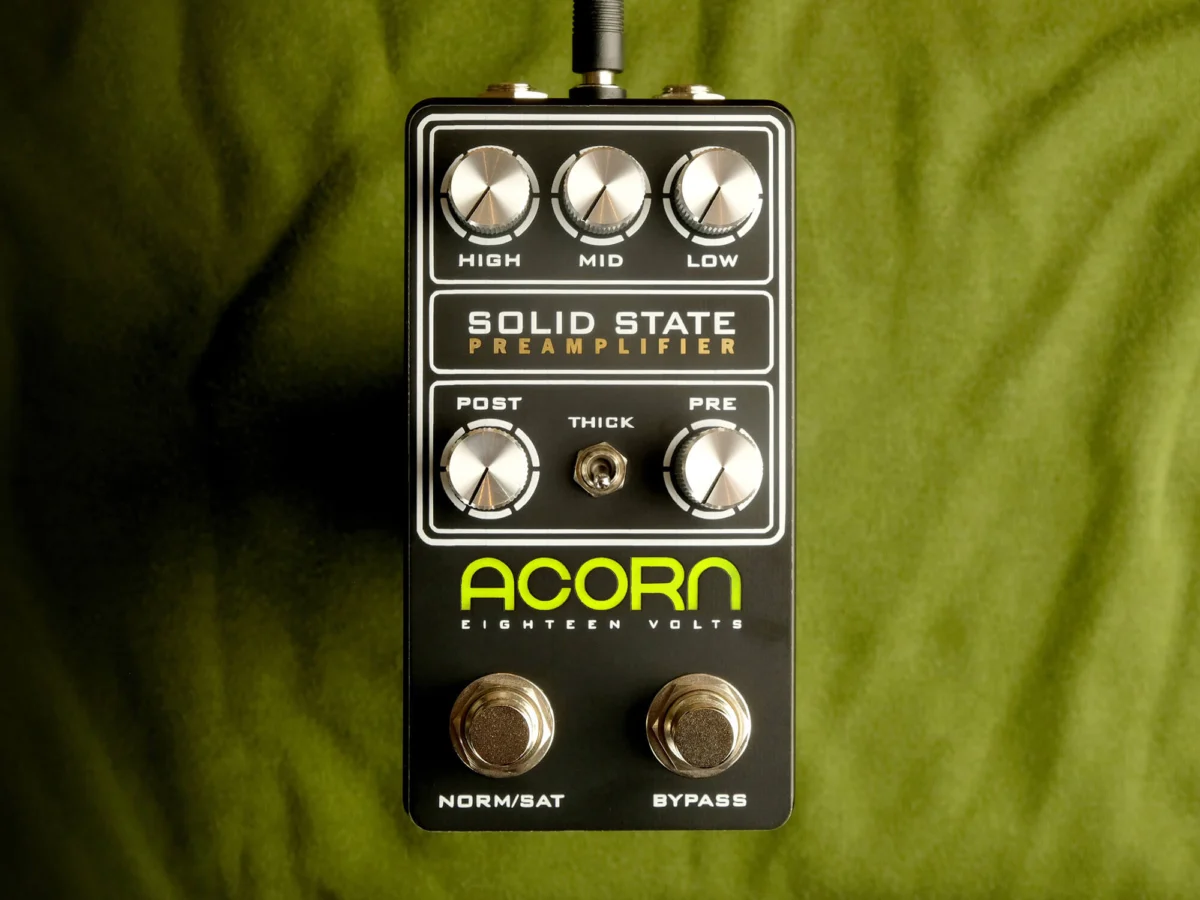
The burgeoning market for effects pedals has recently witnessed the introduction of the Acorn Amplifiers Solid State Preamplifier (SSP), a meticulously crafted stompbox designed to encapsulate the distinctive sonic character of the legendary 1980 Peavey Decade practice amplifier. Priced at $179 (£169), this compact unit, available via acornamps.com and joespedals.com, enters a competitive landscape, aiming to deliver a specific, sought-after tonal palette that has garnered significant attention within the guitar community, largely due to its association with Queens of the Stone Age frontman, Josh Homme.
The Genesis of a Legend: Josh Homme and the Peavey Decade’s Cult Status
The narrative surrounding the Peavey Decade’s unlikely ascent to cult status is deeply rooted in a viral YouTube clip that has circulated widely under titles such as "Josh Homme’s secret weapon." In this now-famous footage, Homme, known for his innovative and often abrasive guitar tones, showcases a seemingly unremarkable 1980 Peavey Decade practice combo amplifier. Far from dismissing it as a relic, he extols its virtues, declaring, "This thing is incredible." This endorsement from a highly influential artist instantly transformed a humble 10-watt solid-state amplifier, originally designed for practice rooms and beginners, into a revered piece of gear, sparking curiosity and a renewed appreciation for its raw, unrefined sonic capabilities.
The Peavey Decade, a product of the early 1980s, was part of a wave of solid-state amplifiers that offered reliability and portability at a lower cost than their vacuum tube counterparts. While many guitarists of the era gravitated towards tube amps for their organic warmth and dynamic response, solid-state designs like the Decade possessed a unique character – a harder, drier, and often more aggressive crunch that, when pushed, could yield distinctive textures. Homme’s use of this amplifier, particularly in studio settings, highlighted that "crappy" or overlooked gear could, in the right hands, become instrumental in forging iconic sounds. This revelation challenged conventional wisdom, demonstrating that tone often lies more in the player’s interaction with the instrument and amplifier than in the sheer expense or perceived prestige of the equipment.

The ripple effect of Homme’s advocacy was profound. Peavey, recognizing the unexpected resurgence of interest in their vintage product, responded by creating a signature reissue of the Decade amplifier itself, alongside incorporating a Decade model into their line of effects pedals launched last year. This move underscored the significant commercial impact of artist endorsements, particularly when a seemingly obscure piece of gear is elevated to legendary status. Concurrently, independent builders like Atlanta-based Acorn Amplifiers identified a niche for a high-quality, boutique-level interpretation of this sound in a more pedalboard-friendly format.
From Atlanta to the Global Stage: Acorn Amplifiers’ Vision
Acorn Amplifiers has established itself within the boutique pedal scene by focusing on meticulous circuit design and premium build quality. Their decision to develop the Solid State Preamplifier stems from a clear understanding of the market’s demand for specific, iconic tones that are often difficult or impractical to achieve with original vintage equipment. The SSP is not merely a rehash; it represents a dedicated effort to capture the essence of the Peavey Decade’s preamplifier section, offering it to guitarists in a versatile and robust stompbox.
It is important to clarify that the SSP is a compact iteration of Acorn’s larger Solid State pedal, which notably includes a recreation of the Decade’s output stage, allowing it to drive a speaker cabinet directly. The SSP, by contrast, is a preamp-only model, designed to integrate seamlessly into an existing amplifier setup or a direct recording chain. This distinction positions the SSP as a more focused tool, catering to players who primarily seek the Peavey Decade’s distinct preamp coloration and drive characteristics without needing the full amplifier simulation of its larger sibling.
The design philosophy behind the SSP is evident in its feature set. It retains all the core functionalities deemed essential for replicating the Decade’s versatility: a comprehensive three-band EQ, footswitchable ‘normal’ and ‘saturated’ channels, and independent pre and post gain controls. A key addition is a toggle switch labeled ‘thick,’ providing an extra dimension of tonal shaping by offering a chunkier, fuller sound option. This thoughtful inclusion demonstrates Acorn’s commitment to enhancing the original’s capabilities while preserving its sonic integrity.

However, the pursuit of compactness has introduced certain ergonomic considerations. The reduced spacing between the two footswitches presents a potential challenge, particularly for live performance scenarios where precise, rapid engagement is crucial. As noted by reviewers, accurately hitting one switch without accidentally triggering the other on a crowded pedalboard could be akin to "trying to perform brain surgery with barbecue tongs." This practical concern might influence its suitability for musicians who frequently switch channels during performances. Furthermore, while the illuminated Acorn logo, which shifts from green to red to indicate channel engagement (and brightens at 18 volts), is a visually appealing and functional indicator, the absence of a channel status display when the pedal is in bypass mode requires the user to remember its last state, a minor inconvenience but one that could be critical in fast-paced live situations. The lack of individual volume controls for the normal and saturated channels also means that any perceived output level differences between them, which can vary depending on gain settings and power supply (9v vs. 18v), cannot be compensated for directly on the pedal.
Sonic Tapestry: Exploring the SSP’s Diverse Tones
For many, the paramount question surrounding the Acorn SSP is whether it truly delivers the sonic signature of Queens of the Stone Age’s seminal album, Songs For The Deaf. The consensus among early adopters and reviewers suggests that, when paired with the appropriate complementary gear, the answer is a resounding yes. However, the SSP is far from a one-trick pony. Its combination of a channel footswitch and the ‘thick’ toggle switch unlocks four distinct sound zones, offering a broad spectrum of solid-state-infused tones beyond mere Homme emulation.
The ‘normal’ channel provides a versatile foundation, ranging from pristine clean tones to a medium-scuzzy overdrive. In this mode, the pedal imparts a crisp edge to the high frequencies and a decidedly solid-state firmness to the low end. This characteristic makes it a strong contender as an "always-on" tone enhancer for players seeking to imbue their sound with a subtle yet distinct solid-state flavor. Engaging the ‘thick’ switch within the normal channel transforms the sound into a more wiry kind of crunch. While this can, at times, flirt with harshness, it largely maintains clarity and introduces an "ultra-sparkly" quality, pushing the boundaries of what might be considered conventional overdrive.
Switching to the ‘saturated’ channel reveals the pedal’s true beastly nature. This is where the core of the Josh Homme tone resides. While a fractional difference in output level between channels may be noticeable depending on pre-gain settings and voltage, the sheer power and character of this channel are undeniable. The effects of the ‘thick’ toggle are significantly magnified here. In its ‘thin’ mode, the saturated channel delivers a beautifully abrasive, cutting tone – raw and unapologetic. Conversely, the ‘thick’ setting provides a chunky richness, still retaining an edgy character, but with a fuller body that harks back to the robust, albeit unpolished, sound of vintage transistor amps.

Across both ‘thin’ and ‘thick’ settings within the saturated channel, the SSP faithfully recreates the quintessential dirty channel sound of small, ’80s-era transistor amplifiers: a tone that is raw, insolent, and captivating in its untamed nature. This channel also demonstrates remarkable versatility in shaping heavier tones. By disengaging the ‘thick’ mode, setting the mids to zero, and maximizing the gain, the SSP can produce a powerful, doomy scoop, ideal for heavier genres that demand a cavernous, imposing low-end presence. This flexibility underscores its potential beyond specific artist emulation, offering a unique voice for diverse musical styles.
Implications and Target Audience: The SSP in the Modern Rig
The Acorn Amplifiers Solid State Preamplifier occupies a unique position in the contemporary effects pedal market. Its sound profile – characterized by hardness, dryness, and an unrefined edge – stands in stark contrast to the smooth, organic saturation often associated with tube-driven overdrives and distortions. For a generation of guitarists who grew up with small practice amps as their primary tools, these solid-state characteristics were once something to be transcended. However, modern music production and performance have increasingly embraced these "lo-fi" or "unpolished" textures, recognizing their inherent vibe and utility in creating distinctive soundscapes.
The SSP’s multifaceted package, while presenting some practical challenges for live performance due to the closely spaced footswitches and lack of independent volume controls, truly shines in the studio environment. Here, its precise tonal sculpting capabilities and ability to deliver a raw, ’80s transistor amplifier sound can be invaluable. Like Josh Homme’s original Peavey Decade, which often serves as a secret weapon behind the scenes for tracking specific textures, the Acorn SSP is poised to become a favored recording tool for producers and guitarists seeking to inject a unique, edgy character into their tracks. Its ability to capture a range of tones from crisp cleans to abrasive saturation, all within the distinct solid-state lineage, makes it a powerful asset for sound design.
The target audience for the Acorn SSP is broad, encompassing not only dedicated Queens of the Stone Age fans and those specifically chasing Homme’s tones but also experimental musicians, producers, and players who appreciate the distinctive qualities of vintage solid-state amplification. It appeals to those who understand that "unrefined" does not equate to "bad," but rather to a specific aesthetic that can contribute significantly to a band’s identity or a recording’s atmosphere.

Alternatives in the Market
While the Acorn SSP offers a boutique interpretation of the Peavey Decade sound, several other options exist for guitarists looking to capture similar tonal characteristics or leverage the Josh Homme connection.
- Peavey Decade Preamp ($199/£179): Manufactured in Taiwan, this official Peavey pedal bears the classic spiky font and name, offering a direct, manufacturer-sanctioned emulation of the original amplifier’s preamp. It appeals to purists seeking brand authenticity.
- Stone Deaf PDF-2 (£160): For those more interested in Josh Homme’s actual working rig, the Stone Deaf PDF-2 is the latest iteration of a drive and EQ pedal he is known to use. While not a direct Peavey Decade emulation, it is integral to his sonic fingerprint and offers versatile tone-shaping capabilities.
- Funny Little Boxes Skeleton Key (£99): This "dirty boost" pedal is explicitly inspired by the sounds of Queens of the Stone Age, offering a more affordable entry point into achieving similar sonic textures, often focusing on the gritty, overdriven aspects of their tone.
The Acorn Amplifiers Solid State Preamplifier carves its own niche by meticulously recreating the specific preamp characteristics of the Peavey Decade within a high-quality, boutique stompbox. While it may present minor ergonomic considerations for live performance, its exceptional sonic fidelity and versatility as a recording tool firmly establish its value. It stands as a testament to the enduring influence of iconic artists and the innovative spirit of independent builders who continue to push the boundaries of guitar tone, transforming overlooked "crappy little amps" into modern legends.
