

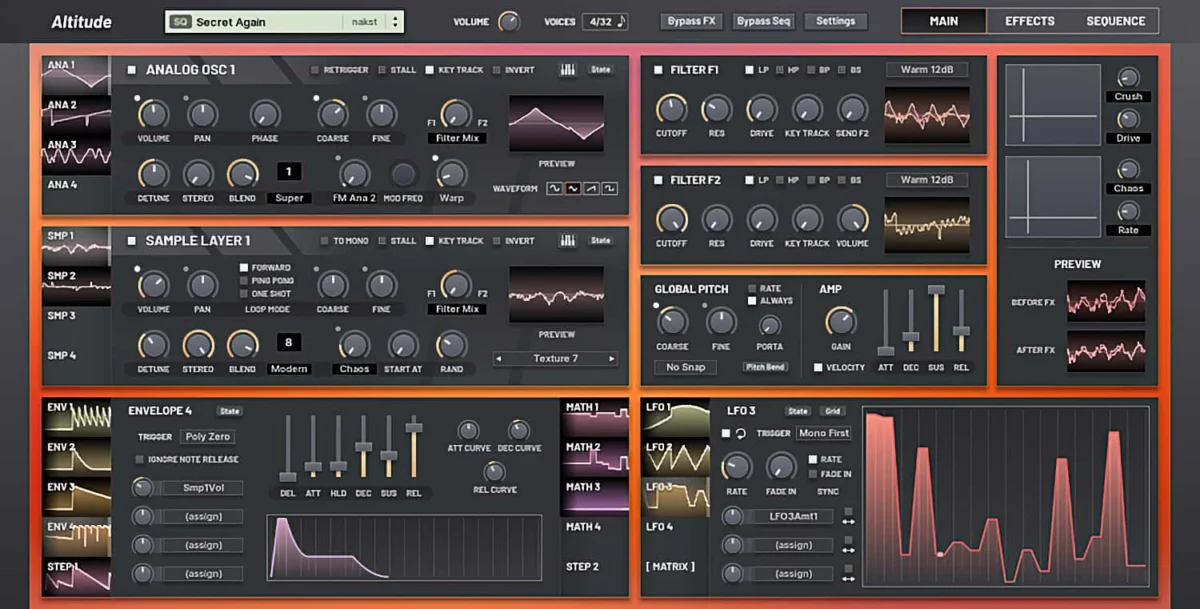
The landscape of digital music production has undergone a significant transformation with the official release of Altitude, a sophisticated multi-engine software synthesizer developed by Nakst. Available as a free download for Linux, macOS, and Windows, Altitude represents a growing trend in the audio industry where high-quality, versatile tools are made accessible to the public without the barrier of entry-level costs. By integrating subtractive, frequency modulation (FM), and sampling synthesis into a single unified interface, Altitude positions itself as a comprehensive solution for sound designers and music producers seeking a broad sonic palette.
The developer, Nakst, has established a reputation within the niche community of independent audio software creators for producing streamlined, efficient, and powerful instruments. Altitude follows in the footsteps of previous successful releases like Apricot and Fluctus, yet it expands upon those foundations by offering a hybrid architecture. This architecture is specifically engineered to produce a diverse range of sounds, described by the developer as being capable of delivering booming basses, provocative pads, effervescent effects, and sonorous sequences. This release marks a notable milestone for cross-platform audio development, particularly for its native support of the Linux operating system, which has historically seen a smaller selection of professional-grade synthesis tools compared to its counterparts.
Technical Architecture and Synthesis Engines
Altitude is built upon a tripartite synthesis foundation, allowing users to layer and modulate sounds across three distinct paradigms. The first of these is the subtractive synthesis engine, which serves as the backbone for traditional analog-style sounds. Subtractive synthesis operates by taking a harmonically rich waveform—such as a saw, square, or pulse wave—and "subtracting" frequencies using a resonant filter. This method is fundamental to electronic music history, providing the warmth and grit found in classic hardware synthesizers.
Complementing the subtractive engine is a dedicated FM (Frequency Modulation) synthesis component. FM synthesis, popularized in the 1980s by instruments like the Yamaha DX7, utilizes one oscillator (the modulator) to modulate the frequency of another (the carrier). This creates complex sidebands and metallic, bell-like, or percussive textures that are difficult to achieve through subtractive methods alone. By including FM capabilities, Altitude allows for the creation of intricate, evolving timbres that can cut through a mix with digital precision.
The third pillar of Altitude’s design is its sampling engine. Unlike traditional synthesizers that rely solely on mathematically generated waveforms, the sampling engine allows for the playback and manipulation of digital audio recordings. This enables producers to incorporate real-world textures, acoustic instrument snippets, or customized vocal grains into their patches. The synergy between these three engines—subtractive, FM, and sampling—results in a hybrid instrument where the organic qualities of samples can be blended with the raw power of oscillators and the harmonic complexity of frequency modulation.
The Developer Context: The Legacy of Nakst
To understand the significance of Altitude, one must look at the trajectory of its developer. Nakst has consistently focused on creating plugins that are "lightweight" in terms of CPU usage but "heavyweight" in terms of features. Previous instruments like Apricot, a hybrid synthesizer with a focus on ease of use, and Fluctus, a dedicated FM synthesizer, laid the groundwork for the algorithms found in Altitude.
A defining characteristic of Nakst’s development philosophy is the adoption of the CLAP (Clever Audio Plugin) format. Developed as an open-source alternative to the industry-standard VST3 and AU formats by companies like Bitwig and u-he, CLAP offers modern features such as per-note modulation and improved multi-core CPU management. Altitude’s support for the CLAP format underscores a commitment to future-proofing software and supporting open standards within the audio industry. This approach has garnered praise from the developer community and power users who are increasingly wary of the proprietary restrictions associated with traditional plugin formats.
Chronology of Development and Release
The development of Altitude can be traced back through a series of iterative updates to Nakst’s internal framework. While many commercial plugins undergo multi-year marketing campaigns, Altitude was released with a focus on immediate utility and community feedback.
- Framework Establishment: Nakst developed a custom, high-performance C++ framework designed for cross-platform compatibility, ensuring that the graphical user interface (GUI) and audio engine would behave identically on Linux, Mac, and Windows.
- Engine Integration: The integration of the three synthesis types was tested through smaller, individual plugin releases. Lessons learned from the FM engine in Fluctus were directly applied to the FM section of Altitude.
- Beta Testing and Community Interaction: Early versions of the synthesis algorithms were often shared within developer forums and through "no-talking" demonstration videos on platforms like YouTube. These videos focused purely on the sonic capabilities of the instrument, bypassing the marketing fluff often found in the industry.
- Official Launch: Altitude was officially launched on the itch.io platform, a choice that reflects a growing movement among independent software developers to use decentralized, creator-friendly marketplaces rather than traditional retail outlets.
Cross-Platform Performance and Accessibility
One of the most compelling aspects of Altitude is its robust support for the Linux operating system. In the world of professional audio, Linux has often been treated as an afterthought. However, the rise of the Steam Deck and the increasing stability of audio backends like PipeWire and Jack have led to a resurgence in Linux-based music production. Altitude provides a native experience for Linux users, ensuring that they have access to the same high-fidelity sound engines as Windows and Mac users without the need for compatibility layers like Wine or Proton.
For macOS users, Altitude is optimized to run on both Intel-based Macs and the newer Apple Silicon (M1/M2/M3) chips. This native optimization is crucial for maintaining low latency and high voice counts in modern digital audio workstations (DAWs). Windows users, meanwhile, benefit from a standard VST3 and CLAP implementation that integrates seamlessly with industry-standard software like Ableton Live, FL Studio, and REAPER.

User Interface and Sound Design Capabilities
The user interface of Altitude is designed with a "form follows function" mentality. It utilizes a clean, vector-based GUI that is resizable, a feature that is essential for modern high-resolution displays. The layout is organized logically, with the primary synthesis controls centrally located, surrounded by modulation sources such as LFOs (Low-Frequency Oscillators) and envelopes.
The modulation system in Altitude is particularly noteworthy. It allows users to drag and drop modulation sources onto various parameters, enabling complex movement within a sound. For example, an LFO can be assigned to the filter cutoff of the subtractive engine while simultaneously modulating the FM index of the second engine. This level of interconnectivity is what allows Altitude to produce the "provocative pads" and "sonorous sequences" mentioned in the developer’s notes.
The inclusion of a sampling engine also opens up unique sound design possibilities. Users can import their own WAV or AIFF files, which can then be processed through the synthesizer’s filters and effects. This makes Altitude not just a synthesizer, but a powerful sound manipulation tool that can bridge the gap between synthesis and musique concrète.
Industry Implications and the Freeware Movement
The release of Altitude for free is a significant event in the context of the broader music technology market. Historically, high-quality hybrid synthesizers could cost anywhere from $150 to $500. The emergence of professional-grade free tools like Altitude, alongside other notable plugins like Vital by Matt Tytel and Surge XT, has disrupted the traditional market.
This democratization of tools means that aspiring producers, regardless of their financial situation, have access to professional-grade sound design capabilities. It also forces commercial developers to innovate more rapidly to justify their price points. The "free" model used by Nakst is often supported by community donations or by serving as a portfolio piece that demonstrates the developer’s technical prowess, which can lead to collaborations with larger hardware or software companies.
Furthermore, the inclusion of "no-talking" demonstrations as the primary marketing material reflects a shift in how information is consumed by the modern producer. Instead of relying on celebrity endorsements, the focus is placed squarely on the "raw" sound of the instrument. This transparency builds trust with the user base and ensures that the software is judged on its sonic merits.
Supporting Data and Technical Specifications
From a technical standpoint, Altitude is designed to handle high sample rates and internal oversampling, which minimizes aliasing—a common digital artifact that can occur during synthesis. While specific CPU benchmarks vary depending on the complexity of the patch, Nakst’s plugins are generally noted for their efficiency.
Key technical features include:
- Oscillator Types: Multiple waveform options with pulse-width modulation and sync capabilities.
- Filter Models: A variety of low-pass, high-pass, and band-pass filters with adjustable resonance and drive.
- Modulation Sources: Multiple ADSR (Attack, Decay, Sustain, Release) envelopes and multi-waveform LFOs.
- Effects Suite: Built-in effects such as reverb, delay, and distortion to polish the final sound within the plugin.
- File Format Support: Native support for high-quality audio formats for the sampling engine.
Conclusion and Future Outlook
Altitude by Nakst is more than just another free plugin; it is a testament to the power of independent software development and the importance of cross-platform accessibility. By combining three powerful synthesis methods into a single, efficient package, it provides a versatile toolset for modern music production. Its support for the CLAP format and native Linux compatibility positions it at the forefront of technical trends in the audio industry.
As the community begins to explore the depths of Altitude’s engine, it is expected that a wealth of user-generated presets and tutorials will emerge, further solidifying its place in the producer’s toolkit. The release serves as a reminder that the quality of a tool is not always defined by its price tag, but by the ingenuity of its design and the creativity it inspires in its users. For those looking to expand their sonic horizons, Altitude offers a professional-grade experience that is now accessible to everyone, across all major operating systems.
