

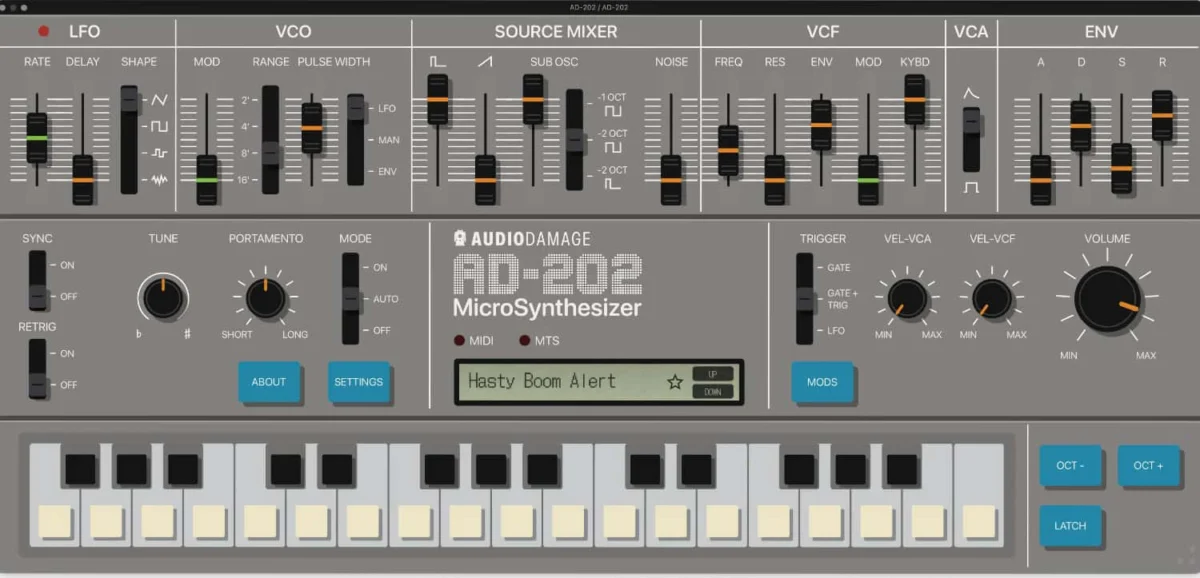
Audio Damage, a veteran developer in the music technology industry known for its innovative signal processors and synthesizers, has officially released the AD-202. This new software instrument is a meticulously crafted emulation and expansion of the Roland MC-202 MicroComposer, a classic silver-boxed synthesizer first introduced in 1983. The AD-202 arrives as a cross-platform solution, supporting Windows, macOS, Linux, and iOS, providing a bridge between the vintage analog synthesis of the early 1980s and the sophisticated digital production environments of the modern era.
The launch of the AD-202 marks a significant moment for enthusiasts of "acid" house, techno, and IDM, genres that have long relied on the specific sonic characteristics of the Roland "MC" and "TB" families. While the original hardware was often overshadowed by its siblings, the SH-101 and the TB-303, it developed a dedicated cult following due to its unique internal sequencer and its punchy, single-oscillator architecture. Audio Damage’s rendition seeks to preserve the simplicity of that original signal path while integrating modern necessities such as polyphony, MPE (MIDI Polyphonic Expression), and advanced saturation circuits.
Historical Context: The Legacy of the Roland MC-202
To understand the significance of the AD-202, one must look back to the early 1980s. When Roland released the MC-202 in 1983, it was marketed as a "MicroComposer"—a portable, battery-powered synthesizer and two-channel sequencer intended to allow musicians to compose on the go. Internally, the MC-202 shared much of its DNA with the legendary SH-101. It featured a single Voltage Controlled Oscillator (VCO) capable of simultaneous waveforms, a resonant 24 dB/octave low-pass ladder filter, and a simple ADSR envelope generator.
However, the original MC-202 was notoriously difficult to program. Its dual-channel sequencer required a mathematical approach to entry, often frustrating musicians who preferred the more immediate "step" sequencing of the TB-303 or the slider-heavy interface of the SH-101. Despite these hurdles, the sound of the MC-202 was undeniable: thick, rubbery, and capable of a specific type of aggressive resonance that defined underground electronic records for decades.
In the decades since its discontinuation, the MC-202 has seen a massive surge in second-hand market value. As original units became increasingly rare and prone to hardware failure, the demand for a reliable, expanded software version grew. Audio Damage has positioned the AD-202 not just as a static clone, but as an evolution that addresses the limitations of the 1983 hardware while honoring its core tonal identity.
Technical Specifications and Signal Path
The AD-202 follows the "one-knob-per-function" philosophy that made early analog synthesizers so intuitive for sound design. The core of the instrument is its single oscillator, which remains faithful to the original Roland architecture. Users can blend multiple waveforms simultaneously, including:
- Sawtooth: The primary source for aggressive leads and classic bass lines.
- Pulse/Square: Featuring adjustable pulse-width modulation (PWM), essential for "hollow" or "reedy" textures.
- Sub-Oscillator: A dedicated square wave tuned one or two octaves below the primary pitch to provide low-end weight.
- Noise Generator: A white noise source used for percussive hits or adding grit to the signal.
This oscillator section feeds directly into a 24 dB/octave resonant ladder filter. This filter is the centerpiece of the AD-202’s sound, capable of smooth frequency sweeps or, when the resonance is pushed, the self-oscillating "chirps" and "screams" associated with classic acid sequences. The modulation section remains intentionally streamlined, featuring a single ADSR (Attack, Decay, Sustain, Release) envelope and a Low-Frequency Oscillator (LFO).
Modern Enhancements and Digital Innovations
While the original MC-202 was strictly monophonic—meaning it could only play one note at a time—Audio Damage has expanded the AD-202 to support eight-voice polyphony. This transformation allows the instrument to move beyond basslines and lead sequences into the realm of lush pads, stabs, and complex chordal structures.
To prevent a polyphonic digital synth from sounding "too perfect" or sterile, Audio Damage has implemented a per-voice analog drift system. This feature subtly modulates the pitch and filter characteristics of each individual voice, mimicking the slight instabilities of vintage analog circuitry. This ensures that even when playing chords, the AD-202 retains a "living," organic quality.
Further modernizing the instrument, the AD-202 includes:

- MPE (MIDI Polyphonic Expression) Support: This allows users with compatible controllers (like the Roli Seaboard or LinnStrument) to modulate individual notes within a chord independently, providing a level of expression impossible on the 1983 hardware.
- MTS-ESP Microtuning: Support for the ODDSound MTS-ESP system allows the AD-202 to utilize non-Western scales and microtonal tunings, a feature highly sought after by experimental and avant-garde composers.
- The "Color" Section: Recognizing that many classic MC-202 recordings were processed through outboard gear, Audio Damage included a post-VCA (Voltage Controlled Amplifier) processing chain. This includes pre-filter saturation, filter drive, a dedicated distortion circuit, and a "Tilt EQ" for quick tonal shaping.
- Tempo-Syncable LFO: Unlike the original, which required manual timing, the AD-202’s LFO can be locked to the host DAW (Digital Audio Workstation) tempo and features a delayed onset parameter to add movement to sustained notes.
Platform Availability and Accessibility
Audio Damage has been a vocal proponent of cross-platform accessibility, and the AD-202 continues this trend. The software is available for Windows (10 or newer), macOS (10.15 or newer, including native Apple Silicon support), and Linux (Ubuntu 20.04 or newer). It is provided in VST3, AU, AAX, and CLAP formats, ensuring compatibility with virtually every major professional production software, including Ableton Live, Logic Pro, FL Studio, and Bitwig Studio.
Perhaps most notably, Audio Damage has also released a fully featured version for iOS. The iOS version utilizes the AUv3 format, allowing it to run as a plug-in within mobile DAWs like AUM, Cubasis, and GarageBand. By offering the iOS version at a significantly lower price point ($4.99 USD), the company has made high-quality analog emulation accessible to a broader demographic of mobile musicians and hobbyists.
Market Analysis and Industry Impact
The release of the AD-202 enters a competitive market for Roland emulations. Roland itself offers the "Roland Cloud" subscription service, which includes an official version of many of its classic instruments. However, Audio Damage’s approach differs by focusing on a "clean-sheet" coding method that prioritizes low CPU usage and a modern user interface over a literal visual recreation of the original plastic casing.
Industry analysts suggest that the AD-202 will appeal particularly to the "Live Jam" community. The rise of hardware-style workflows within software—where users map physical MIDI controllers to a limited set of parameters—favors the AD-202’s layout. Because there are no hidden menus or complex modulation matrices, the instrument encourages immediate performance and "happy accidents."
Early feedback from the synthesizer community has highlighted the value of the "Color" section. Many software emulations of 80s gear can sound "thin" in a modern digital mix; by integrating saturation and distortion directly into the signal path, Audio Damage has ensured the AD-202 can compete with modern "heavyweight" wavetable synthesizers in terms of presence and grit.
Pricing and Chronology of Release
The AD-202 follows a standard release cycle for Audio Damage products. It is currently available at an introductory price of $39.00 USD for the desktop version, a discount from its standard retail price of $49.00 USD. This introductory window typically lasts for several weeks following the launch, providing an incentive for early adopters.
The development of the AD-202 is part of a broader "refresh" of the Audio Damage catalog. Over the past two years, the company has been updating its classic plugins to support newer standards like CLAP and Apple Silicon, while simultaneously introducing new instruments that bridge the gap between their experimental "modular-style" plugins and traditional subtractive synthesis.
Summary of Implications for Producers
For the modern music producer, the AD-202 represents more than just a trip down memory lane. It is a functional tool that solves several problems associated with vintage gear. It provides the "MC-202 sound" without the need for expensive repairs, CV/Gate conversion hardware, or the limitations of a monophonic signal.
The inclusion of Linux support also cements Audio Damage’s reputation as one of the few high-end plugin developers supporting the open-source community. As more producers explore Linux-based DAWs like Bitwig or Ardour, the availability of professional-grade synthesizers like the AD-202 is a crucial factor in the platform’s viability.
In conclusion, the Audio Damage AD-202 stands as a sophisticated tribute to a classic piece of Japanese engineering. By maintaining the simplicity that made the original MC-202 a staple of early electronic music while adding the polyphony and processing power of the 21st century, Audio Damage has created an instrument that is likely to find a permanent home in the toolkits of electronic musicians across the globe. Whether used for a simple sub-bass or a complex, MPE-driven polyphonic pad, the AD-202 proves that the fundamental building blocks of 1983 are still remarkably relevant in 2024 and beyond.
