

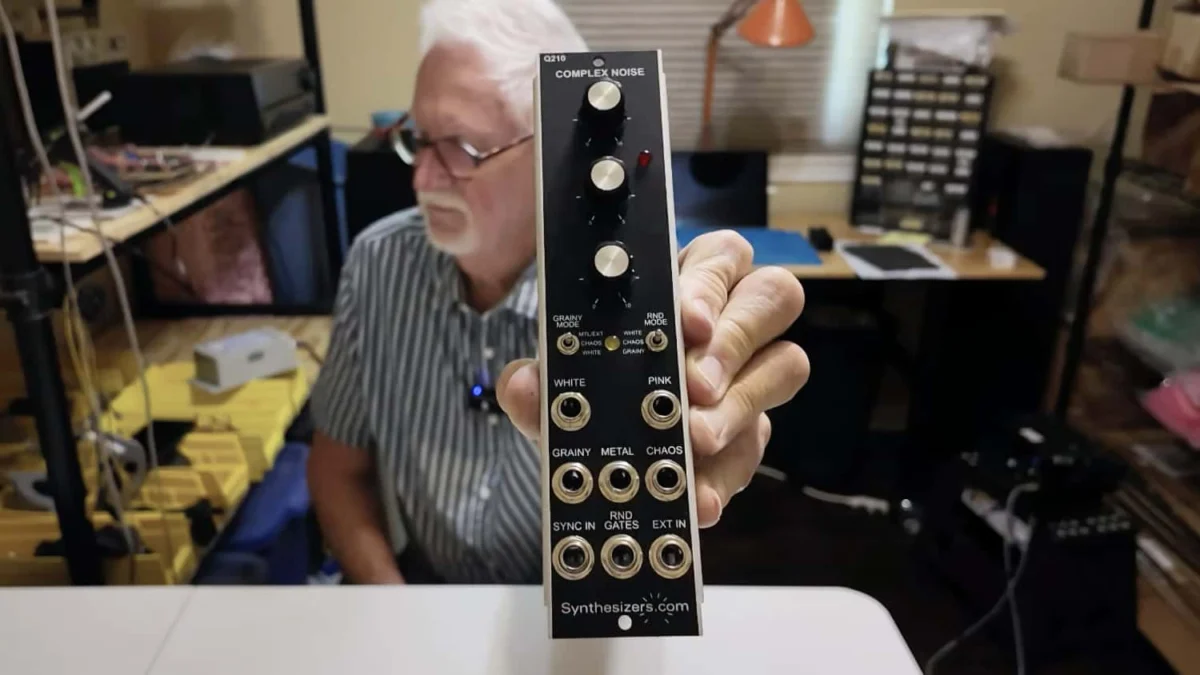
Synthesizers.com has officially expanded its hardware catalog with the release of the Q210 Complex Noise module, representing the first new product entry from the manufacturer in more than two years. This release, designed in the traditional "dotcom" or 5U Moog format, introduces a multi-faceted noise generation tool that aims to provide synthesists with a broader palette of textures ranging from standard white and pink noise to metallic timbres and chaotic digital artifacts. The module’s arrival has been highlighted by synthesist George Benton, whose initial technical overview and demonstration provide a first look into the unit’s capabilities and its integration into established modular workflows.
The Q210 Complex Noise module is marketed as a "noisemaker’s playground," a description that reflects its multifaceted internal architecture. Unlike traditional noise generators that offer a single fixed output, the Q210 features multiple distinct sections, including a dedicated "Grainy" output section and a Random Gate generator. This variety is intended to satisfy the requirements of both traditional subtractive synthesis—where noise is often used as a source for percussion or wind sounds—and more experimental, generative patch design where random fluctuations and digital grit are utilized as primary sound sources.
Technical Specifications and Architecture of the Q210
The architecture of the Q210 is divided into several functional blocks, each providing a different character of sonic or control voltage (CV) output. At its core, the module provides standard White and Pink noise. White noise is characterized by equal energy per frequency, resulting in a bright, hiss-like sound, while Pink noise offers equal energy per octave, providing a deeper, more naturalistic sound often used to emulate environmental textures.
Beyond these staples, the Q210 introduces a "Metallic" noise output. In modular synthesis, metallic noise is typically achieved through the sum of multiple high-frequency oscillators or through specific shift-register configurations. This output is specifically tuned to assist in the creation of percussive sounds such as hi-hats, cymbals, and snares, where a complex, non-harmonic frequency distribution is required.
One of the most distinctive features of the Q210 is its "Grainy" noise section. This part of the module appears to operate on principles of granular or digital bit-reduction synthesis, allowing users to introduce "chaos" and textural irregularities into the signal. The "Grainy" section is adjustable via dedicated panel controls, enabling the user to shift between smooth noise and more fragmented, "broken" digital textures. Furthermore, this section is not limited to internal noise generation; it features an input for external signals, allowing the module to act as a processor for other audio sources within the modular system.
Performance Analysis and Synthesist Feedback
George Benton, an experienced synthesist within the 5U community, recently provided a hands-on assessment of the Q210. His evaluation focuses on the practical utility of the module in a studio environment, particularly regarding its percussive applications. Benton noted that his primary motivation for acquiring the module was its metallic noise capability, which he found particularly effective for synthesizing cymbals.
Benton’s feedback also highlighted a divergence in the module’s Pink noise character compared to industry standards. He described the Q210’s Pink noise as being "very different" from what he had previously encountered in other modules. While he did not specify the exact frequency curve, the variation suggests a unique filtering approach by Synthesizers.com, which Benton categorized as a positive attribute, offering a new sonic flavor for sound design.
However, the review was not without technical critique. Benton identified a significant design choice regarding the "Grainy" section: the absence of Control Voltage (CV) inputs for the parameters governing chaos and texture. In modern modular synthesis, CV control is generally considered essential for dynamic sound design, allowing parameters to be modulated by envelopes, LFOs, or sequencers. Benton expressed a desire for CV integration in this section, noting that while the manual adjustments are effective, the inability to automate these changes via external voltages limits the module’s potential for evolving, generative soundscapes.
Chronology of Synthesizers.com Development
The release of the Q210 is a significant milestone for Synthesizers.com, a company that has been a cornerstone of the 5U modular market since its founding by Roger Arrick. The brand is credited with revitalizing the large-format modular synthesizer market, offering a more affordable and accessible alternative to vintage Moog systems while maintaining the 1/4-inch jack standard and robust build quality associated with professional studio gear.
The two-year hiatus preceding the Q210 release had led to speculation within the modular community regarding the brand’s future direction. During this period, the industry saw a continued dominance of the Eurorack format, which is smaller and often more digitally focused. The Q210 serves as a reaffirmation of the company’s commitment to the 5U format, often referred to as "dotcom" due to the company’s web domain.
Timeline of recent events:
- 2024–2025: Synthesizers.com maintains existing product lines with periodic restocks but introduces no new hardware designs.
- Early 2026: Development of the Q210 begins, focusing on a multi-engine noise source to fill a gap in the current 5U lineup.
- July 23, 2026: Official announcement and introduction of the Q210 Complex Noise Module.
- Late July 2026: First units reach synthesists and reviewers, including George Benton, leading to the first public demonstrations of the hardware.
The Role of Noise in Modern Modular Synthesis
To understand the significance of the Q210, one must look at the evolving role of noise in electronic music. In the early days of synthesis, noise was primarily a secondary tool used for "dirt" or simple percussive patches. However, in contemporary sound design, noise is often treated as a primary oscillator source.
The Q210’s inclusion of a Random Gate output further bridges the gap between audio and control. A Random Gate provides a rhythmic but unpredictable pulse that can trigger other modules, such as envelopes or sequencers. This feature is highly valued in "West Coast" style synthesis and generative music, where the goal is to create systems that can play themselves or provide "happy accidents" during a performance.
The "Chaos" sound mentioned in Benton’s review suggests that the Q210 may utilize a digital noise engine or a complex feedback loop. Unlike linear analog noise, chaotic noise can be tuned or manipulated to produce shifting rhythmic patterns or harmonic screams, making it a versatile tool for industrial, drone, and ambient music genres.
Market Context and Professional Implications
The modular synthesizer market is currently divided into several competing formats, with Eurorack holding the largest market share due to its compact size and vast array of third-party manufacturers. However, the 5U format, championed by Synthesizers.com, retains a dedicated following among professional musicians and collectors who prefer the tactile experience of larger knobs, wider spacing, and the structural integrity of 1/4-inch patch cables.
The introduction of the Q210 is an indicator that there is still viable demand for innovation within the 5U ecosystem. For professional studios, the Q210 offers a consolidated solution for noise generation that would previously have required multiple modules (a standard noise source, a bit-crusher, and a random pulse generator).
Industry analysts suggest that the "no CV" limitation noted by Benton may be a strategic choice to keep the module’s price point competitive or to maintain a simpler, more "old-school" interface that aligns with the traditional Moog philosophy. Nevertheless, the feedback from the user community often informs future revisions or "plus" versions of modules, and it remains to be seen if Synthesizers.com will address the demand for CV-controllable grain parameters in subsequent releases.
Conclusion and Future Outlook
The Synthesizers.com Q210 Complex Noise module represents a successful return to form for one of the industry’s most respected manufacturers. By combining traditional noise types with experimental "Grainy" textures and random gate capabilities, the module provides a comprehensive utility for both sound design and rhythmic sequencing.
While the lack of CV control over certain parameters may be a drawback for some power users, the module’s sonic character—particularly its metallic and unique pink noise—offers a distinct value proposition. As the first new module in two years, the Q210 not only provides synthesists with a new tool for their racks but also signals a renewed period of activity for the 5U modular format. The community response to this module will likely dictate the trajectory of future developments from Synthesizers.com as they continue to navigate a market that balances vintage aesthetics with modern functional demands.
