

Technical Overview and Core Functionality
Grainferno operates on the fundamental principles of granular synthesis, a method of sound generation that involves dividing an audio sample into minute segments, known as "grains," typically ranging from 1 to 100 milliseconds in duration. While traditional granular synthesizers focus on creating ethereal pads, ambient textures, or "cloud-like" sonic environments, Grainferno is engineered to push these grains into the audio-frequency range.
When grains are triggered at high enough speeds, the human ear ceases to perceive them as individual rhythmic events and begins to interpret them as a continuous pitch. This phenomenon allows Grainferno to function as a playable synthesizer where the "oscillator" is not a standard geometric waveform—such as a sine, saw, or square wave—but rather a rapid-fire succession of fragments from a user-provided audio file. This approach ensures that the resulting synth voice carries the "spectral fingerprint" of the original recording, whether it be a vocal snippet, a field recording of environmental noise, or a complex orchestral phrase.
The architecture of the plugin is designed to accommodate both seasoned sound designers and producers who require immediate results. By dragging and dropping any audio file into the interface, users can immediately begin manipulating the playback position, grain size, density, and pitch. The engine’s ability to transition seamlessly from slow, rhythmic grain scattering to high-speed tonal synthesis provides a broad palette for creative exploration.
Chronology of Development and Market Context
The release of Grainferno marks a significant milestone in Baby Audio’s product timeline. Since its founding in 2019, the Los Angeles-based company has built a reputation for creating "creative" effects and instruments that prioritize workflow and character over clinical precision. Following the success of products like the BA-1 (an emulation of the CS01 synthesizer), Crystalline (an algorithmic reverb), and Transit (a transition designer created in collaboration with Andrew Huang), Grainferno represents the company’s deepest dive into complex synthesis to date.
The development of Grainferno follows a broader industry trend toward "organic" digital synthesis. In the early 2000s, granular synthesis was largely relegated to academic software or high-end workstations. Over the last decade, however, the popularity of plugins like Output’s Portal, Arturia’s Efx Fragments, and Robert Henke’s Granulator II has brought the technique into mainstream music production. Baby Audio’s entry into this space suggests a focus on making these complex mathematical processes more intuitive and "musical" for the modern producer.
According to internal development notes and introductory tutorials released alongside the software, the project began with the goal of creating a granular engine that didn’t just "smear" sound, but could actually "sing." This necessitated the development of a high-performance engine capable of handling hundreds of simultaneous grains without excessive CPU overhead, a common challenge in granular synthesis.
Key Features and User Interface Design
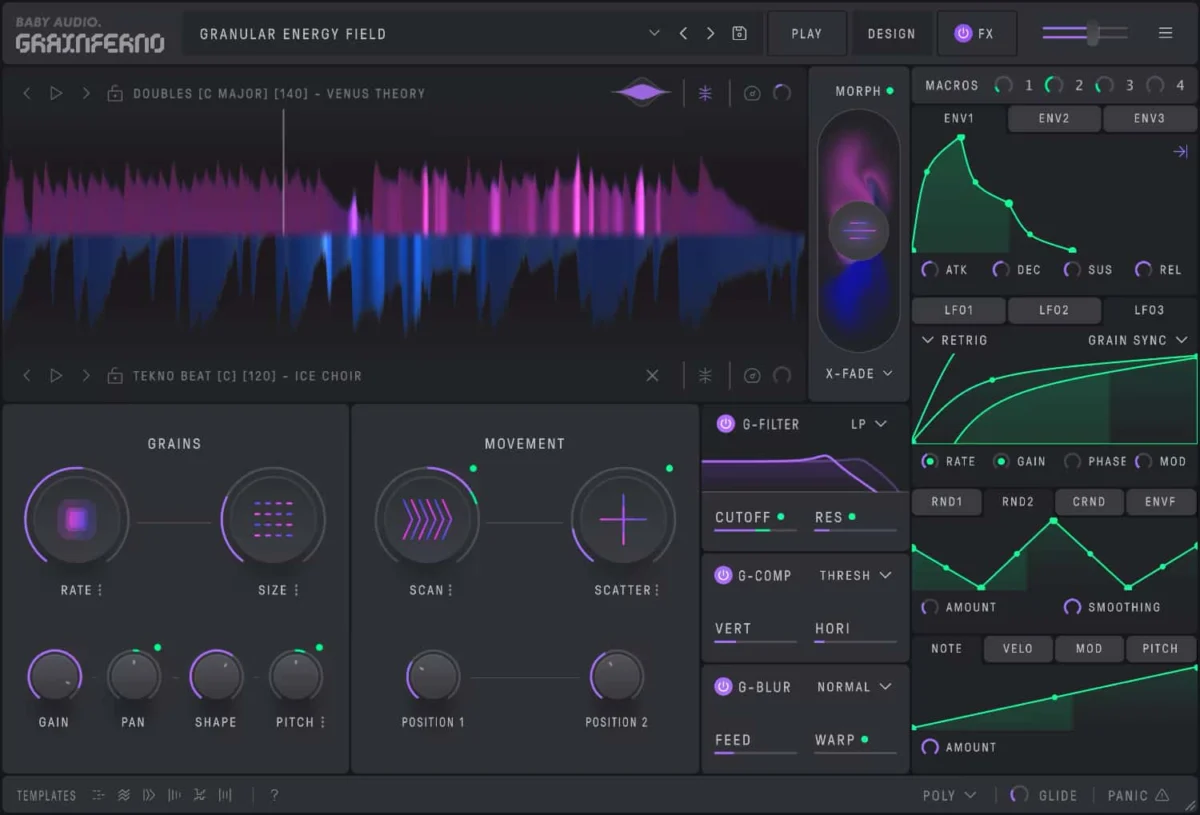
Grainferno adheres to Baby Audio’s signature aesthetic: a minimalist, vector-based interface that avoids the clutter of traditional "knob-heavy" synthesizers. The interface is divided into logical zones that guide the user through the sound design process.
- The Grain Engine: The heart of the plugin, where users control the rate and size of grain generation. This section allows for the "audio-rate" transition that defines the plugin’s character.
- Sample Manipulation: A visual display of the loaded waveform allows users to select specific regions for playback. The "Playhead" and "Scan" controls determine how the engine traverses the sample, allowing for static tonal generation or evolving timbral shifts.
- Modulation Matrix: To add movement to the sounds, Grainferno includes a robust modulation system. Users can map LFOs, envelopes, and randomizers to nearly any parameter, facilitating the creation of sounds that breathe and change over time.
- Integrated Effects Suite: Following the granular stage, the signal can be processed through a series of built-in effects. While the developer has not detailed every specific module in the initial launch text, Baby Audio typically includes high-quality filters, delays, and spatial processors derived from their standalone effect plugins.
- Preset Library: The plugin ships with a diverse array of factory presets designed by professional sound designers. These presets serve as both a starting point for users and a demonstration of the engine’s versatility, ranging from cinematic drones to aggressive lead synths.
Industry Impact and Sound Design Implications
The introduction of Grainferno is expected to resonate particularly well within the film scoring and game audio communities. In these sectors, the ability to take a thematic audio recording—such as a specific instrument used in a score—and turn it into a playable synthesizer allows for a high degree of sonic cohesion. A composer can take a recording of a cello, load it into Grainferno, and create a synth pad that shares the exact harmonic structure and resonance of the original instrument.
In the realm of electronic music production, Grainferno offers an alternative to wavetable synthesis. While wavetable synths like Xfer Records’ Serum or Ableton’s Wavetable are industry standards, they rely on pre-rendered cycles of waveforms. Grainferno’s real-time granular approach allows for more "jitter" and organic imperfection, which many producers find more pleasing and less "digital" in a traditional sense.
Technical analysts note that the ability to keep the "spectral fingerprint" of source audio while playing it as a synth voice bridges the gap between sampling and synthesis. This "hybrid" approach is becoming increasingly popular as producers look for ways to stand out in an era where millions of people have access to the same stock sound libraries.
Pricing, Availability, and System Compatibility
Baby Audio has positioned Grainferno with an aggressive introductory pricing strategy to capture market share upon launch. The plugin is currently available for $79 USD, representing a significant discount from its standard retail price of $129 USD. This "intro price" period is a common fixture in the software industry, intended to generate early adoption and community feedback.
The software is compatible with all major Digital Audio Workstations (DAWs) that support VST, VST3, AU, or AAX formats. This includes industry-standard platforms such as Ableton Live, Logic Pro, FL Studio, Cubase, Pro Tools, and Reaper.
System requirements for Mac users include macOS 10.11 or later, with native support for Apple Silicon (M1, M2, and M3 chips) as well as Intel-based systems. For Windows users, the plugin requires Windows 10 or 11. The developer recommends a minimum of 8GB of RAM and a modern multi-core processor to ensure stable performance when utilizing high grain densities.
Official Responses and Future Outlook
Initial reactions from the beta-testing community and early adopters have highlighted the plugin’s "musicality" and "ease of use." While some granular processors are criticized for being overly scientific or difficult to control, Grainferno appears to have struck a balance that appeals to creative musicians.
In a statement regarding the philosophy behind the tool, the development team emphasized the goal of "removing the friction" between an idea and its sonic realization. By focusing on audio-rate speeds, they have essentially turned a "glitch machine" into a melodic instrument, expanding the utility of granular synthesis beyond its traditional niche.
Looking ahead, Baby Audio is expected to provide ongoing support for Grainferno through firmware updates and potential expansion packs. Given the company’s history of community engagement, users can likely expect future iterations to include refined modulation options or additional effects modules based on user requests.
The launch of Grainferno solidifies Baby Audio’s transition from a boutique effects developer to a serious contender in the virtual instrument market. By focusing on a specific, high-performance niche—audio-rate granular synthesis—the company has provided a tool that addresses a specific need for unique, organic textures in a digital environment. As the software reaches more studios globally, its influence on the sound of contemporary music and media is likely to become increasingly apparent.
