

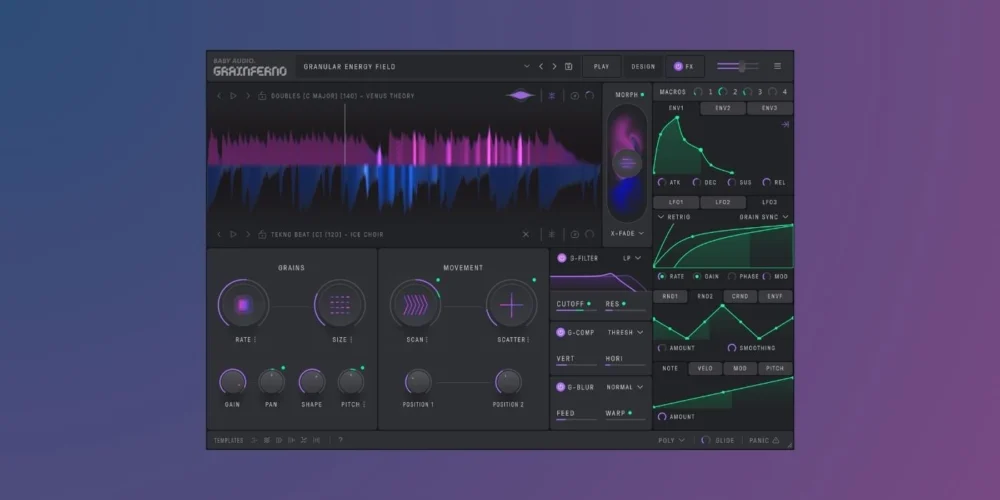
Baby Audio has officially launched Grainferno, an advanced granular synthesizer plugin engineered to transform ordinary audio samples into intricate, evolving soundscapes and entirely new sonic textures. This innovative instrument dissects audio files into microscopic fragments, known as grains, which can then be manipulated and reassembled with unprecedented flexibility, offering music producers and sound designers a powerful new tool for sonic exploration. The plugin is currently available at an introductory price of $79, a significant reduction from its regular retail price of $129. This strategic pricing aims to make the sophisticated capabilities of granular synthesis accessible to a wider audience within the digital audio workstation (DAW) ecosystem.
The release of Grainferno on March 11, 2026, marks a significant addition to Baby Audio’s growing portfolio of acclaimed audio processing tools, further cementing the company’s reputation for developing high-quality, user-friendly plugins that blend innovative functionality with intuitive design. Grainferno operates by generating these aforementioned grains from any loaded audio file, providing users with extensive control over their creation, shaping, and playback. Users can seamlessly integrate their own audio by dragging and dropping samples directly from their DAW or computer’s file system. For immediate creative exploration, the plugin also includes a comprehensive built-in factory library comprising 378 royalty-free audio files, offering a diverse starting point for experimentation across various genres and sound design applications.
The Genesis of Granular Synthesis and Baby Audio’s Innovation
Granular synthesis, a concept first theorized by Hungarian-British physicist Dennis Gabor in the late 1940s and later extensively explored by composer Iannis Xenakis in the 1950s, involves breaking down a sound into tiny segments, or "grains," typically ranging from 1 to 50 milliseconds in duration. By manipulating parameters such as the density, duration, pitch, spatialization, and amplitude envelope of these individual grains, entirely new sounds and textures can be created, ranging from dense soundscapes and shimmering pads to glitchy effects and abstract sonic movements. Historically, implementing granular synthesis required complex programming or specialized hardware. However, advancements in computing power and software development have made it increasingly accessible through plugins like Grainferno.
Baby Audio, known for its minimalist interfaces and powerful underlying algorithms in products such as "Comeback Kid" (delay), "Super VHS" (lo-fi multi-effect), and "Smooth Operator" (intelligent EQ/compressor), has approached granular synthesis with a similar philosophy. Their aim with Grainferno appears to be to demystify this often-complex synthesis method, packaging its immense potential into an intuitive and musically inspiring interface. The plugin’s development aligns with a broader trend in the audio software industry towards more creative and transformative tools, moving beyond traditional synthesis methods to offer deeper levels of sound manipulation.
Core Mechanics: Deconstructing Audio into Microscopic Worlds
At its heart, Grainferno excels at the fundamental process of granular synthesis: taking any loaded audio sample and atomizing it into countless microscopic fragments. These fragments, or "grains," are then individually processed and reassembled, allowing for the creation of sounds that bear little resemblance to their original source, or conversely, sounds that retain the spectral essence of the input while being radically reshaped. This process unlocks a vast spectrum of sonic possibilities, from subtle textural enhancements to complete sonic metamorphosis. The ability to easily import personal audio via drag-and-drop ensures that producers can leverage their existing sample libraries, turning familiar sounds into fresh, innovative elements. The inclusion of a robust factory library serves as an excellent educational and creative resource, providing expertly crafted sounds that showcase the plugin’s capabilities and offer royalty-free material for immediate use in commercial projects.
Audio-Rate Grain Generation: Transforming Samples into Playable Instruments
One of Grainferno’s most compelling and technically sophisticated features is its ability to generate grains at speeds fast enough to enter the audio rate range. This specific capability elevates the plugin beyond a mere texture generator, fundamentally altering how granular synthesis can be employed. When grains are generated at such high frequencies, they cease to behave as individual textural elements and instead begin to coalesce and interact in a manner akin to traditional oscillators. This effectively transforms any loaded sample into a playable synthesizer voice, capable of producing distinct pitches and melodies that remain in tune with the host song’s key and tempo.
The implications of this feature are profound. Producers are no longer limited to using samples as static loops or one-shots; instead, an entire sample library can be reimagined as a collection of unique, harmonically rich oscillators. The Rate control, a crucial component of this functionality, offers key-mapped modes that precisely sync the synthesized pitch to incoming MIDI notes. This integration ensures that the granular engine can be played melodically or harmonically, much like any conventional synthesizer. A key advantage highlighted by the developers is the retention of the original sample’s spectral fingerprint, even at audio rates. This means that while the sample becomes a tunable synth voice, it still carries the unique tonal characteristics and timbral qualities of its source material, providing tonal building blocks with a distinct sonic identity that sets it apart from purely subtractive or wavetable synthesis. This fusion of sample character with harmonic playability opens doors to entirely new sound design paradigms.
Dynamic Soundscapes: The Power of Dual-Sample Morphing
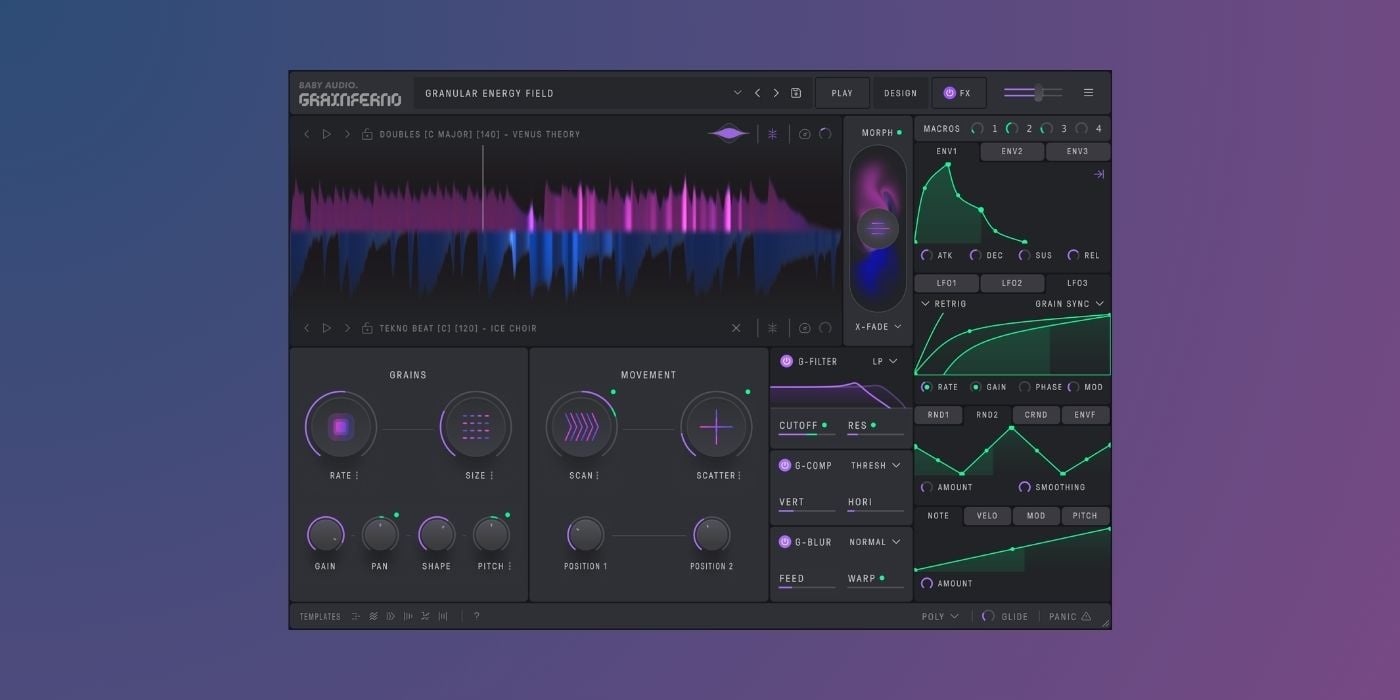
Grainferno further extends its creative reach with an innovative dual-sample morphing system, allowing users to load two distinct audio samples simultaneously and seamlessly morph between them in real time. This capability is instrumental for creating dynamic and evolving soundscapes that transcend the static nature of single-source audio. The plugin offers seven distinct morphing modes, each employing a unique algorithm to blend the granular characteristics of the two source samples:
- Crossfade: A traditional blend, gradually transitioning the volume and grain parameters between the two sources.
- Follow: One sample’s grain characteristics "follow" or influence the other, creating a symbiotic blend.
- Weave: Grains from both sources are interleaved in complex patterns, producing intricate textures.
- 4-Bit & 8-Bit: These modes introduce a degree of bit-crushing or reduction during the morphing process, adding lo-fi characteristics and digital artifacts.
- Random: Grains are randomly selected from either source, leading to unpredictable and often experimental textures.
- Bi Follow: A bidirectional following mechanism where both samples influence each other’s grain generation.
These diverse morphing modes provide an expansive palette for sonic experimentation. For cinematic sound design, this feature is invaluable for crafting continuously evolving textures that can underscore narrative shifts or create immersive atmospheres. In electronic music, it allows for the generation of complex, generative pads and leads that never repeat precisely, maintaining listener engagement. Experimental artists will find these modes particularly fertile ground for exploring abstract sound phenomena and creating unique sonic identities. The ability to shift grains between two disparate sources enables the creation of hybrid sounds that possess the combined characteristics of both, fostering genuinely novel sonic outcomes.
Precision Control: Shaping the Granular Landscape
Effective granular synthesis relies heavily on precise control over the grain parameters, and Grainferno delivers a comprehensive set of controls designed for deep manipulation. The four main granular controls are:
- Rate: Governs the speed at which new grains are generated. As previously detailed, pushing this into the audio-rate range transforms textures into oscillators.
- Size: Determines the length or duration of each individual grain. Shorter grains lead to more pointillistic or "glitchy" sounds, while longer grains create smoother, more textural results.
- Scan: Functions as a playhead that moves through the loaded sample, determining which portion of the audio is currently being granulated. This allows for dynamic exploration of the sample’s content.
- Scatter: Introduces randomness to the grain position, causing grains to be drawn from slightly different points in the sample. High scatter values can lead to diffuse, smeared, or chaotic textures.
These controls are designed to interact dynamically, meaning that changes to one parameter often have cascading effects on the others, producing vastly different results depending on the source material and the interplay of settings. For rhythmic applications, both the Rate and Scan controls can be synced to the host DAW’s tempo in BPM mode. This synchronization is crucial for maintaining rhythmic integrity when working with percussive or time-sensitive material, allowing for the creation of intricate rhythmic patterns or perfectly timed textural swells that lock into the groove of a composition.
Per-Grain Effects: Intricate Sound Sculpting at the Micro Level
A distinguishing feature of Grainferno is its implementation of three dedicated per-grain effects. Unlike conventional effects that process the entire audio output, these effects are applied to each individual grain at the precise moment of its generation, offering an unparalleled level of micro-level sound sculpting.
- G-Filter: This multimodal filter can be applied to individual grains, offering low-pass, high-pass, band-pass, and band-reject modes. By filtering each grain separately, producers can create evolving timbres, introduce spectral movement, or sculpt the harmonic content of the granular stream with extreme precision, resulting in textures that shimmer, pulsate, or gradually open and close.
- G-Comp: This per-grain dynamics processor handles the amplitude of individual grains. It includes multiple detection modes and, notably, an inverse mode that makes louder grains quieter. This allows for meticulous control over the dynamic range of the granular output, enabling everything from subtle compression to extreme shaping of transient behavior, creating sounds that are either more uniform or possess enhanced internal dynamics.
- G-Blur: This effect introduces feedback into the grain engine, creating a smearing effect that can soften transient attacks and blend grains together. The inclusion of a "Violent" mode further expands its capabilities by introducing ring modulation, which can produce metallic, dissonant, or highly complex harmonic textures. G-Blur is particularly effective for generating lush pads, ethereal soundscapes, or aggressive, distorted textures.
The ability to apply these effects at the grain level provides a distinct advantage, allowing for a level of detail and complexity in sound design that is difficult to achieve with post-synthesis processing alone. It enables the creation of sounds where the internal components are constantly shifting and interacting in nuanced ways.
Advanced Modulation System: Unleashing Creative Automation
Grainferno boasts a powerful and flexible modulation system, designed to animate and evolve sounds over time. The system employs a drag-and-drop interface, making it intuitive to connect various modulation sources to virtually any destination parameter within the plugin. This visual approach simplifies the process of setting up complex modulation routings, encouraging experimentation and rapid sound design.
The plugin provides a comprehensive array of modulation sources, ensuring a wide spectrum of dynamic possibilities:
- Three Envelopes: These allow for the precise shaping of amplitude, filter cutoff, or any other parameter over time, ideal for creating dynamic swells, sharp attacks, or decaying textures.
- Three LFOs (Low-Frequency Oscillators): LFOs provide rhythmic or cyclical modulation. Grainferno’s LFOs are particularly advanced, featuring drawable waveshapes that allow users to design custom modulation curves. A standout feature is the "Grain Sync" mode, which locks LFO modulation to the grain generation rate, enabling the creation of intricate per-grain modulation patterns that are perfectly synchronized with the granular engine.
- Three Random Value Generators: These introduce an element of unpredictability, essential for generative sound design and creating ever-evolving textures.
- An Envelope Follower: This allows external audio dynamics to control parameters within Grainferno, enabling responsive and interactive soundscapes.
- MIDI Controller Inputs: Standard MIDI inputs such as note, velocity, mod wheel, and pitch wheel can be assigned as modulation sources, integrating Grainferno seamlessly into performance setups and expressive playing.
The capacity for cross-modulation between sources further amplifies the system’s power, allowing one LFO to modulate the speed of another, or an envelope to control the intensity of a random generator, leading to highly complex and organic modulation behaviors. This depth of modulation control is crucial for crafting sounds that breathe, evolve, and react dynamically within a musical context.
Integrated Effects Chain: A Comprehensive Post-Processing Suite
Beyond its powerful granular engine and per-grain effects, Grainferno includes a full-featured onboard effects section, designed to further shape and polish the plugin’s output. This integrated suite eliminates the need for external processing in many cases, streamlining the workflow and ensuring sonic consistency. The signal chain within this section is fully reorderable, allowing users to experiment with different effect combinations and processing orders to achieve specific sonic outcomes. Nearly all effect parameters within this section can also be modulated, providing another layer of dynamic control and expressive potential.
The integrated effects include:
- EQ: A versatile equalizer featuring 12dB and 24dB multimode filters (low-pass, high-pass, band-pass), enabling precise tonal sculpting.
- Compression: Offers both standard compression and an "OTT" (Over The Top) mode, providing powerful dynamics shaping for punch, sustain, or extreme density.
- Six Clipping/Saturation Styles: A range of options for adding harmonic richness, warmth, or aggressive distortion, from subtle saturation to extreme clipping.
- Chorus/Phaser/Flanger: Classic modulation effects for adding width, movement, and spatial depth.
- Delay: A versatile delay unit with reverse and glitched modes, capable of creating rhythmic echoes, atmospheric repeats, or experimental sonic artifacts.
- Reverb: A high-quality reverb algorithm that includes a "shimmer" mode, ideal for creating lush, ethereal spaces and evolving harmonic tails.
This comprehensive effects suite, combined with its modulatable parameters and reorderable chain, makes Grainferno a complete sound design powerhouse, capable of producing polished and production-ready sounds directly within the plugin.

Curated Content and Streamlined Workflow
To ensure users can immediately tap into Grainferno’s vast potential, the plugin ships with an extensive library of 325 expertly crafted presets. These presets, designed by renowned sound designers including Virtual Riot, Francis Preve, and dnksaus, showcase the plugin’s versatility across various genres and sound design applications. From intricate rhythmic textures and evolving pads to aggressive leads and abstract soundscapes, these presets serve as both inspirational starting points and educational tools for understanding the plugin’s capabilities.
Furthermore, Grainferno includes six factory templates, each designed to quickly configure the plugin for specific granular synthesis applications:
- Grain: Optimized for general granular manipulation.
- Tonal: Configured for melodic and harmonic synthesis from samples.
- Stretch: Ideal for time-stretching and freezing textures.
- Slice: For rhythmic chopping and reordering of sample segments.
- Chaos: Designed for experimental, unpredictable, and generative sound design.
- Rhythmic: Tailored for creating intricate rhythmic patterns and grooves.
These templates significantly streamline the workflow, allowing users to jump directly into their desired application without extensive setup. In terms of sample compatibility, Grainferno is highly flexible, supporting a wide array of popular audio formats including WAV, AIFF, FLAC, MP3, and Ogg Vorbis, ensuring that producers can utilize virtually any audio file in their library.
Technical Specifications and Market Position
Grainferno is available in all major plugin formats, including VST, VST3, AU, and AAX, catering to the diverse ecosystems of modern digital audio workstations. It is exclusively a 64-bit plugin, reflecting current industry standards and ensuring optimal performance. In addition to the plugin formats, a standalone version is also provided, allowing users to experiment and design sounds outside of a DAW environment.
The plugin offers broad operating system compatibility, supporting macOS 10.11 and newer versions, including full native support for Apple Silicon processors (M1, M2, etc.). For Windows users, it runs on Windows 10 and newer. These specifications ensure that Grainferno is accessible to a vast majority of contemporary music producers and sound designers.
In a market increasingly saturated with software instruments, Baby Audio has carved out a niche by offering tools that combine depth with user-friendliness. Grainferno enters a competitive landscape of granular synthesizers, but its unique blend of audio-rate grain generation, comprehensive morphing capabilities, per-grain effects, and a robust modulation system positions it as a formidable contender. The introductory price of $79, coupled with the availability of a free trial, is a strategic move to lower the barrier to entry, allowing potential users to experience its capabilities firsthand before committing to a purchase. This approach is consistent with Baby Audio’s philosophy of making powerful sound design accessible.
Broader Impact and Implications
The release of Grainferno is poised to have several key implications for the audio production community. Firstly, it democratizes advanced granular synthesis, presenting a complex synthesis method in a user-friendly package that can inspire both seasoned professionals and newcomers. Its ability to turn any sample into a playable synth voice could fundamentally alter how producers approach sample libraries, transforming them from static resources into dynamic, melodic instruments.
Secondly, for sound designers, particularly those working in film, television, and game audio, Grainferno’s morphing and evolving texture capabilities offer a potent tool for creating immersive and adaptive soundscapes. The nuanced control over per-grain effects and the extensive modulation options mean that designers can craft sounds with incredible detail and dynamic movement, essential for contemporary media.
Finally, for Baby Audio itself, Grainferno represents a significant step forward in its product evolution. By venturing into a more complex synthesis domain, the company demonstrates its commitment to innovation and expanding its offerings beyond effects plugins. Should Grainferno achieve the same critical acclaim as its predecessors, it will further solidify Baby Audio’s position as a leading developer of creative and essential audio software, contributing to an ever-evolving landscape of sonic possibilities for producers worldwide.
