

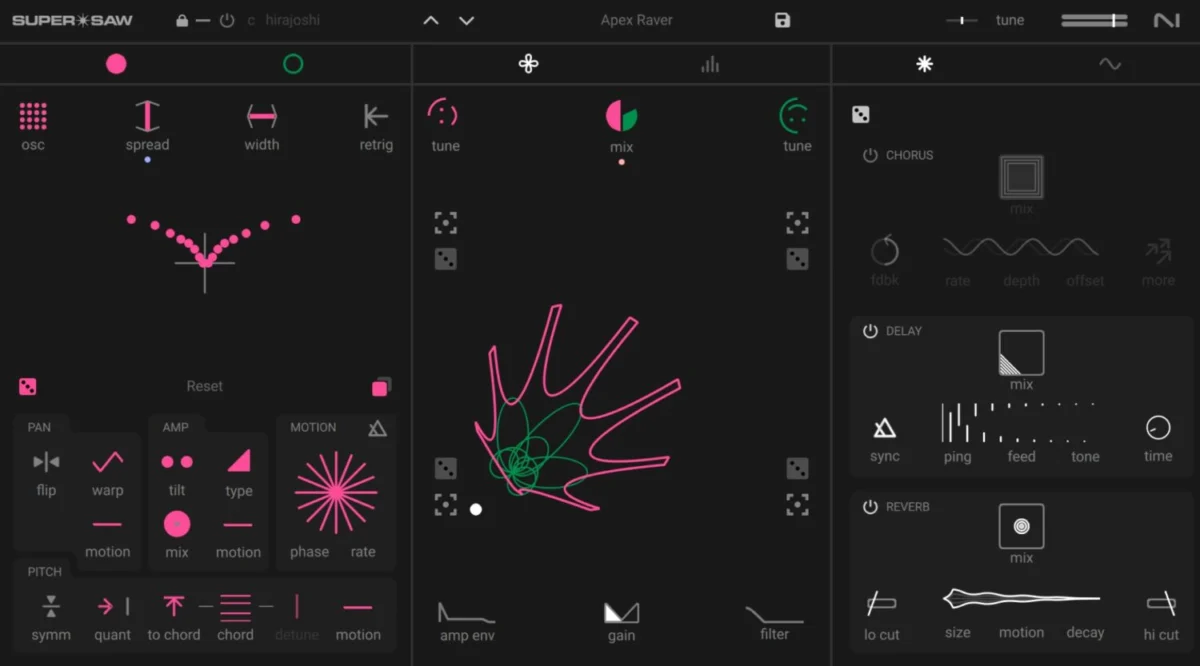
Native Instruments has officially announced the release of SuperSaw, a specialized software synthesizer developed in close collaboration with the influential producer and PC Music founder A. G. Cook. This new virtual instrument is built specifically to harness and expand upon the "super saw" synthesis technique, a staple of electronic music that has defined genres ranging from 1990s trance to contemporary hyperpop. By combining traditional subtractive synthesis principles with modern interpolation technology and a streamlined user interface, SuperSaw aims to provide producers with a versatile tool for creating high-energy leads, dense pads, and intricate rhythmic textures. The collaboration marks a significant moment for Native Instruments as it continues to align its product development with avant-garde figures in the pop and electronic music landscapes.
Technical Architecture and Core Synthesis Features
At the heart of SuperSaw lies a dual-oscillator architecture designed to maximize the harmonic density of the sawtooth waveform. The instrument utilizes two independent oscillator banks, each capable of generating up to 16 detuned sawtooth waves simultaneously. This stacking effect creates the thick, buzzing "wall of sound" characteristic of the super saw aesthetic. Unlike traditional synthesizers where detuning might be a global setting, SuperSaw allows for granular control over the spread and phase of these waves, enabling a spectrum of sounds from precise, laser-like leads to chaotic, wide-stereo textures.
The most distinctive feature of the synthesizer is the X/Y Morpher. This central control allows users to store four distinct sound states—effectively "snapshots" of the instrument’s parameters—and transition between them in real-time. By moving a cursor across the X/Y grid, the software continuously interpolates all internal values, allowing for fluid timbral shifts that would be difficult to achieve through standard automation. This functionality is particularly useful for live performance and for creating evolving pads that require constant movement.
Complementing the oscillator banks is a comprehensive suite of modulation and shaping tools. The instrument includes per-voice glide and offset controls, which provide a level of micro-tonal variation and organic "drift" often missing in digital synthesis. The filtering section features a multimode filter capable of high-pass, low-pass, and band-pass operations, allowing producers to carve out specific frequencies within the dense harmonic output of the stacked oscillators. Additionally, the integrated effects chain and chord/scale constraints ensure that the instrument remains musically coherent even when pushed to experimental extremes.
The Evolution of the Super Saw: A Historical Context
The release of Super*Saw represents the latest chapter in a synthesis history that began nearly three decades ago. The "Super Saw" waveform was first introduced by the Roland Corporation in 1996 with the release of the JP-8000 analog modeling synthesizer. Roland’s innovation was to emulate the sound of seven detuned sawtooth oscillators using a single digital oscillator, providing a massive sound that required significantly less processing power than traditional multi-oscillator setups.
Throughout the late 1990s and early 2000s, this sound became the definitive element of the "Anthem Trance" movement, characterized by euphoric, high-register melodies. As electronic music evolved, the super saw found its way into Hardstyle, EDM, and eventually the "Future Bass" genre of the 2010s. However, it was the emergence of the "hyperpop" movement—led largely by A. G. Cook and his PC Music collective—that reinvented the super saw as a tool for maximalist, high-definition pop music.
By partnering with A. G. Cook, Native Instruments is tapping into this modern lineage. Cook’s work with artists like Charli XCX, Caroline Polachek, and the late SOPHIE helped redefine the digital "sheen" of the super saw, moving it away from its trance roots and into a more experimental, plasticized sonic palette. Super*Saw is designed to encapsulate this specific aesthetic, offering a library of presets that reflect Cook’s signature approach to sound design.
Strategic Collaboration and Development Timeline
The development of Super*Saw follows a multi-year trend of Native Instruments collaborating with high-profile artists to create bespoke tools. Previous successes in this vein include collaborations with Noah "40" Shebib for the "40’s Very Own" series and Alicia Keys for the "Alicia’s Keys" piano library. The partnership with A. G. Cook represents a strategic move to capture the interest of the "bedroom producer" demographic and the experimental pop community.
While the exact development timeline for Super*Saw has not been disclosed in full, the project reportedly grew out of Cook’s desire for a streamlined tool that could replicate the complex routing and stacking he frequently employed in his own productions. Native Instruments’ engineering team worked to translate these complex workflows into a single, cohesive interface. The objective was to remove the technical barriers associated with multi-tracking and manually detuning dozens of oscillators, providing a "one-stop shop" for the hyper-processed sound that has become synonymous with Cook’s production style.
The instrument’s release also aligns with a broader corporate shift at Native Instruments. Since its merger with iZotope and the subsequent formation of the "Soundwide" group (now operating under the unified Native Instruments brand), the company has focused on creating "intelligent" tools that bridge the gap between professional engineering and creative accessibility. Super*Saw fits this mold by offering high-end synthesis capabilities behind an intuitive, modern UI.
Market Positioning and Industry Implications
SuperSaw enters a highly competitive market for software synthesizers. It faces direct competition from industry standards such as Xfer Records’ Serum, Vital Audio’s Vital, and Native Instruments’ own Massive X. However, SuperSaw distinguishes itself by its hyper-specialization. Rather than attempting to be a "do-it-all" wavetable synthesizer, it focuses exclusively on the sawtooth aesthetic and the specific workflow of a world-renowned producer.
Priced at US$99 / €99, the instrument is positioned as an affordable entry point for producers looking to replicate the "PC Music" sound. The inclusion of a curated preset library is a significant value proposition, as it provides immediate access to the professional-grade sounds used in chart-topping pop hits. Industry analysts suggest that this "boutique" approach to software—where a plugin is marketed around a specific artist’s brand—is likely to become more prevalent as the market for general-purpose synthesizers becomes increasingly saturated.
Furthermore, the launch of Super*Saw highlights the growing importance of "morphing" and "interpolation" in modern sound design. The X/Y Morpher reflects a shift away from static sound presets toward dynamic, performance-oriented instruments. This trend is driven by the needs of modern creators who demand tools that can evolve over the course of a track without requiring exhaustive manual programming.
Official Responses and Artist Involvement
In statements regarding the launch, A. G. Cook emphasized the importance of accessibility and the unique character of the sawtooth wave. Cook noted that the sawtooth is often considered the most "basic" of waveforms, yet its potential for complexity is nearly limitless when stacked and manipulated. He expressed that the goal of Super*Saw was to create an instrument that felt both "physical and digital," capturing the raw energy of analog hardware with the precision of modern software.
Native Instruments has echoed these sentiments, highlighting the collaborative nature of the project. The company’s product specialists have pointed out that while the instrument is simple to use, its internal engine is sophisticated enough to handle the high CPU demands of 32 simultaneous oscillators without compromising stability. This balance of performance and ease of use was a primary focus during the beta testing phase, ensuring that the plugin would be viable for both studio production and live performance environments.
Early feedback from the production community has been largely positive, with many praising the instrument’s "instant-gratification" factor. Producers have noted that while similar sounds can be achieved in other synthesizers, the specific voicing and the X/Y Morpher in Super*Saw provide a unique character that is difficult to replicate elsewhere.
Technical Specifications and Availability
Super*Saw is available for immediate download through the Native Instruments website and the Native Access portal. It is compatible with both macOS and Windows operating systems and supports VST3, AU, and AAX plugin formats.
Key Technical Specifications:
- Oscillators: Two banks of up to 16 stacked sawtooth waves each.
- Modulation: X/Y Morpher with four assignable sound states and continuous interpolation.
- Controls: Per-voice glide, offset, and global spread/detune.
- Filtering: Multimode filter (LP, HP, BP) with dedicated resonance and cutoff controls.
- Utilities: Integrated chord and scale constraints for melodic consistency.
- Content: A comprehensive library of presets designed by A. G. Cook and the NI sound design team.
- Price: US$99 / €99.
As the music industry continues to embrace the digital-first aesthetics of the 21st century, tools like Super*Saw are likely to play a pivotal role in shaping the sound of the next generation of pop and electronic music. By codifying the techniques of a visionary producer like A. G. Cook into a commercial product, Native Instruments has provided a bridge between underground innovation and mainstream production.
