

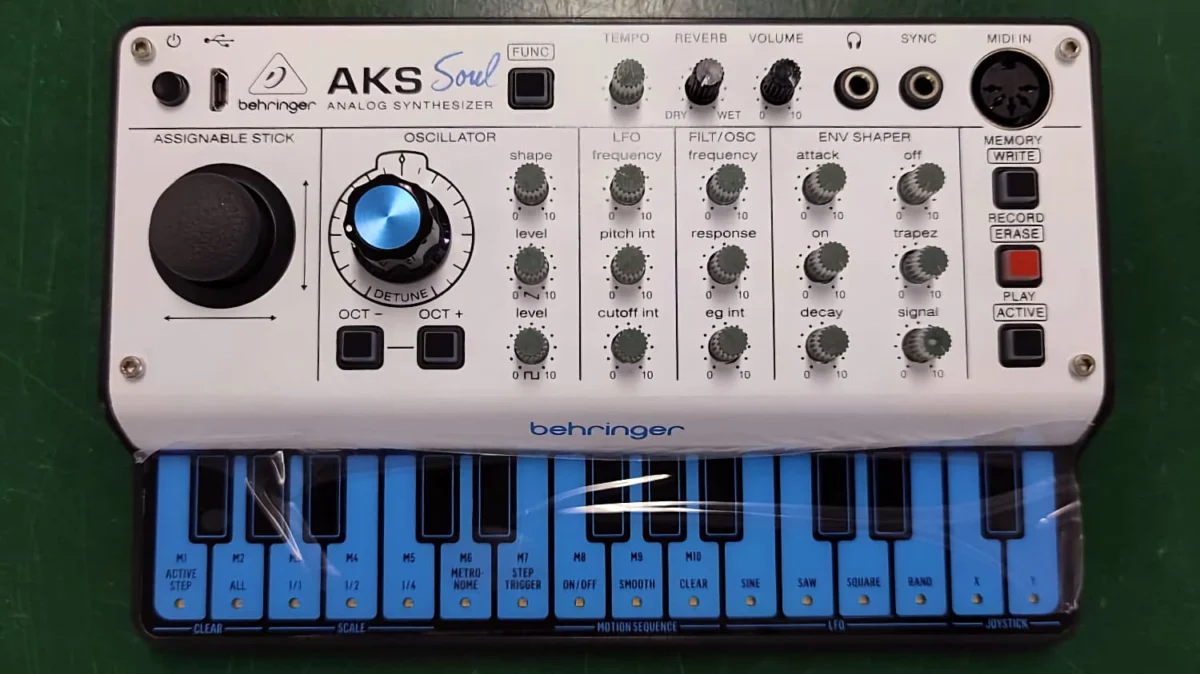
Behringer has officially released a comprehensive first look at the AKS Mini, a compact analog synthesizer that draws heavy inspiration from the legendary EMS Synthi AKS. The announcement, accompanied by a detailed demonstration video, marks a significant milestone in a development cycle that began in 2022. By distilling the complex architecture of one of the most revered synthesizers in music history into a portable, modern format, Behringer aims to provide musicians with the distinctive sonic character of the 1970s at a fraction of the cost and size of the original hardware.
The AKS Mini is described by the manufacturer as a portable polyphonic analog synthesizer that maintains the integrity of the original Electronic Music Studios (EMS) circuitry while introducing modern digital conveniences. Key features highlighted in the release include programmable patches, a 16-step motion sequencer, and what Behringer asserts is a faithful reproduction of the original AKS Voltage Controlled Oscillator (VCO) and Voltage Controlled Filter (VCF) designs. This release represents the latest entry in Behringer’s broader initiative to "democratize" vintage synthesis by recreating rare and prohibitively expensive instruments for a mass-market audience.
Historical Context: The Legacy of the EMS Synthi AKS
To understand the significance of the AKS Mini, it is necessary to examine the heritage of the EMS Synthi AKS. Originally introduced in 1971 by Electronic Music Studios, a British company founded by Peter Zinovieff, David Cockerell, and Tristram Cary, the Synthi AKS was a portable version of the VCS3 (often called "The Putney"). The Synthi AKS was housed in a Spartan blue plastic briefcase and featured a unique pin-matrix patch board rather than traditional patch cables, making it a favorite among experimental and progressive musicians.
The original instrument’s most iconic appearance is undoubtedly on Pink Floyd’s 1973 masterpiece, The Dark Side of the Moon. The frantic, bubbling sequence in the track "On the Run" was created using the Synthi AKS’s built-in sequencer and noise generator. Beyond Pink Floyd, the Synthi and VCS3 were staples in the studios of Brian Eno, Jean-Michel Jarre, and Hawkwind. Because the original units were handmade and produced in limited quantities, they have become exceptionally rare in the contemporary market. Vintage units frequently command prices upwards of $15,000 to $25,000, placing them far out of reach for the average producer.
Behringer’s decision to recreate this specific architecture follows a pattern of identifying "cult classic" instruments and re-engineering them using modern surface-mount technology (SMT). While the original Synthi AKS was a monophonic instrument known for its unstable but harmonically rich oscillators, Behringer’s AKS Mini introduces polyphony, a move that significantly expands the harmonic capabilities of the original design.
Technical Specifications and Design Architecture
The AKS Mini distinguishes itself from Behringer’s previous full-sized clones by adopting a "Mini" form factor, similar to their "Soul" and "Spirit" series of micro-synths. Despite its diminutive size, the device seeks to replicate the specific behavior of the EMS filters and oscillators.
Oscillators and Filters
At the heart of the AKS Mini are the recreated VCOs and VCFs. The original EMS design was famous for its "diode ladder" filter, which offered a different resonance character compared to the Moog transistor ladder or the ARP 4072 filter. Behringer claims to have meticulously modeled these components to ensure the "unpredictable" and "organic" feel of the original remains intact. The inclusion of polyphony suggests that the internal architecture likely utilizes multiple voice cards or a sophisticated digital control system managing the analog signal path.
The Patching System and Interface
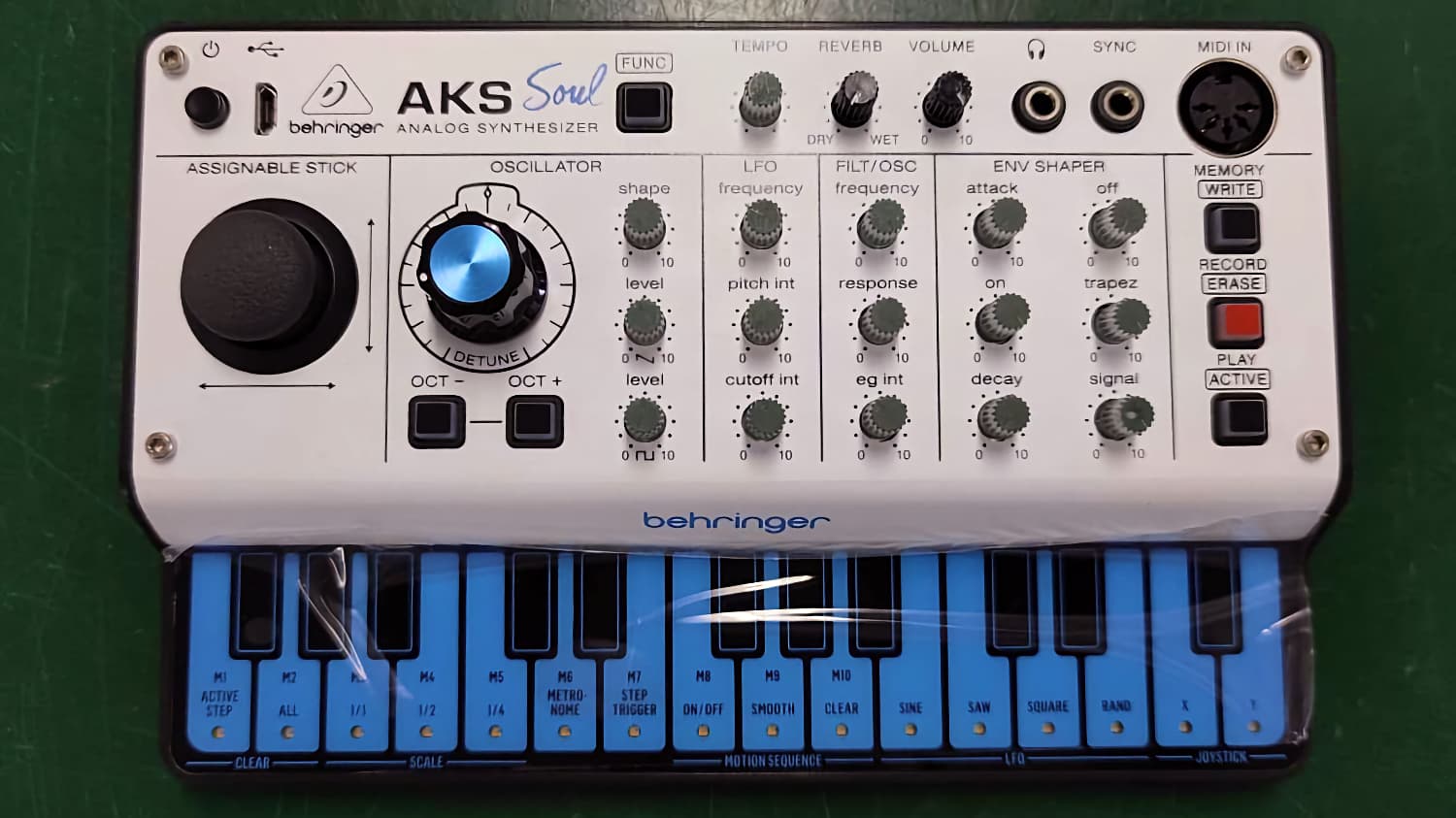
One of the most defining characteristics of the original Synthi AKS was its 16×16 pin matrix. In the AKS Mini, this matrix has been reimagined for a smaller interface. While the video demonstration shows a streamlined control set, the inclusion of "programmable patches" indicates that the unit can save and recall settings—a feature the original 1971 unit lacked entirely. This digital recall system addresses one of the primary frustrations of vintage EMS users: the inability to perfectly replicate a sound once the pins were moved.
Sequencing and Connectivity
The AKS Mini features a 16-step motion sequencer, allowing users to record parameter changes over time. This aligns the synth with modern production workflows, where automation and movement are essential. Furthermore, the unit includes a touch-sensitive keyboard, mirroring the "KS" (Keyboard Sequencer) portion of the original Synthi AKS, which used a flat capacitive touch plate rather than traditional piano-style keys.
Chronology of Development
The journey of the AKS Mini from concept to "first look" has spanned over two years, reflecting the broader challenges faced by the music technology industry during the early 2020s.
- May 2022: Behringer first announced the AKS Mini via social media. At the time, the company suggested a target price of $99, positioning it as an entry-level gateway into the world of EMS-style synthesis.
- 2022–2023: Development was slowed by global semiconductor shortages. During this period, Behringer frequently updated its followers on the status of various "mini" projects, noting that while the engineering was complete, the availability of specific chips prevented mass production.
- Late 2023: Behringer moved into the final prototyping phase, refining the firmware for the sequencer and the digital patch-management system.
- July 2024: The release of the "First Look" video signals that the product has entered the final pre-production or initial production stage.
Official statements from the company indicate that the synth is expected to be available through major retailers within "a few months," suggesting a late 2024 or early 2025 shipping date.
Industry Implications and Market Reaction
The introduction of the AKS Mini is likely to have a multifaceted impact on the synthesizer market. First, it continues the trend of "miniaturization" in the hardware world. As home studio spaces become more crowded, there is a growing demand for instruments that offer a "big sound" in a footprint small enough to fit on a desktop or in a backpack.
The Democratization of Sound
By targeting a significantly lower price point than boutique recreations, Behringer is effectively opening up the "EMS sound" to a new generation of musicians. Critics of the company often point to the ethical concerns of cloning designs from existing manufacturers; however, in the case of the Synthi AKS, the original company has not produced the unit in significant quantities for decades, leaving a vacuum in the market that Behringer is now filling.
Impact on the Boutique Market
There are several high-end boutique manufacturers, such as Erica Synths with their "Syntrx" line, that have created premium "spiritual successors" to the Synthi. The AKS Mini does not necessarily compete with these $2,000+ instruments in terms of build quality or depth of modulation, but it does offer a "flavor" of that experience for hobbyists and students.
Official Responses and Analyst Perspectives
While official reviews are pending the unit’s retail release, early reactions from the synthesis community have been cautiously optimistic. Technical analysts note that the challenge for Behringer will be maintaining the "instability" that made the original EMS units famous. The Synthi was beloved because it felt like a living, breathing entity—often difficult to tune and prone to unexpected sonic "happy accidents."
"The original EMS circuitry was notoriously finicky," says an industry analyst specializing in analog hardware. "If Behringer has managed to stabilize the oscillators for modern polyphonic use while keeping the grit of the diode filter, they will have a very successful product on their hands. The $99 price point mentioned in 2022 was ambitious; even if it launches at $129 or $149, it remains a disruptor."
Behringer has not yet confirmed the final MSRP, stating only that pricing will be announced closer to the shipping date. Given the current economic climate and the cost of raw materials, many industry observers expect a slight increase from the original $99 estimate, though the unit is still expected to remain under the $200 threshold.
Conclusion and Future Outlook
The Behringer AKS Mini represents a bridge between the avant-garde experimentation of the early 1970s and the accessible, portable technology of the 2020s. By integrating the core DNA of the EMS Synthi AKS into a device that features motion sequencing, patch memory, and polyphony, Behringer is attempting to modernize a classic rather than simply duplicating it.
As the music industry awaits the final release, the AKS Mini stands as a testament to the enduring appeal of analog synthesis. Whether it can truly capture the "magic" that Pink Floyd found in a blue briefcase fifty years ago remains to be seen, but its arrival ensures that the legacy of Peter Zinovieff’s vision will continue to resonate in modern electronic music production. The coming months will reveal if the AKS Mini can live up to its heritage when it finally reaches the hands of synthesists worldwide.
