

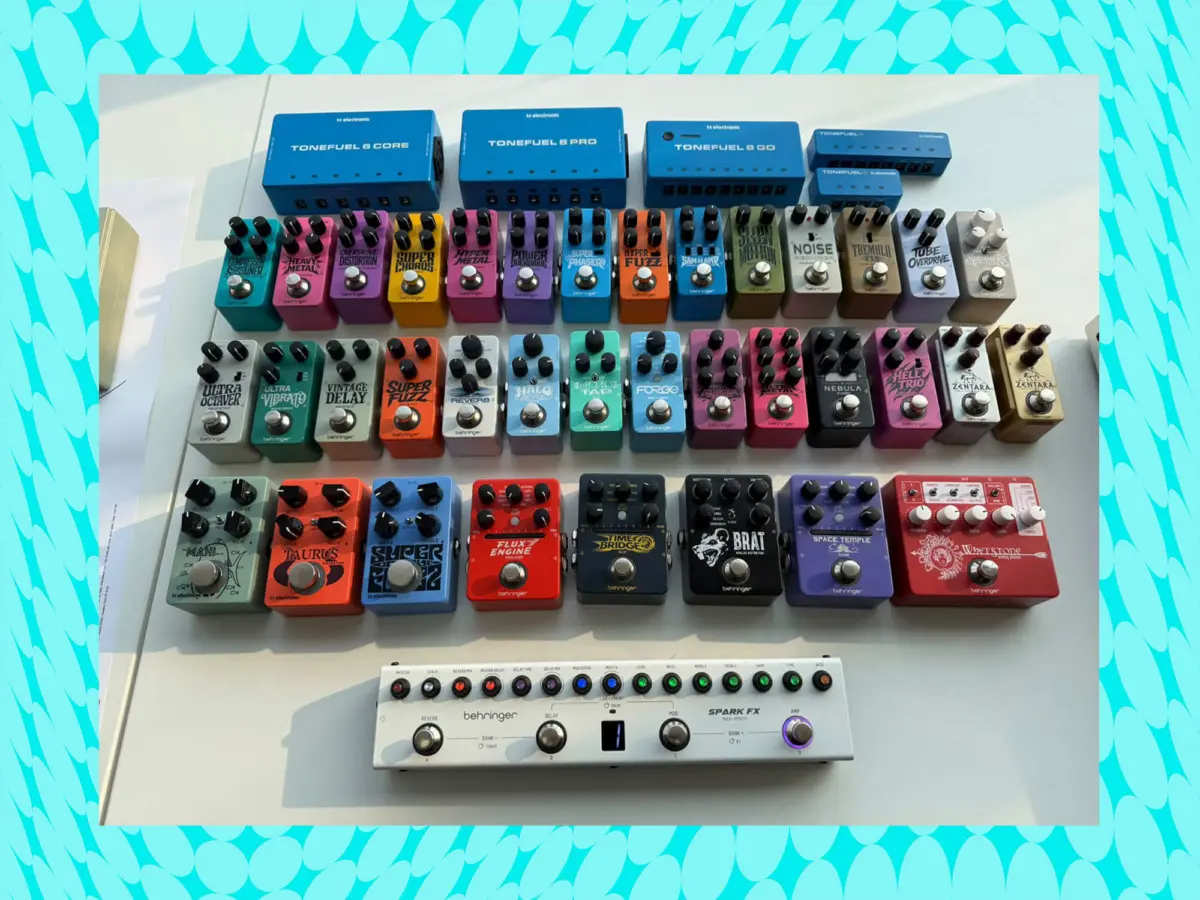
The global music gear industry is once again abuzz with controversy following Behringer’s audacious announcement of a vast new line of ultra-affordable guitar effects pedals. Known for its disruptive strategies across synthesizers, mixers, and DJ equipment, the multinational giant has now set its sights squarely on the guitar effects market, promising 200 to 300 new analog and digital pedals priced between an unprecedented $10 and $15 each. This move, unveiled via a social media post that began with a mock apology to guitar players, has sent shockwaves through the industry, particularly among the independent and boutique pedal manufacturers who view it as a direct threat to their livelihoods and the very ecosystem of innovation they have cultivated.
The Provocative Announcement and Behringer’s Strategic Play
Behringer’s entry into the guitar pedal market was heralded with characteristic flair and a dash of calculated provocation. The social media post, framed as an apology for having been "so busy disrupting synthesizers, mixers and DJ gear" that it "forgot about guitarists," quickly outlined its remedy: an extensive catalogue of 200 to 300 all-metal, analog and digital pedals. The stated price point of $10 to $15 per unit is remarkably aggressive, significantly undercutting even many existing mass-produced budget options, let alone the premium boutique market. The company also promised a range spanning "legendary legacy pedals to wildly innovative new designs," crucially adding that it would include "open-source pedals players can hack and modify themselves," a detail designed to appeal to the DIY community.
The post directly acknowledged the potential fallout, asking rhetorically, "will this upset a few boutique pedal manufacturers? Probably. Sorry about that," punctuated with a laughing emoji. This statement, coupled with a photo teasing a substantial initial lineup, underscored Behringer’s awareness of the disruption it intended to cause. Furthermore, in the comments section, the company invited users to suggest pedals they would like to see cloned or created, explicitly asking for schematics, reinforcing its strategy of responding directly to market demand, often by replicating existing popular designs. Behringer’s core philosophy, reiterated in their announcement, asserts that "great tone should come from your fingers, not your credit card," positioning itself as the democratizer of sound for musicians on any budget.
The Boutique Backlash: Intensive Care Audio’s Urgent Call
The reaction from the independent pedal manufacturing community was swift and vehemently negative. London-based Intensive Care Audio (ICA), a respected boutique builder, was among the first and most vocal critics. Reposting Behringer’s announcement on their Instagram story, ICA minced no words, stating, "Behringer openly joking about destroying small independent builders. This is fucking shameful behaviour." This immediate outcry highlighted the deep-seated anxieties within a sector often characterized by passion, craftsmanship, and a tight-knit community.
In a subsequent, more detailed post, ICA articulated the severe pressures already faced by small-scale operations. "Running a small operation like this is becoming increasingly difficult due to a wide range of complicated issues," they wrote, citing a feeling that "everything is against us right now." The company expressed profound dismay at Behringer’s move, lamenting, "The last thing we need is a giant, faceless multinational company gleefully revelling in destroying the livelihoods of thousands of small builders."
ICA also raised critical questions regarding the originality of Behringer’s designs. "Behringer did not design these circuits for the most part. They did not live on a shoe string budget to carry on doing what they love," their post continued. This accusation strikes at the heart of a long-standing debate surrounding Behringer’s business model: whether it primarily innovates or replicates. The sentiment expressed by ICA, that "Things like this make it hard to want to bother carrying on," is a stark warning that resonates deeply within the independent pedal scene, which has seen a boom in creativity and specialized offerings over the past decade. Intensive Care Audio, founded in 2020, exemplifies this vibrant sector, having quickly gained recognition for distinctive designs like the Fideleater lo-fi chorus and the Vena Cava Filter, the latter notably used by IDLES guitarist Lee Kiernan. Such innovative, characterful pedals are the lifeblood of the boutique market, offering unique sonic textures often unavailable from larger manufacturers.
A History of Disruption: Behringer’s Business Model and Past Controversies
Behringer’s strategy in the guitar pedal market is not an isolated incident but rather a continuation of a well-established business model that has consistently disrupted various segments of the music gear industry. The company, founded by Uli Behringer in 1989, built its initial reputation on producing affordable alternatives to professional studio and live sound equipment. In recent years, it has gained significant notoriety for its aggressive entry into the synthesizer market, releasing numerous affordable clones of classic, often long-discontinued, analog synthesizers from brands like Moog, Roland, and Korg. These products, while widely criticized by some for their lack of originality and impact on intellectual property, have also been praised for making iconic sounds accessible to a new generation of musicians who could never afford the prohibitively expensive originals.
This "democratization of gear" philosophy is central to Behringer’s public defense. Its critics, however, frequently argue that this model often relies on copying others’ designs, a charge that has led to several legal disputes. A notable example in the guitar effects world was the lawsuit filed by Klon, the manufacturer of the legendary Klon Centaur overdrive pedal, against Behringer over its alleged clone. While the details of that specific case are complex and often involve questions of patent and copyright law regarding circuit designs, it underscores the contentious nature of Behringer’s approach. Defenders often counter that many of the targeted "classic" designs are long out of patent protection or are based on widely understood electronic principles, and that their products fill a void by making unavailable or unaffordable sounds accessible.
The sheer scale of Behringer’s operation, backed by its parent company Music Tribe, which also owns brands like Midas, Tannoy, and TC Electronic, enables it to achieve manufacturing volumes and cost efficiencies that are simply impossible for small independent builders. This global manufacturing capability in regions with lower labor costs allows Behringer to offer products at price points that defy traditional market logic, particularly for analog circuitry.
The Economics of Pedal Manufacturing: A Tale of Two Worlds
The pricing strategy of $10-$15 per pedal is not merely provocative; it highlights a stark economic disparity within the industry. For boutique builders, particularly those in Western countries like the USA and UK, the cost of doing business has been steadily rising. Factors such as increased tariffs on imported components, fluctuating global shipping costs, inflation impacting raw materials (resistors, capacitors, enclosures, potentiometers), and higher labor costs (even for small teams) all contribute to a significantly higher per-unit manufacturing expense. Many small builders source high-quality, often hand-selected, components and engage in meticulous, often hand-wired assembly processes that are inherently more expensive and time-consuming than mass production.
A typical boutique overdrive pedal, for example, might retail anywhere from $150 to $300 or more, reflecting not just the cost of components and assembly, but also the research and development, design originality, branding, marketing, and the profit margin necessary for a small business to survive and innovate. The average cost for parts alone for a boutique pedal can easily exceed $30-50, before factoring in labor, R&D, marketing, and distribution. When Behringer offers a comparable pedal for $15, it forces a direct comparison that, on price alone, is devastating for smaller entities.
This pricing strategy is only viable due to Behringer’s massive manufacturing scale, vertical integration, and optimized supply chains. A small workshop in North London, like Intensive Care Audio, or any similar independent builder globally, simply cannot match these economies of scale, regardless of the quality or ingenuity of their designs. The global economic climate, characterized by supply chain disruptions, rising inflation, and reduced consumer spending power, has already placed immense pressure on small businesses worldwide, leading to reduced margins and increased difficulty in sustainability. Behringer’s move intensifies this pressure significantly, forcing a reevaluation of business models across the industry.
Innovation vs. Accessibility: A Philosophical Crossroads
The debate ignited by Behringer’s announcement touches upon a fundamental philosophical tension within the music technology landscape: the balance between innovation driven by independent creators and the desire for widespread accessibility. The boutique pedal market has been a crucible of innovation over the last decade, with small makers pushing the boundaries of effects design, exploring new sonic territories, and offering unique user experiences. Many iconic sounds and novel circuit architectures that later become industry standards originated in these small workshops. Their creative risks and specialized niches have enriched the guitar effects ecosystem immensely.
Behringer’s stated aim to make "great tone" accessible aligns with a long-standing tradition of affordable gear enabling more musicians to participate and create. However, critics argue that if the economic viability of these innovative boutique builders is undermined, the wellspring of future innovation could dry up. If small companies cannot sustain themselves through their unique designs, there will be fewer incentives and resources for the groundbreaking R&D that often defines the cutting edge of the industry. The "open-source" aspect of Behringer’s plan further complicates this. While open-source principles can foster community and customization, applying them to commercially replicated "legacy" designs can blur ethical lines concerning intellectual property and fair competition, even if not strictly illegal.
The question of how many of the 200 to 300 proposed Behringer pedals will be direct copies of existing or legacy designs versus truly original concepts remains crucial. While Behringer has indicated a mix of "legendary legacy pedals to wildly innovative new designs," the historical precedent leans heavily towards the former. This strategy capitalizes on established market demand for specific sounds, bypassing the costly and time-consuming process of original R&D that boutique manufacturers undertake.
The Road Ahead: Implications for the Guitar Effects Market
The implications of Behringer’s aggressive foray into the guitar pedal market are far-reaching and complex.
- Market Consolidation: The most immediate concern is the potential for market consolidation. Smaller, less established boutique builders, already operating on thin margins, may find it impossible to compete on price, potentially leading to closures or acquisitions.
- Impact on Innovation: While Behringer’s move could democratize access to certain sounds, it could simultaneously stifle the very innovation that the boutique market thrives on. If the financial rewards for original design diminish, so too might the incentive for risky, experimental R&D.
- Consumer Choice and Value Perception: Consumers will face an unprecedented choice between ultra-affordable options and higher-priced boutique alternatives. This could shift consumer perception of "value," potentially making it harder for boutique brands to justify their pricing, even if their products offer superior quality, unique features, or ethical production.
- Ethical Considerations: The debate around "cloning" and intellectual property will intensify. While some circuits are decades old and out of patent, the ethical implications of directly copying the unique sonic signatures or aesthetic designs of contemporary boutique pedals remain a contentious point.
- Evolution of the Boutique Market: Boutique builders may be forced to further differentiate themselves, focusing even more intensely on extreme niche markets, bespoke services, unparalleled quality, unique aesthetics, or community engagement to justify their pricing and maintain relevance. Some might pivot to more complex, multi-effect units or digital platforms where Behringer’s analog cloning model is less disruptive.
- Accessibility for New Musicians: On a positive note, the availability of extremely cheap pedals could lower the barrier to entry for aspiring guitarists, allowing them to experiment with a wider range of effects earlier in their musical journey, potentially fostering a new generation of effects enthusiasts.
Behringer’s stated intention to listen to the community for suggestions, even asking for schematics, suggests a reactive and opportunistic product development strategy. This approach, while efficient for identifying market gaps and popular designs, reinforces the apprehension among small makers who have poured their lives into creating those very designs. How many of these new pedals will directly impact the business of the independent effects makers that have driven so much of the innovation behind the effects boom of the last decade remains to be seen. However, the anxiety and concern expressed by companies like Intensive Care Audio are palpable, signaling a new, potentially turbulent, chapter for the vibrant and diverse world of guitar effects pedals.
