

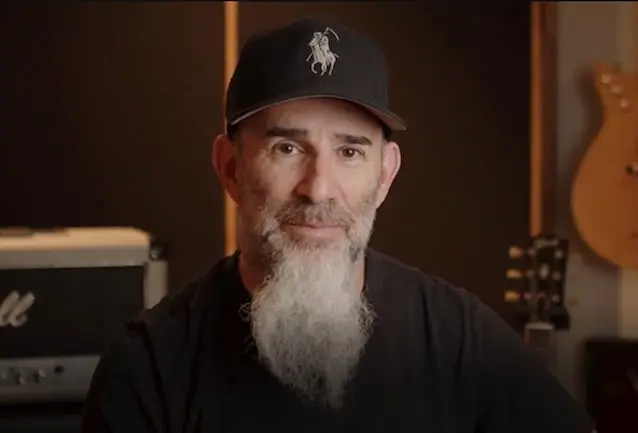
The official Bon Scott YouTube channel has ignited a wave of nostalgia and admiration with the release of a new video featuring Anthrax guitarist Scott Ian. In the compelling interview, Ian recounts a pivotal moment in his formative years: the first time he encountered the raw, electrifying voice of Bon Scott, then the frontman for AC/DC, within the bustling confines of a junior high school lunchroom in Queens, New York. The track that seared itself into his young consciousness was "Rock ‘N’ Roll Damnation" from the band’s 1978 album, "Powerage." This initial sonic assault proved to be an indelible experience, hooking Ian instantly and setting him on a lifelong path of reverence for Scott’s unique vocal prowess, his masterful storytelling, and the profound impact AC/DC had on his own musical journey. The interview delves into Scott Ian’s deep appreciation for Bon Scott’s lyrical artistry, his undeniable swagger, and the formative influence the Australian rock legends had on Anthrax’s sound. It also reveals a poignant personal regret: missing the opportunity to witness Bon Scott perform live during AC/DC’s iconic "Highway To Hell" tour.
The Genesis of a Lifelong Devotion: "AC/DC with Bon" as the Pinnacle of Rock
Scott Ian unequivocally declares Bon Scott-era AC/DC as his "favorite band of all time." However, he often qualifies this statement with a crucial distinction, emphasizing that his adoration is specifically for the band during Scott’s tenure. "I always have to preface it with when I get asked that question, ‘What’s your favorite band?’ And I say, ‘AC/DC with Bon.’" He elaborates on this fervent allegiance, explaining, "That moment in time, for me, that’s my favorite music to ever listen to ever." Ian fondly reminisces about the 1970s, a period when he and his peers immersed themselves in AC/DC’s catalog. He notes the band’s distinctive appeal, particularly in contrast to the theatrical spectacle of bands like KISS, which dominated the era’s visual landscape. "And I think about those times back in the ’70s, listening to those records, and seemingly not something that you should be so fascinated by because it wasn’t like KISS. It wasn’t like this big image, and they’re hiding themselves behind. But it was just something about the fact that they were making rock ‘n’ roll music that had been done, obviously at that point, for decades, but had done something different."
The transformative element, in Ian’s estimation, was Bon Scott himself. "And to me, the difference was Bon. Bon was different than all the rock ‘n’ roll that came before, in my mind." He candidly admits his limitations as a music critic but asserts the unparalleled nature of Scott’s vocal delivery. "I’m not a rock critic, but in my mind, I had never heard anything like it, and that’s what made it for me." For Ian and his generation, AC/DC with Bon Scott occupied a similar cultural and emotional space as seminal bands like Led Zeppelin and The Beatles did for previous generations. "They were my LED ZEPPELIN. They were my BEATLES… You know what I mean? For my generation of kids, it was all about Bon." This sentiment underscores the profound impact AC/DC had on shaping the musical sensibilities of a generation of burgeoning rock fans, with Bon Scott at the epicenter of that seismic shift.
The Poetic Grit of Bon Scott’s Lyrics: Realism and Relatability
Ian’s admiration extends beyond Scott’s vocal delivery to his exceptional lyrical abilities. He characterizes Bon Scott’s lyrics as "bold, cheeky, and packed with swagger," but importantly, he sees them as possessing a punk-like realism. "I feel like Bon’s lyrics were way more punk in that they were just more realistic." He cites examples such as "It’s A Long Way To The Top" and "Rock ‘N’ Roll Singer," noting the absence of any perceived artificiality or "cheese." "You could read the lyrics to ‘It’s A Long Way To The Top’ or ‘Rock ‘N’ Roll Singer,’ there’s no whiff of cheese anywhere, that kind of stuff, which in the hands of other vocalists or singers probably would’ve been terrible." Instead, Scott’s genius lay in his ability to imbue his narratives with a relatable and authentic quality. "But he’s telling you a story in a way that’s just so relatable and so real life and just hardcore — real. There’s no fluff, there’s no bullshit."
However, Ian is quick to distinguish Scott’s narratives from mundane reportage. "But also it’s not like you’re reading a story in the newspaper." He highlights Scott’s masterful command of language, his ability to "turn a phrase," which maintained listener engagement. "The way he can turn a phrase also then keeps you interested as well, because it just doesn’t feel like I’m reading a generic story about some guy that wanted to be in a band." This skill, for Ian, was a testament to Scott’s inherent genius. "It’s just part of his genius, that he could take sometimes something that would be completely mundane and actually make it interesting."
The Unwavering Authenticity: Bon Scott’s "Pirate Tales"
Scott Ian further delves into the perceived sincerity and commitment embedded within Bon Scott’s lyrics, suggesting a complete absence of artifice or insincerity. "Bon, he doesn’t wink. You feel like he’s winking at you with some of these lyrics, but no." Ian articulates his belief that Scott was recounting genuine experiences, regardless of their veracity. "Whether or not some of it is true, I always believed this to be, this guy, he’s telling us stories from his life." He draws a compelling analogy to literature, stating, "If I was reading this in a book of poetry or an autobiography, I would absolutely believe that these pirate tales of his were all true." The power of Scott’s delivery lay in his total immersion and unwavering conviction. "And the fact that he was so all in and committed, that’s what truly made me feel like he’s not winking at us, that he doesn’t need to."
This unvarnished authenticity created a sense of shared understanding and intimacy with the audience. "Like we’re in on the joke because it’s all so real, and it’s almost like a ‘can you believe this?’ Like, ‘Can you believe this shit I’m talking about in these lyrics?’" For a young Ian, this provided a captivating glimpse into a life he found both exotic and profoundly compelling. "And it was fascinating to a then 15-, 16-year-old to have a window into… I keep using the word ‘pirate,’ because it truly was the first thing I thought of when I heard Bon Scott, and I had a window into this pirate’s life." He also notes the perceived enigmatic nature of the other band members at the time, further amplifying Scott’s individual charisma. "I didn’t know anything about anyone else in the band ’cause seemingly none of them spoke." This focus on Bon Scott as the primary storyteller and voice of the band solidified his larger-than-life persona in Ian’s young mind.
The Malcolm Young Pedigree: A Masterclass in Rhythm Guitar
Scott Ian’s admiration for AC/DC extends to the instrumental architects of their sound, particularly rhythm guitarist Malcolm Young. As a young teenager, Ian credits Young as his primary tutor, learning to play rhythm guitar by meticulously dissecting and emulating AC/DC’s intricate guitar work. "As a young teen, Ian actually learned how to play rhythm guitar by listening and playing along to AC/DC’s Malcolm Young, whom he considers the greatest rhythm guitarist of all time." This statement is not hyperbole for Ian; it represents a deeply ingrained truth about his musical development.
In a 2018 interview with Gretsch, Ian articulated the immediate and enduring impact of AC/DC’s music. "There is just an instant rush anytime I hear AC/DC," he stated. "It’s like mainlined into my brain. As soon as I hear him playing chords, I just get excited, still, after all these years. If I put on ‘Let There Be Rock,’ I feel the same now as I did 40 years ago. It moves me in exactly the same way." This visceral connection speaks to the timeless power of AC/DC’s core sound.
Ian further elaborated on the distinctiveness of Malcolm Young’s playing and its influence on his own approach. "Look, I don’t get to play big open chords in my band," he explained, referring to Anthrax’s thrash metal sound. "My band is all about down picking and palm muting, fast alternating — a completely different style of rhythm playing. So, when I get to hit really big chords and dig in, it is so much fun for me because it is the opposite of what I do. But it is what I grew up learning how to do. And it’s what I still love, going back to that. Anytime I can just pick up a guitar that sounds so good and feels so good, and then play chords that sound perfect, I could do it all day. It makes me happy. I could literally sit for an hour and play that A chord over and over again and not get bored." This demonstrates a profound appreciation for the fundamental power and satisfaction derived from Malcolm Young’s signature chord work, a style that, while different from his own band’s output, remains a foundational element of his musical identity.
The Enduring Legacy: Tributes Etched in Skin and Soul
The reverence Scott Ian holds for Malcolm and Angus Young is so profound that he has chosen to immortalize them through tattoos. "The number of artists who consider Malcolm Young an inspiration runs pretty deep, but not too many have gone so far to actually have his face inked into their own skin. Ian, though, has immortalized the late-great rhythm guitarist on his left bicep, along with his brother Angus Young on his right." These are not mere decorative pieces but deeply personal testaments to their significance in his life and career.
"Specifically, these guys, as a guitar player, mean everything to me," Ian explained. "That’s why I really wanted them on me because it makes me happy to be able to look at them every day." This physical manifestation of his admiration underscores the depth of his gratitude. He reiterates Malcolm Young’s role as his primary guitar educator. "Malcolm has always been my hero since day one because he basically taught me how to play guitar," Ian said. "As a kid with AC/DC albums, vinyl albums, in my little bed room on a turn table, I just used to sit and figure out how to play their songs. It was all Malcolm. You know? It was all him. So, I was learning to play specifically by listening to what he was doing. He was my guitar teacher. He was the reason I learned how to play rhythm guitar the way I do." This statement is a powerful testament to the impact of dedicated self-study and the profound influence of musical idols, particularly in the pre-internet era where learning resources were scarce.
The Unfulfilled Desire: Missing the "Highway To Hell" Tour
Despite his lifelong devotion, a significant personal regret for Scott Ian is his inability to have witnessed Bon Scott perform live during the "Highway To Hell" tour. This tour, which ran from 1979 to 1980, was AC/DC’s most successful to date, propelling them to global superstardom before Bon Scott’s untimely death in February 1980. The missed opportunity to experience Scott’s raw energy and captivating stage presence firsthand remains a source of lingering disappointment for the Anthrax guitarist. While the article doesn’t delve into the specific reasons for his absence, the sentiment highlights the intense desire of fans like Ian to connect with their musical heroes in a live setting, a desire that, in this instance, went unfulfilled. This regret adds a layer of human vulnerability to Ian’s passionate tribute, underscoring the transient nature of live performances and the enduring power of recorded music.
The Enduring Impact: Bon Scott’s Voice in the Pantheon of Rock Gods
The enduring impact of Bon Scott’s voice and AC/DC’s music, particularly from the era featuring Scott, continues to resonate decades later. Scott Ian’s candid reflections serve as a powerful reminder of the raw, unadulterated power of their sound. In a musical landscape often characterized by evolving trends and sonic experimentation, the timeless appeal of AC/DC’s hard-hitting rock and roll, powered by Bon Scott’s distinctive rasp and lyrical prowess, remains a constant. His ability to translate everyday experiences and rebellious attitudes into anthemic rock songs cemented his status as a true icon. The fact that a guitarist from a pioneering thrash metal band like Anthrax can still be so profoundly moved by the fundamental power chords and vocal delivery of Bon Scott-era AC/DC speaks volumes about the band’s enduring legacy and their place in the pantheon of rock gods. Scott Ian’s tribute, shared on the official Bon Scott YouTube channel, not only celebrates a beloved artist but also serves as a testament to the lasting power of authentic, no-nonsense rock and roll.
