

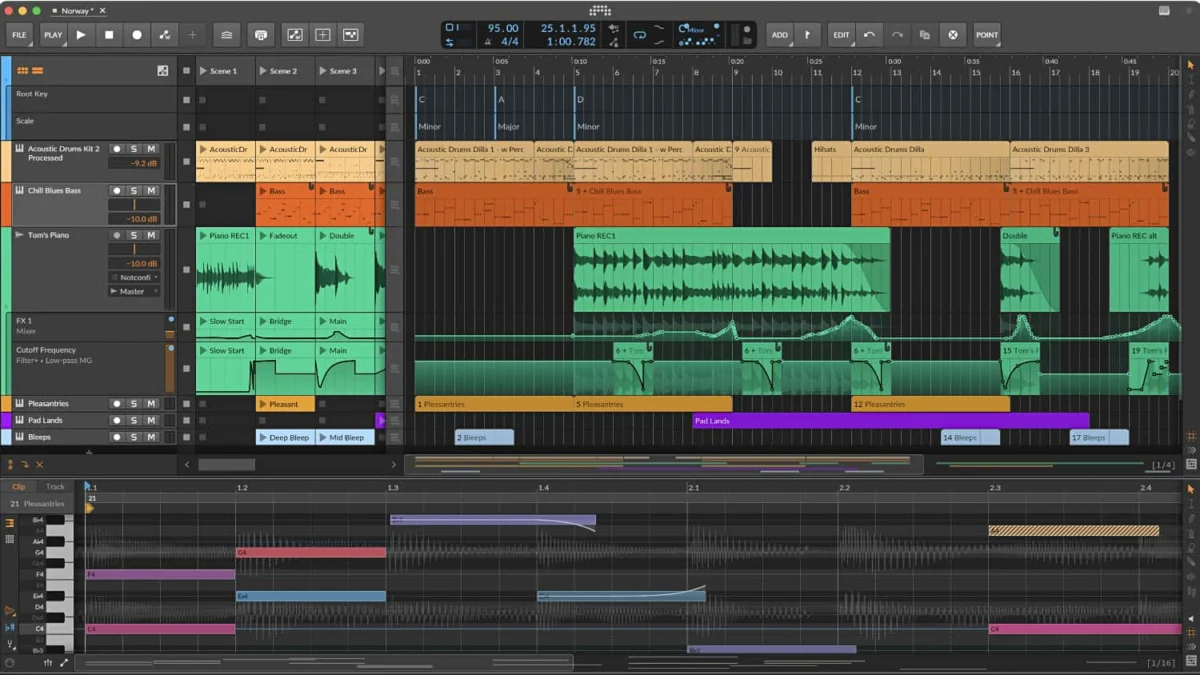
Bitwig GmbH, the Berlin-based music software developer, has officially announced the release of Bitwig Studio 6, the latest major iteration of its flagship digital audio workstation (DAW). This update represents a comprehensive overhaul of several core systems, focusing primarily on the refinement of automation workflows, project organization through clip aliasing, and the implementation of a sophisticated global key signature system. Since its initial debut in 2014, Bitwig Studio has positioned itself as a modular-first alternative to traditional recording software, and version 6 continues this trajectory by bridging the gap between non-linear composition and traditional arrangement-based production.
The release of Bitwig Studio 6 comes at a pivotal moment in the music technology industry, as professional producers increasingly demand tools that facilitate both creative experimentation and efficient project management. The update introduces several long-requested features, most notably Automation Clips and Clip Aliases, which are designed to streamline the complexities of modern electronic music production and film scoring. By decoupling automation from specific tracks and allowing for synchronized clip editing, Bitwig aims to reduce the mechanical overhead associated with large-scale project arrangement.
A New Paradigm for Automation: Automation Clips and Enhanced Editing
At the heart of the Bitwig Studio 6 update is a fundamental shift in how the software handles automation. Historically, DAWs have treated automation as either a track-based overlay or a fixed parameter within a MIDI or audio clip. Bitwig Studio 6 introduces Automation Clips, which treat automation as independent, moveable, and reusable blocks of data. This allows users to create complex modulation shapes or parameter movements and treat them as discrete objects that can be dragged, dropped, and looped across different sections of a project.
This new architecture addresses a significant pain point for sound designers and arrangers. In previous versions and competing software, repeating a specific filter sweep or volume swell across multiple parts of a song often required tedious copying and pasting or the manual drawing of curves. With Automation Clips, these movements can be saved in the library and deployed with the same ease as a drum loop. Furthermore, the automation editing engine has been upgraded to provide higher precision and more intuitive curve manipulation, allowing for smoother transitions and more rhythmic, synchronized parameter changes.
Supporting this is a suite of enhanced automation editing tools. These improvements include more responsive snapping behaviors, the ability to scale and transform multiple automation points simultaneously, and a refined visual interface that provides better feedback on how automation is interacting with the underlying audio or MIDI data. These technical refinements are intended to provide a more tactile feel to the digital environment, mimicking the precision of hardware controllers within a software context.
Structural Efficiency Through Clip Aliases
Another cornerstone of the Bitwig Studio 6 update is the introduction of Clip Aliases. This feature is designed to solve the logistical challenges of managing repetitive structures in a musical arrangement. In traditional DAW workflows, if a producer has a four-bar melody that appears four times in a song, and they decide to change one note, they must manually update all four instances.
Clip Aliases allow users to create "mirrored" versions of a clip. When an edit is made to the original "source" clip, every alias of that clip across the entire project—whether in the Clip Launcher or the Arrangement Timeline—is updated instantaneously. This non-destructive, linked editing system is particularly beneficial for composers working on complex arrangements where themes or motifs are frequently reprised. It ensures structural consistency while significantly reducing the time spent on repetitive editing tasks.
To provide flexibility, Bitwig has included an "Un-alias" function, allowing users to break the link for a specific instance if they wish to introduce a variation. This hybrid approach caters to the iterative nature of music production, where a composer might start with identical sections and gradually evolve them into unique movements.
Global Key Signatures and Harmonization Tools
Bitwig Studio 6 introduces a dedicated Key Signature system, a feature that integrates deeply with the DAW’s existing "Operators" and note-processing capabilities. For the first time, users can define a global key and scale for their project, which then propagates through various devices and editors.
This system is not merely a visual aid; it is functionally integrated into the software’s MIDI tools. New "Scale Awareness" features allow MIDI clips and the Bitwig "Grid" (the software’s modular synthesis and processing environment) to respond dynamically to the project’s key. For instance, note transformations and transpositions can be constrained to the set scale, ensuring that generative sequences or improvised melodies remain harmonically coherent.
The implementation includes support for multiple key signature changes within a single project timeline. This is a critical addition for film composers and experimental musicians who frequently utilize modulation and key shifts to drive emotional narratives. By centralizing key management, Bitwig Studio 6 reduces the cognitive load on the producer, allowing them to focus on the creative aspects of harmony rather than the technicalities of manual transposition.
Historical Context and Development Timeline
The launch of version 6 marks a decade of rapid evolution for Bitwig. Founded by a group of former Ableton developers, Bitwig GmbH set out to create a DAW that prioritized modularity and "the studio as an instrument."
- 2014: Bitwig Studio 1.0 – Introduced the hybrid Arrangement/Launcher view and a unique modulation system.
- 2017: Bitwig Studio 2.0 – Introduced a massive array of modulators (LFOs, Envelopes) that could be mapped to any parameter, including VST plugins.
- 2019: Bitwig Studio 3.0 – Debuted "The Grid," a fully modular sound design environment that allowed users to build their own synthesizers and effects from scratch.
- 2021: Bitwig Studio 4.0 – Focused on "Operators" (probability and recurrence in MIDI) and advanced audio comping.
- 2023: Bitwig Studio 5.0 – Introduced Multi-segment Envelope Generators (MSEGs) and expanded the modulation system to the mixer and track levels.
- 2024/2025: Bitwig Studio 6.0 – Focuses on structural integrity, automation flexibility, and global harmonic control.
This chronology demonstrates a consistent focus on expanding the user’s control over the "micro" (individual sounds and modulations) and the "macro" (project structure and arrangement). Version 6 represents a maturation of the macro-level tools, balancing the software’s famous granular control with powerful new organizational features.
Technical Analysis and Industry Implications
From a technical standpoint, Bitwig Studio 6 reinforces the company’s commitment to a "unified" workflow. Unlike other DAWs that often feel like a collection of separate modules bolted together over decades, Bitwig’s architecture is highly integrated. The introduction of Automation Clips, for example, leverages the software’s existing object-oriented design, allowing these clips to interact with the modulation system in ways that would be difficult to implement in older codebases.
Industry analysts suggest that Bitwig’s move toward better arrangement tools is a direct response to the diversifying needs of its user base. While initially popular with electronic music producers and sound designers, Bitwig is increasingly being adopted by film and game composers who require the efficiency of Clip Aliases and the precision of Key Signatures.
Furthermore, the "Upgrade Plan" model used by Bitwig—where users pay for 12 months of updates rather than a traditional subscription—continues to be a point of discussion in the software industry. By releasing a major version like 6.0, Bitwig provides tangible value to those currently on an active plan, while enticing older users to renew their licenses to access the new automation and organizational tools.
Official Response and Market Positioning
While official statements from the development team emphasize the "fluidity" of the new workflow, early reactions from the beta-testing community have highlighted the transformative nature of the Automation Clips. Professional users have noted that the ability to treat automation as a "clip" effectively turns the DAW into a more powerful performance tool, as these clips can be triggered in real-time during live sets, much like audio or MIDI loops.
Bitwig’s market positioning remains focused on the "power user"—the producer who wants to go beyond the presets and standard linear recording. By improving the core features used "every day," as noted in the release documentation, Bitwig is attempting to prove that its innovative, modular approach is not just for experimental sound design, but is also a viable and superior workflow for professional-grade music production and mixing.
Conclusion and Future Outlook
Bitwig Studio 6 is more than a incremental update; it is a restructuring of how a producer interacts with the timeline and the harmonic content of a project. With the addition of Automation Clips, Clip Aliases, and Global Key Signatures, Bitwig has addressed three of the most significant workflow hurdles in modern digital production.
As the software continues to grow, the industry will be watching to see how competitors like Ableton Live, Apple’s Logic Pro, and PreSonus Studio One respond to these structural innovations. For now, Bitwig Studio 6 stands as a testament to the company’s vision of a DAW that is both a playground for sound exploration and a rigorous tool for professional arrangement. The software is available now for download, maintaining compatibility across Windows, macOS, and Linux, further solidifying its place as one of the most versatile and forward-thinking platforms in the audio industry.
