

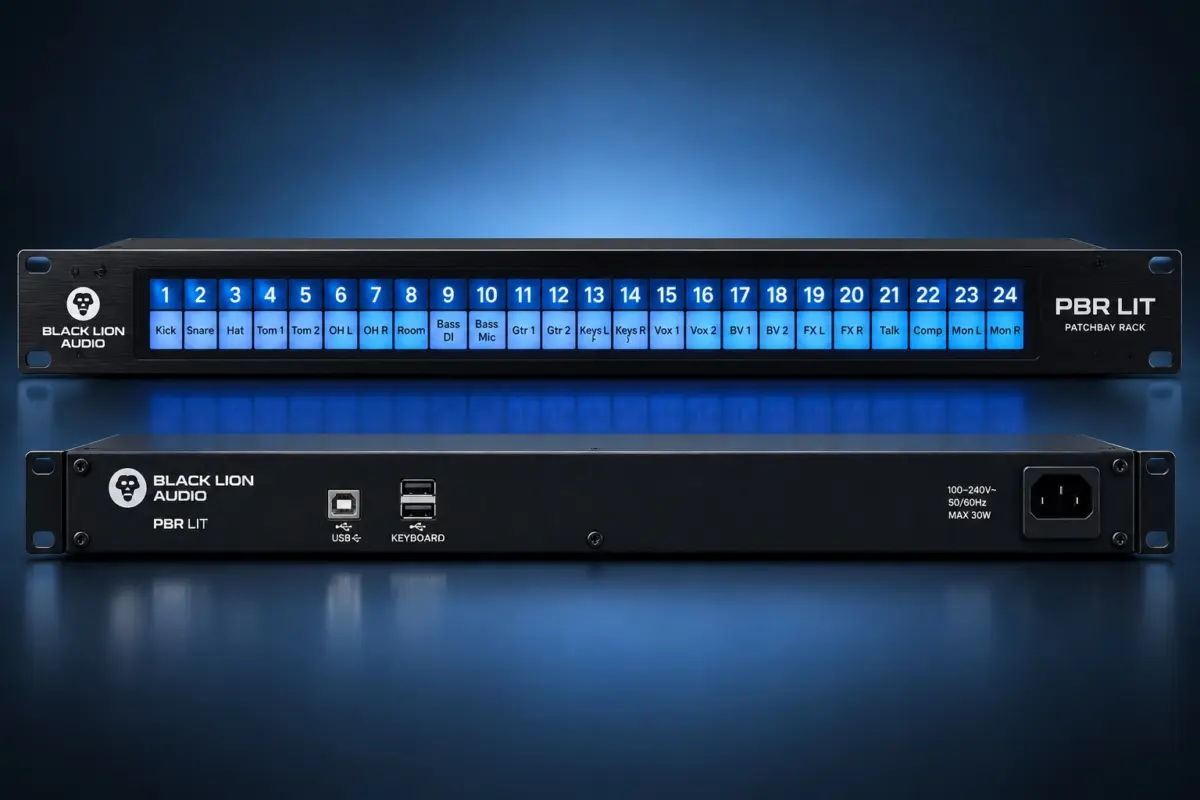
The professional audio industry is witnessing a significant shift in studio organization and workflow management with the introduction of the Black Lion Audio PBR LIT. This 1U rackmount device is designed to solve a persistent, decades-old problem in recording environments: the messy, inefficient, and often illegible practice of using masking tape and felt-tip pens to label patchbays. By integrating a high-visibility, blue-backlit LED panel into a standard 19-inch rack format, Black Lion Audio aims to modernize the analog patching experience, offering engineers a digital alternative that aligns with the precision of contemporary recording software.
Scheduled for release in late 2026, the PBR LIT is positioned as a companion piece to any standard patchbay, though it naturally complements Black Lion Audio’s own PBR series of routing hardware. The device serves as a dedicated digital display that can be mounted directly above or below a patchbay to provide clear, illuminated identification for every input and output point. With a suggested retail price of 289.00 EUR (including 19% VAT), the unit represents a professional-grade investment for studios looking to move away from the "tape and sharpie" aesthetic toward a more streamlined, high-tech interface.
The Evolution of Studio Organization and the End of the Tape Era
For the better part of the last century, the patchbay has remained one of the few truly "low-tech" holdouts in the recording studio. While signal processing, recording mediums, and mixing consoles have transitioned from vacuum tubes to transistors and eventually to digital algorithms, the physical act of patching cables has remained largely unchanged. The standard method for identifying these connections has historically involved strips of white artist tape or masking tape applied to the front of the rack, with handwritten notes that quickly become outdated as gear is swapped or studio configurations evolve.
The limitations of this analog method are well-known to professional engineers. Over time, adhesive residue accumulates on expensive rack gear, tape peels in humid environments, and handwriting can become unreadable under the dim lighting typical of a control room. Furthermore, updating a 96-point TT patchbay can be a labor-intensive process that requires stripping old tape, cleaning the surface, and meticulously rewriting every label. The PBR LIT addresses these pain points by offering a dynamic, digital surface that can be updated in seconds, ensuring that the studio’s documentation is as modern as its signal chain.
Technical Specifications and Hardware Construction
Black Lion Audio has built a reputation for "Chicago-tough" hardware, often focusing on the durability and electrical integrity of their devices. The PBR LIT follows this philosophy, featuring a chassis constructed from reinforced steel to withstand the rigors of permanent installation or mobile rack use. The front panel is crafted from black anodized aluminum, providing a sleek, professional appearance that matches the aesthetic of high-end outboard gear.
The centerpiece of the device is the full-width LED display. Unlike standard LCD screens, which can suffer from poor viewing angles or glare, the blue-backlit LED panel used in the PBR LIT is designed for maximum contrast and visibility from across a room. This is particularly beneficial in large-scale commercial studios where an assistant engineer or producer might need to verify a connection from a distance. On the rear of the unit, the device features USB connectivity for data transfer and power, alongside a dedicated port for a standard USB keyboard, allowing for direct text entry without the need for a computer.
Versatile Display Modes and Customization
Recognizing that studios utilize a variety of patchbay formats, Black Lion Audio has programmed the PBR LIT with four distinct operational modes. These presets ensure that the digital labels align perfectly with the physical spacing of the most common patchbay configurations:
- 48-Point TRS Mode: Specifically spaced for 1/4-inch balanced TRS patchbays, providing clear vertical alignment for 24 pairs of jacks.
- 96-Point TT (Bantam) Mode: Designed for high-density professional patchbays, where 96 points are packed into a single rack unit. The display adjusts its character spacing to ensure each of the 96 points is accurately identified.
- 16-Point XLR Mode: Tailored for rack-mounted XLR pass-through panels or stage boxes, typically used for microphone inputs or tie-lines.
- Custom Mode: Perhaps the most versatile feature of the PBR LIT, the Custom Mode allows the entire width of the display to be used as a continuous text field. In this mode, the device transcends its role as a patchbay labeler and can function as a general-purpose rack display. It can show the name of the studio, the title of the current project, specific "Do Not Touch" warnings for sensitive gear settings, or branding for social media and video content creators.
Software Integration and Workflow Efficiency
While the PBR LIT allows for direct editing via a connected USB keyboard, the true power of the system lies in its integration with the Patchcad BLA Edition software. Developed in collaboration with Patchcad, the industry standard for patchbay labeling and documentation, this software allows users to design complex labeling schemes on their macOS or Windows computers.
Through the software, engineers can manage multiple "snapshots" of their studio setup. If a studio frequently switches between a tracking configuration and a mixing configuration, the PBR LIT can be updated instantly to reflect the changes in the signal path. This eliminates the need to re-label the rack manually. The ability to save, export, and print layout plans also ensures that the studio has a digital backup of its routing architecture, which is invaluable for troubleshooting or future expansions.
Official Statements and Industry Context
Preston Whiting, Vice President of Operations at Black Lion Audio, emphasized the necessity of this product in the modern studio landscape. "Patching is one of the very few areas in the studio that has remained almost entirely analog," Whiting noted during the product announcement. He highlighted the irony of using cutting-edge digital workstations while still relying on 1950s-era labeling techniques. "Technology is constantly evolving, but the way we label our patchbays hasn’t. With the PBR LIT, we are bringing that final piece of the puzzle into the digital age. I am particularly excited to see how our customers utilize the Custom Mode for applications we haven’t even envisioned yet."
Industry analysts suggest that the PBR LIT represents a broader trend toward "smart" studio furniture and utility gear. As recording spaces become more modular and hybrid, the demand for hardware that can adapt to changing workflows is increasing. While digital patchbays (which route audio digitally) exist, they are often prohibitively expensive for mid-sized studios. The PBR LIT offers a middle ground: keeping the audio in the analog domain where many engineers prefer it, but digitizing the management and visualization layer.

Economic Impact and Availability
The PBR LIT is set to be distributed exclusively in the DACH region (Germany, Austria, and Switzerland) by Audiowerk e. Kfm. The anticipated launch at the end of 2026 places it as a key release for the following fiscal year. At the 289.00 EUR price point, Black Lion Audio is targeting a wide demographic, from high-end home studio owners to commercial facility managers.
From a long-term economic perspective, the device may offer cost savings by reducing the time spent on studio maintenance. In a commercial environment where studio time is billed by the hour, the ability to reconfigure and re-label a room in seconds rather than hours represents a tangible increase in operational efficiency. Furthermore, the reduction in physical waste—eliminating rolls of specialty tape and cleaning solvents—aligns with modern movements toward more sustainable studio practices.
Broader Implications for Studio Design
The introduction of the PBR LIT also speaks to the growing importance of "studio ergonomics" and aesthetics. In an era where many studios are showcased on social media or used for video-recorded sessions and live streams, the visual presentation of a rack has become a marketing tool for producers. The clean, illuminated glow of a digital display provides a high-tech "command center" feel that traditional tape simply cannot replicate.
Moreover, the PBR LIT addresses accessibility concerns. For engineers with visual impairments or those working in high-pressure, low-light environments, the high-contrast LED display is a significant ergonomic upgrade. By providing a clear, standardized font and adjustable brightness, the device reduces eye strain and minimizes the risk of patching errors—errors that can, in some cases, lead to equipment damage if signals are routed incorrectly.
As the industry moves toward the 2026 release date, Black Lion Audio’s PBR LIT stands as a testament to the idea that even the most basic elements of a studio can benefit from thoughtful technological intervention. By bridging the gap between analog connectivity and digital convenience, the PBR LIT is poised to become a staple in the modern professional rack.
