

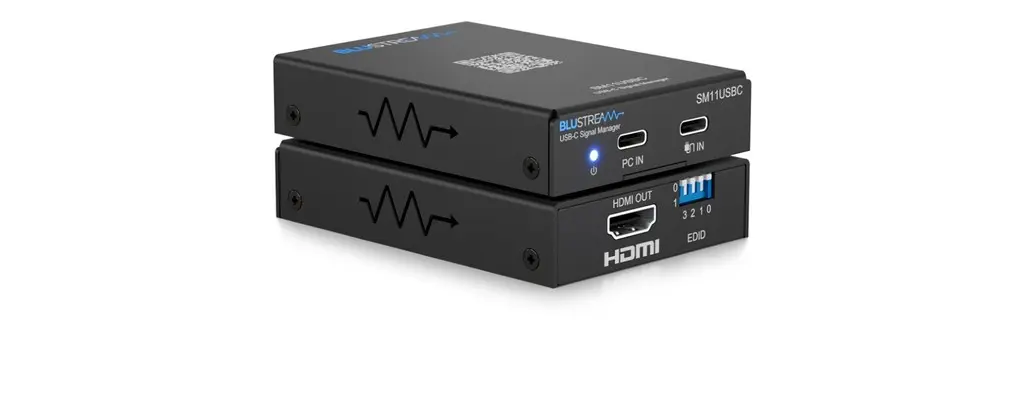
The professional audiovisual landscape is currently undergoing a significant transition as USB-C becomes the primary interface for video, data, and power delivery across consumer and enterprise hardware. In response to the growing complexities of this transition, Blustream has announced the release of the SM11USBC, a compact yet high-performance signal manager designed specifically to bridge the gap between modern USB-C source devices and traditional HDMI-based display ecosystems. This new hardware solution is engineered to address the persistent "handshake" issues that often plague professional installations, offering a robust toolset for system integrators, IT managers, and field technicians.
The SM11USBC is not merely a passive adapter; it is an active signal management device that facilitates the conversion of USB-C DisplayPort Alt-Mode signals into HDMI 2.0. By incorporating sophisticated EDID (Extended Display Identification Data) and HDCP (High-bandwidth Digital Content Protection) management, the device ensures that communication between a source—such as a laptop, tablet, or smartphone—and a destination display remains stable and optimized for the highest possible quality.
Technical Specifications and Performance Standards
At the core of the Blustream SM11USBC is the ability to support high-bandwidth video signals without degradation. The device is rated for resolutions up to 4K UHD at a 60Hz refresh rate, utilizing 4:4:4 chroma subsampling. This is a critical specification for professional environments where text clarity and color accuracy are paramount, such as in medical imaging, architectural presentations, or high-end corporate boardrooms. Unlike lower-tier consumer adapters that often compress color data to 4:2:0 to save bandwidth, the SM11USBC maintains the full integrity of the video signal.
Furthermore, the device offers comprehensive support for HDR (High Dynamic Range) metadata, ensuring that modern content with high contrast ratios and expanded color gamuts is reproduced accurately. In addition to standard 16:9 aspect ratios, the SM11USBC is compatible with a wide range of Wide and Ultra-Wide formats. This makes it an ideal solution for creative studios and financial trading floors where 21:9 or 32:9 monitors are increasingly becoming the standard for productivity.
One of the standout features of the SM11USBC is its "driverless" operation. In many corporate environments, security protocols prevent users from installing third-party software or drivers on company-issued laptops. Because the SM11USBC operates at the hardware layer, it functions as a plug-and-play device, ensuring compatibility across Windows, macOS, ChromeOS, and mobile operating systems without requiring administrative privileges for installation.
Addressing the Challenges of EDID and HDCP Management
The primary source of failure in modern AV systems is rarely the physical cable, but rather the digital handshake between devices. When a USB-C source is connected to an HDMI display, the two devices must agree on a resolution, refresh rate, and security protocol. If the display’s EDID information is misinterpreted by the source, the result is often a blank screen, flickering video, or a fallback to a low-resolution image.
The SM11USBC solves this by providing integrated EDID management. Through the use of physical DIP switches located on the side of the chassis, integrators can "force" the source device to output a specific resolution or audio format. This capability is invaluable in legacy environments where an older display might not properly communicate its capabilities to a modern laptop. By presenting a consistent EDID profile to the source, the SM11USBC eliminates the guesswork and ensures a reliable connection every time.
Similarly, HDCP conflicts frequently disrupt content playback, particularly when dealing with protected content from streaming services or Blu-ray players. The SM11USBC supports HDCP 2.2, the latest standard for content protection. Its management system allows it to negotiate these security keys effectively, preventing the "black screen of death" that occurs when a source device detects a non-compliant link in the signal chain. This makes the device a powerful troubleshooting tool; if a system is failing to display an image, inserting the SM11USBC into the path can often resolve the conflict by acting as a stable intermediary.
USB-C Power Delivery and the BYOD Revolution
The modern workplace is increasingly centered around the concept of "Bring Your Own Device" (BYOD). Employees and guest speakers expect to walk into a conference room, plug in a single cable, and have their device instantly connected to the room’s display while simultaneously charging. The Blustream SM11USBC is designed to meet this demand through its support for USB-C Power Delivery (PD) Pass-Through.
The device can deliver up to 100W of power to the connected source device. This is a significant threshold, as it provides enough wattage to charge even power-hungry mobile workstations and high-performance laptops like the 16-inch MacBook Pro or Dell XPS series. By integrating power and video into a single point of connection, the SM11USBC reduces cable clutter on conference tables and eliminates the need for users to carry bulky power bricks to meetings.
Chronology of Signal Management Evolution
To understand the significance of the SM11USBC, one must look at the timeline of signal management over the last decade.
- 2010–2015: The HDMI Dominance: During this period, HDMI replaced VGA and DVI as the standard for professional AV. Signal management focused primarily on extending HDMI over long distances using HDBaseT.
- 2016–2020: The Rise of USB-C: Apple and other major manufacturers began phasing out dedicated video ports in favor of USB-C. This led to a "dongle era" where users relied on cheap, unreliable adapters that frequently failed in professional settings.
- 2021–2024: The Integration Phase: Professional AV manufacturers began integrating USB-C ports directly into switchers and wall plates. However, these integrated solutions were often expensive and difficult to retrofit into existing rooms.
- 2025–Present: The Specialized Management Era: As the limitations of simple adapters became clear, the industry moved toward dedicated signal managers like the SM11USBC. These devices are designed to provide the same level of control for USB-C that professionals have long enjoyed for HDMI and SDI.
Blustream’s introduction of the SM11USBC represents the culmination of this evolution, providing a standalone, professional-grade solution that can be added to any existing system to modernize its connectivity.
Market Positioning and Distribution
In the European market, particularly in Germany, the Blustream SM11USBC is distributed by Pro Audio-Technik GmbH (PAT). This partnership ensures that the device is backed by high-level technical support and availability for large-scale projects. Blustream has positioned the SM11USBC as a premium alternative to consumer-grade hubs. While a consumer hub might offer similar ports, it lacks the rugged build quality, the 100W power rating, and, most importantly, the granular EDID and HDCP controls required for mission-critical applications.

Industry analysts suggest that the demand for such devices will continue to grow as corporate offices undergo "hybrid" renovations. These renovations focus on making meeting spaces more accessible to remote participants and varying hardware types. The ability to troubleshoot a room by simply swapping an adapter for a managed signal device like the SM11USBC significantly reduces the "mean time to repair" (MTTR) for IT departments.
Implications for System Integrators and AV Professionals
For the system integrator, the SM11USBC serves two distinct roles. First, it is a "problem solver" for the field technician’s kit. When a client reports that a specific laptop won’t display on a specific projector, the SM11USBC is the tool used to diagnose and fix the handshake. Second, it is a foundational component for new "huddle room" designs. Its compact form factor allows it to be mounted discreetly under a table or behind a display, providing a clean and professional interface for the end-user.
The inclusion of 4K 60Hz 4:4:4 support also future-proofs installations. As displays move toward higher resolutions and more sophisticated color processing, the SM11USBC ensures that the signal path will not be the bottleneck. This is particularly relevant as organizations move toward "digital signage 2.0," where interactive displays and high-resolution content are used for branding and internal communication.
Conclusion and Future Outlook
The release of the Blustream SM11USBC highlights a broader trend in the AV industry: the shift from simple connectivity to intelligent signal management. As the hardware used by presenters becomes more diverse and the security protocols governing digital content become more stringent, the need for intermediary devices that can "translate" and "negotiate" between hardware becomes critical.
Blustream’s focus on the 100W Power Delivery and the specific nuances of HDCP 2.2 management suggests a deep understanding of the current pain points in the professional AV market. By providing a device that is as much a diagnostic tool as it is a converter, Blustream has offered a versatile solution for the modern era of connectivity. As we move closer to 2027 and beyond, the standardization of USB-C as the universal port will only increase the relevance of dedicated signal managers like the SM11USBC in ensuring that the technology in our meeting spaces remains invisible, reliable, and efficient.
