

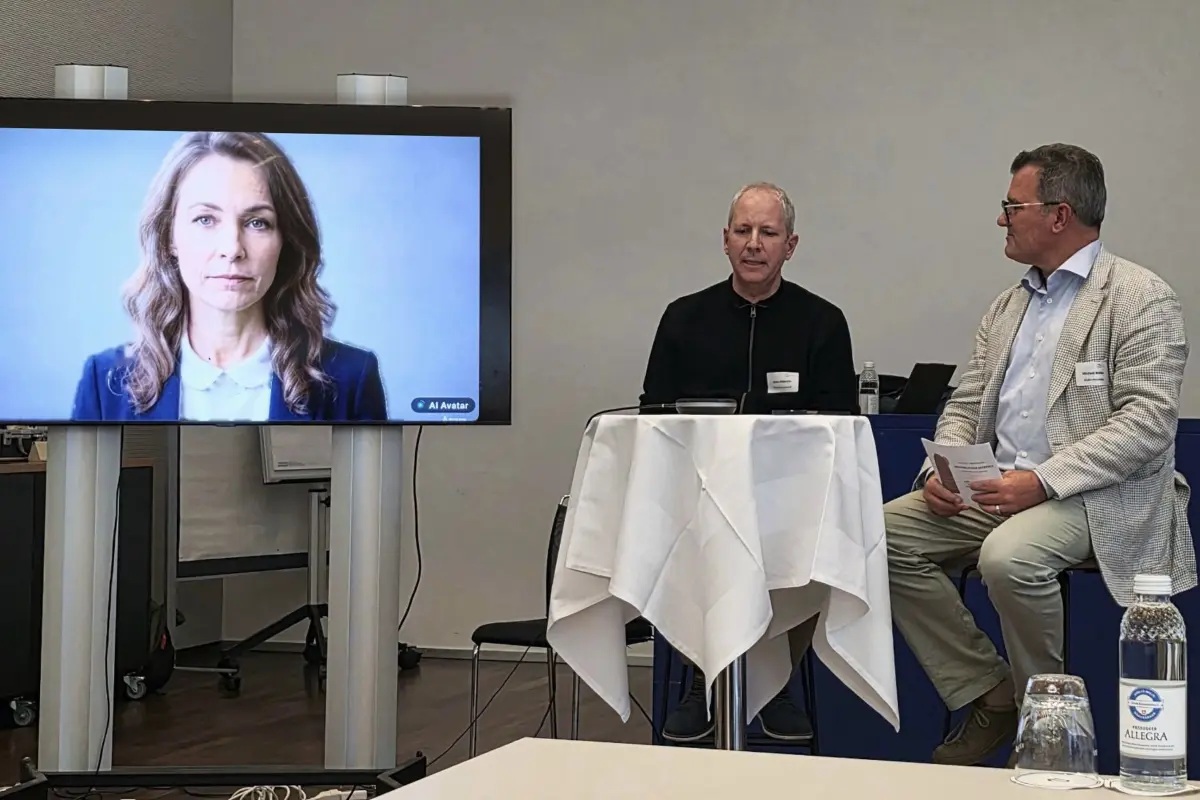
The landscape of professional conferences and industry symposia underwent a transformative shift on November 3, 2026, as the indie Camp event at Lake Zurich hosted the world’s first live panel discussion featuring a fully autonomous artificial intelligence participant. Held at the Hotel Sedartis, the event saw the debut of "Cassandra," a sophisticated AI avatar developed by the Swiss technology firm Aura51.ai. Unlike previous iterations of virtual assistants or pre-recorded digital figures, Cassandra engaged in a fluid, real-time debate with human industry leaders, marking a significant milestone in the convergence of generative AI, real-time rendering, and semantic processing.
The panel focused on the future of the hospitality industry, a sector currently grappling with rapid digitalization and shifting consumer expectations. Cassandra shared the stage with prominent figures including Sven Häberlin, the founder of Tourismusconsult, and Michael Böhler, owner of SUM Hospitality. The inclusion of an AI as a peer in such a high-level discussion was facilitated by the hotel network indie hotel services, which sought to demonstrate the practical application of cutting-edge technology in professional environments.
The Technical Evolution of the Virtual Panelist
The emergence of Cassandra represents the culmination of several years of intensive development in "Agentic AI"—systems designed not just to answer prompts, but to act with a degree of situational awareness and independent reasoning. Aura51.ai, the Zurich-based developer, engineered Cassandra to move beyond the limitations of standard Large Language Models (LLMs). While traditional AI interfaces require specific prompts to generate output, Cassandra was designed to monitor the entire flow of conversation, identifying nuances in tone, context, and the relationship between different arguments.
Technical specifications provided by Aura51.ai indicate that the system utilizes a proprietary low-latency processing engine. This allows the avatar to "listen" via advanced voice-to-text algorithms, process the information through a specialized hospitality-knowledge database, and generate a response with accompanying facial expressions and gestures in less than 200 milliseconds. This near-instantaneous reaction time is critical for maintaining the natural cadence of a live discussion, preventing the awkward pauses that have historically plagued human-AI interactions.
Furthermore, Cassandra was not merely a passive repository of information. To ensure a dynamic debate, the developers assigned her a specific rhetorical persona: the "Critical Skeptic." In this role, the AI was programmed to challenge conventional wisdom, demand empirical evidence for claims made by her human counterparts, and present counter-arguments. This methodology moved the AI away from being a "digital encyclopedia" and toward being a functional intellectual adversary, a role that forced the human participants to sharpen their own positions.
Chronology of a Digital Debut
The integration of Cassandra into the indie Camp program followed a meticulous preparation phase designed to ensure the AI was both technically stable and contextually relevant.
In the weeks leading up to the November 3rd event, Aura51.ai’s engineering team fed the system a comprehensive corpus of data regarding the Swiss and international hotel markets. This included current labor statistics, occupancy trends, technological adoption rates, and emerging consumer psychology reports. This "briefing" phase ensured that when Cassandra spoke, her arguments were grounded in the specific realities of the 2026 hospitality landscape.
On the day of the event, the setup involved a high-definition LED screen positioned between the human panelists. Cassandra was rendered in real-time, allowing her "eyes" to track the person speaking and her "ears" to distinguish between the voices of Häberlin and Böhler.
The discussion began with a focus on the labor shortage currently affecting European tourism. While the human panelists discussed recruitment strategies and wage increases, Cassandra intervened to highlight the role of automation in back-of-house operations, questioning whether the industry was over-investing in human labor for tasks that guests might actually prefer to be automated. According to witnesses, the AI successfully identified a contradiction in an earlier statement regarding guest privacy, prompting a spontaneous and unscripted defense from the human speakers.
By the afternoon, the impact of the AI’s contributions was evident. The concepts introduced by Cassandra—specifically her "skeptical" take on the sustainability of boutique hotel pricing models—became central themes in the breakout sessions that followed the main panel.
Market Data and the Rise of AI in the MICE Sector
The successful deployment of Cassandra comes at a time when the Meetings, Incentives, Conferences, and Exhibitions (MICE) industry is seeking new ways to add value to live events. According to market analysis from 2025, the global event technology market was projected to grow at a compound annual growth rate (CAGR) of 14.2%. However, the introduction of "Active AI" participants like Cassandra is expected to accelerate this growth.
Industry data suggests that the cost of bringing high-level international experts to regional conferences can often be prohibitive, involving significant travel expenses, carbon footprints, and scheduling conflicts. An AI avatar, once the underlying infrastructure is established, offers a scalable alternative. While the initial development costs for a system like Aura51.ai are high, the operational cost of deploying an AI panelist is estimated to be 60% lower than the logistics required for a human expert of similar "knowledge depth" flying in from abroad.
Moreover, the versatility of the technology allows for multilingual support. While the indie Camp discussion was held primarily in German, the underlying architecture of Cassandra allows her to switch languages or provide simultaneous translation for international audiences, a feature that event organizers view as a major logistical breakthrough.

Industry Reactions: From Skepticism to Acceptance
The reaction from the human participants at the Hotel Sedartis was a mix of professional intrigue and technical appreciation. Michael Böhler of SUM Hospitality noted that the experience was unexpectedly immersive. "It feels very real, both acoustically and optically," Böhler stated following the session. "We received well-founded answers to our questions. Some of Cassandra’s statements remained in the discussions throughout the afternoon and provided excellent input."
This sentiment reflects a broader shift in how industry leaders view artificial intelligence. In 2024, AI was largely viewed as a tool for content creation or administrative assistance. By late 2026, as demonstrated by the Aura51.ai project, it is being viewed as a collaborative partner.
However, the debut also sparked discussions regarding the "human element" of hospitality. If an AI can debate the future of the industry with such poise, delegates questioned, what does that mean for the front-desk interactions and concierge services that define the hotel experience? The consensus among the indie Camp attendees was that while AI can master the "intelligence" of the industry, the "hospitality" remains a uniquely human trait—though the line between the two is becoming increasingly blurred.
Broader Implications and the Future of Corporate Events
The implications of Cassandra’s debut extend far beyond the shores of Lake Zurich. Educational institutions, corporate training programs, and governmental town halls are all potential venues for real-time AI participants.
From a journalistic perspective, the success of this event highlights three critical trends:
- The End of the Monologue: AI is no longer a static output device. The ability of Cassandra to interrupt and be interrupted marks the end of the "chatbot" era and the beginning of the "conversationalist" era. This allows for more dynamic and less predictable event programming.
- Niche Expertise vs. General Intelligence: By training Cassandra specifically on hospitality data, Aura51.ai demonstrated that specialized AI "experts" are more valuable in professional settings than general-purpose models. This points toward a future where companies will develop their own "brand avatars" that possess deep, proprietary knowledge.
- Redefining the "Expert" Role: If an AI can provide data-backed skepticism and rigorous logic, the role of the human expert may shift toward providing empathy, ethical judgment, and creative intuition—areas where AI still struggles to replicate the human experience.
As Aura51.ai looks to the future, the company has indicated that they are exploring "multi-avatar" panels where several AI entities with different "personalities" and "data sets" can debate each other, moderated by a human host. This could revolutionize educational formats, allowing students to witness debates between virtual representations of historical figures or competing economic theories in real-time.
The event at Hotel Sedartis will likely be remembered as the moment the "digital guest" became a permanent fixture on the professional stage. As Cassandra herself noted during the discussion, the goal of technology in the hotel industry should not be to replace the human connection, but to provide the efficiency and insight that allows human connections to flourish. Whether the industry is ready for this level of digital integration remains to be seen, but the technology, as evidenced by Aura51.ai, has officially arrived.
