

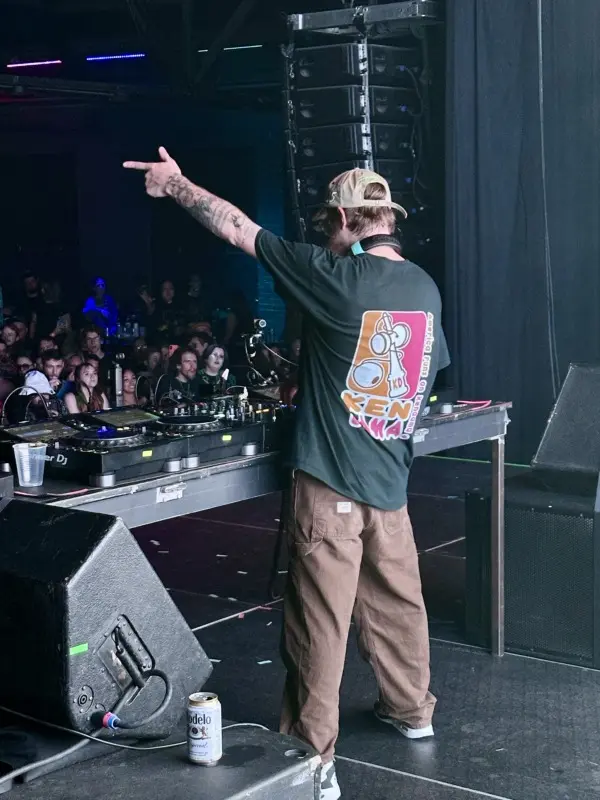
The hum of bass music reverberated through The Intersection in Grand Rapids, Michigan, on November 14th, as Louisiana-native producer Boogie T delivered a performance that underscored his unique position within the genre. His signature blend of blues, funk, and an undeniably distinctive, "wonky" sound has cemented his status as a staple in the dubstep scene, a journey that began long before the festival stages and high-profile collaborations with artists like Ganja White Night. This particular evening’s performance was preceded by an unexpected eight-hour drive due to flight complications, a testament to the dedication that fuels his career. Following his set, amidst the post-show buzz, Boogie T, real name Brock Billingsley, sat down with Dancing Astronaut for an extended conversation that delved into his formative musical experiences, the ever-shifting landscape of dubstep, the hurdles faced by burgeoning artists, and even unearthed a few anecdotes far from the typical interview fare. While a surprising amount of time was dedicated to discussions about felines, a topic perhaps best reserved for a separate feature, the core of the interview provided a comprehensive look at an artist who has consistently charted his own course.
Early Melodies: The Genesis of a Bass Music Pioneer
Billingsley’s musical journey commenced at a remarkably young age, a path that solidified into a clear ambition during a pivotal moment in his youth. "Actually, I would say so," he responded when asked about a definitive moment of realization. "There was a Battle of the Bands that I played when I was 14." This wasn’t a singular event, but rather a series of victories that marked his early years. "There were three of them. We won, like, three of them. Different years throughout my life. But one of them was at this place called the Cajundome in Lafayette, Louisiana."
The experience of performing at the Cajundome, a venue typically reserved for larger sporting events and concerts, left an indelible mark on the then-14-year-old Billingsley. "I remember being 14 years old, because I wasn’t even in high school yet, and it was a high school Battle of the Bands," he recalled. "I had to go find some dudes from a music shop. I just asked, ‘Is there anybody that plays drums? Anybody that plays bass?’ And I found these crazy-ass dudes." The serendipitous assembly of musicians led to a significant victory. "We ended up getting in, won the first round, and then went to the Cajundome. It’s a dome, it’s a fucking arena, you know? So I’m in there, and I’m playing, and I remember just looking at the lights. And then we won. It was insane." This early triumph at such a prominent venue served as a powerful affirmation of his burgeoning talent and passion for music.
The trajectory of his life was undeniably shaped by this early immersion in sound. "It was all music all the time," Billingsley affirmed, underscoring the all-encompassing nature of his musical pursuit. His dedication extended beyond performance; by the age of 16, he was already a music educator, a testament to his early mastery. "I was teaching guitar and shit to lawyers when I was, like, 16. That’s how I made my money through high school. Recording, producing, all my friends are musicians. We got in where we fit in." This hands-on experience in various facets of music creation and instruction laid a robust foundation for his future endeavors in the electronic music realm.
The Sonic Shift: From Live Stages to Electronic Landscapes
The transition from the tangible performance of live instrumentation to the intricate world of electronic music production represented a significant, albeit organic, evolution in Billingsley’s career. "When I first started, I was 14, 15 years old, playing blues music in all these little venues, and I was always jealous of all the dudes," he admitted, referencing the emerging DJ culture. "I’m like, ‘Man, what the fuck? These guys are just playing songs. They’re just pressing play and playing other people’s music. How are they making so much money?’" While the commercial aspect of DJing initially intrigued him, his intrinsic motivation remained rooted in the act of creation. "And I still don’t get it, legit. I literally still don’t get it."
His attraction to electronic music, particularly dubstep, was multifaceted. "But I’m like, I’ll do it. It works, and it’s fun. It’s a weird one. It makes people excited, but the whole passion is creating music and doing the music and making music." He further clarified his stance on the genre: "Don’t get me wrong, I love dubstep. I get a fucking vibe from it.” This sentiment highlights a core principle of his artistic philosophy: the pursuit of creative expression and connection with an audience, regardless of the specific sonic palette.
The Evolving Sound of Dubstep: Authenticity in the Digital Age
The landscape of dubstep has undergone significant transformation since its underground inception, a phenomenon that has sparked ongoing debates within the electronic music community regarding mainstream appeal and artistic integrity. "I do feel like it’s a little stale sometimes, you know? It gets a little sellout-y sometimes," Billingsley commented, reflecting on the genre’s evolution. "I really was attracted to it because it was so underground back in the day."
He articulated a nuanced perspective on the audience’s role in shaping an artist’s perception. "I think that’s a fan’s opinion. If you like the dude, you gotta follow where they came from and then follow what they’re still doing. If you like what they’re doing, listen to it. If you don’t, don’t listen to it.” Billingsley emphasized the crucial distinction between an artist’s natural growth and a perceived dilution of their sound for commercial gain. "I think the fine line is whenever they do start getting bigger, you start thinking people are trying to appease a crowd. Playing the same set, or just a TikTok bullshit song to get a crowd reaction.”

He concluded this thought with a broader observation on the industry’s complexities: "It’s such a game. It goes so much deeper than just playing the music.” This statement alludes to the multifaceted nature of a successful career in music, which extends beyond pure sonic output to encompass marketing, audience engagement, and navigating the evolving digital landscape.
Artificial Intelligence in Music: A Tool or a Threat?
The increasing integration of Artificial Intelligence (AI) into music production presents a new frontier, sparking discussions about its potential benefits and drawbacks for artists. Billingsley shared his early encounters with AI music tools, acknowledging their utility as creative aids. "Mr. Bill even showed me that, like, two years ago or something. I was like, ‘This is kind of cool.’"
He elaborated on the practical applications: "You could go into Suno and put your song in, or even the beginning of your song, and be like, ‘Give me a trumpet riff.’ Let’s say you already played the riff on a piano, and it’ll give you different instruments of that riff.” He categorized these tools as valuable assets for artists: "That’s helpful. That’s a tool, you know?”
However, Billingsley also expressed caution regarding the potential for misuse, where AI-generated content is presented as original work. "But then there’s other cats that will put the whole thing in and just take the whole thing that came out and be like, ‘That’s my thing.’” He foresaw a rapidly evolving landscape: "It’s such a weird thing, and it’s going to get weirder and weirder because it’s growing exponentially instead of linearly.” This observation underscores the rapid pace of AI development and its potential to significantly reshape the music industry.
Navigating a Competitive Scene: The Path for Emerging Artists
The contemporary bass music scene is undeniably competitive, leading to questions about the viability for new artists to establish a significant presence. Billingsley offered a candid assessment of the opportunities available. "Absolutely," he stated when asked if there was still room for newcomers. "There’s a lot of hope for people coming into the scene. You never know where you’ll be. There’s a lot of people, it’s one song, one tour."
His advice to aspiring producers, however, was starkly direct, designed to filter out those lacking genuine dedication. "Quit," he declared. "If you just heard me say, ‘Hey, quit making music,’ and you said, ‘Man, fuck that,’ then you fucking passed.” This seemingly harsh directive serves as a litmus test for true passion. "The person that actually wants to do it is going to do it. There’s no real advice to give to somebody. If you’re going to fucking do it, you’re going to fucking do it.”
He emphasized the long-term commitment required for success in music production. "I’ve been playing piano since I was six, guitar since I was eight. Ten years old, I got my first program to start programming shit. It takes fucking years, bro.” This perspective highlights that mastery and impact in the music industry are rarely achieved overnight, but rather through sustained effort and dedication over an extended period.
The Story Behind "Flava": An Unexpected Encounter
One of the more engaging and unexpected revelations from the conversation pertained to the inspiration behind the popular track "Flava," a collaboration with Ganja White Night. The song features the memorable lyric, "I don’t need your lord, I don’t need your savior." Billingsley shared the amusing anecdote that directly led to this line.
"Dude, fun fact about ‘Flava,’" he began. "I was in my house. I was living in Tampa for a year, and I had some Jehovah’s Witnesses come up to my door while I was writing the song.” The scenario unfolded during a moment of solitary creative immersion. "I was drinking a bunch of beer, smoking a ton of weed, all by myself, just moved there, doing some work and shit. These dudes knock on the door, boom, boom, boom.”

Upon answering the door, still engaged in his creative process, he was met with a familiar religious proposition. "I open the door, and I’m smoking a joint. ‘What’s up?’ ‘Can we tell you about our Lord and Savior?’" Billingsley, in a moment of inspired improvisation, countered their query with an offer of his own work. "And I was like, ‘Can I show you some of my music?’" Their polite refusal was met with further insistence. "They were like, ‘No, no, no, we’re good.’ I’m like, ‘Come on, man. Come on in. Let me show you.’"
The timing of this encounter was serendipitous: "I was literally writing the song. And it’s because of that. Because those dudes came up to the house.” He concluded with a playful flourish, "Fun fact. Boom. Exclusive. Dancing Astronaut exclusive.” This lighthearted revelation offers a glimpse into the often-unconventional sources of artistic inspiration.
The Heartbeat of the Scene: The Meaning of the Rave Community
Beyond the technical aspects of music production and the business of the industry, Billingsley reflected on the profound significance of the rave community. When asked what it represents to him, he described it as a space that amplifies the listener’s existing connection to music. "I think it’s a place to feel the music that you’ve already been listening to, but on a bigger scale.”
He elaborated on the immersive experience: "You get to hear your favorite song on a huge system with a light show and some visuals and stuff. And your besties. You get to feel what you’ve always heard. It’s nostalgic in a point where you heard it a couple days ago, but now you get to feel it.” This communal aspect and the sensory enhancement of the music create a powerful and memorable experience.
Furthermore, he highlighted the dedication and anticipation that often surround attending these events. "A lot of people save their hard-earned money to go to these shows, and then, bam, they’re here and have the best time of their life. They’ve been planning for this. They have all their friends with them.” He summarized the essence of the experience: "It’s an experience. It’s such a cool experience.”
A Legacy Forged in Passion
For Boogie T, the foundational element of his career has consistently been his unwavering passion for music. Whether reminiscing about his early performances in Louisiana, sharing humorous anecdotes behind his popular tracks, or candidly discussing the realities of forging a path in the music industry, that initial spark has never diminished.
Following an arduous eight-hour drive, a compelling live set, and an interview that extended far beyond the expected parameters, it was evident that Billingsley remains deeply connected to the scene he has helped shape. His enduring enthusiasm, as potent now as it was when he first embarked on his musical journey, serves as an inspiration to both aspiring artists and seasoned fans alike. His story is a compelling narrative of dedication, innovation, and the enduring power of authentic musical expression in an ever-evolving global soundscape.
