

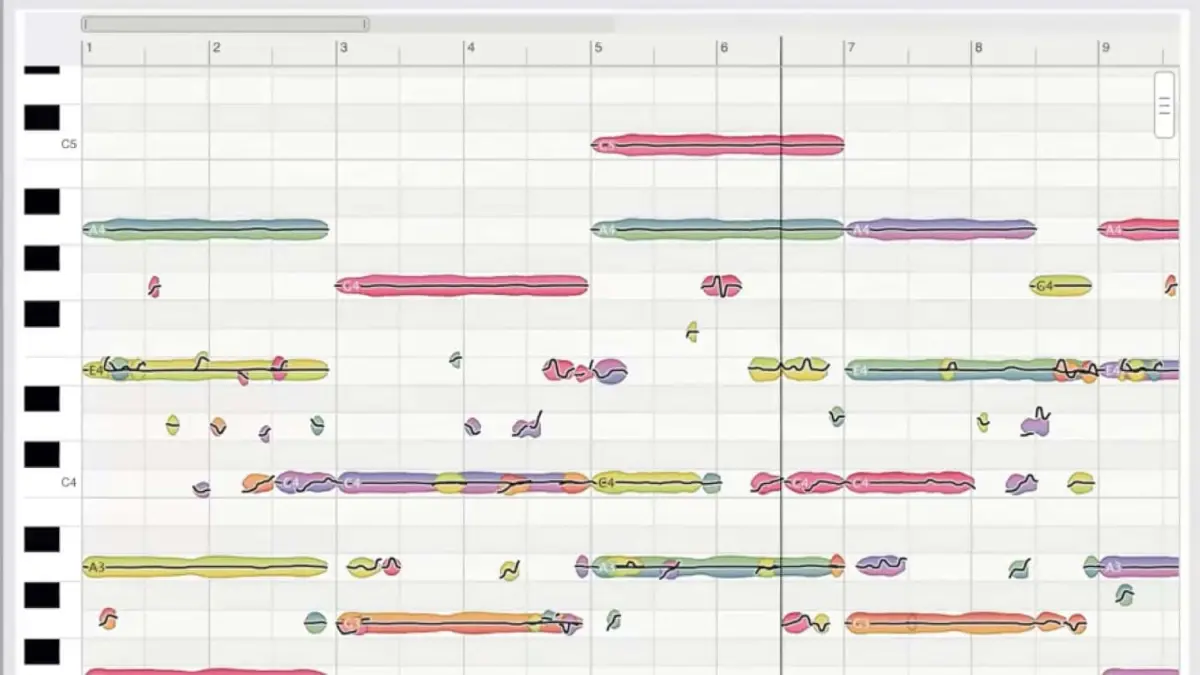
The landscape of digital audio workstation (DAW) utilities has undergone a significant shift with the introduction of Bubblegum, a sophisticated polyphonic pitch editing plugin now available for Linux, macOS, and Windows. Developed as a free tool, Bubblegum addresses a historically high-cost segment of the music production market: the ability to manipulate individual notes within polyphonic audio recordings. While monophonic pitch correction—the process of tuning a single vocal line or solo instrument—has been a staple of the industry for decades, polyphonic editing remains a complex technical feat. Bubblegum enters this space with a feature set that allows producers to move, tune, and stretch notes even when they are embedded within complex chords, providing a level of control that was previously almost exclusive to expensive proprietary software like Celemony’s Melodyne.
The Evolution of Pitch Correction Technology
To understand the significance of Bubblegum’s release, one must look at the chronology of pitch manipulation in recorded music. The journey began in the late 1990s with the release of Antares Auto-Tune, which utilized a phase vocoder to map input frequencies to a user-defined scale. While revolutionary, these early tools were strictly monophonic; they could only track one pitch at a time. If a singer hit a wrong note, the software could pull it back into tune, but if a guitarist played a sour note within a six-string chord, the software was largely ineffective.
The breakthrough for polyphonic editing occurred in 2009 when Celemony introduced Direct Note Access (DNA) technology. This allowed for the spectral deconstruction of chords, enabling engineers to reach inside a polyphonic recording and adjust the pitch or timing of a single note without affecting the others. For over a decade, this technology served as the industry standard, commanding high retail prices that often exceeded $600 for the full-featured versions. The arrival of Bubblegum represents a democratization of this technology, offering independent artists and budget-conscious studios access to high-end spectral manipulation without the financial barrier of entry.
Technical Specifications and Core Functionality
Bubblegum operates as a plugin that integrates directly into a host DAW. Its primary interface is a visual "blob" based system, a design philosophy clearly inspired by the industry leaders in the field. This visual representation allows users to see the pitch of a note on a vertical axis and its duration on a horizontal axis.
The software utilizes advanced Fast Fourier Transform (FFT) algorithms and spectral analysis to identify the fundamental frequencies and overtones within an audio file. By distinguishing these components, the plugin can isolate a specific note within a polyphonic structure. Once isolated, the user can perform several key operations:
- Pitch Correction: Snapping notes to a specific key or manually dragging them to the desired semi-tone. This includes the ability to adjust "pitch drift" (how a note wavers over time) and "pitch transitions" (how one note slides into another).
- Time Stretching: Adjusting the start and end points of individual notes within a chord to fix rhythmic inconsistencies without altering the overall tempo of the track.
- Note Movement: Moving a note from one pitch to another to change the harmonic structure of a recording—for example, changing a major chord to a minor chord after the recording session has ended.
The Significance of Cross-Platform Compatibility
A standout feature of Bubblegum is its native support for Linux, alongside Windows and macOS. Historically, the Linux audio community has faced challenges regarding the availability of professional-grade plugins. While many open-source DAWs exist for Linux, such as Ardour and Bitwig Studio, the ecosystem for high-end pitch correction has been sparse.
By providing a native Linux version, the developers of Bubblegum are catering to a growing niche of producers who prefer open-source operating systems but require professional-level tools. This move aligns with a broader industry trend where developers are increasingly utilizing cross-platform frameworks to ensure that software is accessible regardless of the user’s choice of hardware or operating system.
Market Context and Economic Implications
The release of Bubblegum comes at a time when "subscription fatigue" is high among creative professionals. Many software suites have transitioned to monthly payment models, which can be a significant burden for hobbyists and emerging artists. A free, high-quality alternative to professional pitch editors serves as a disruptive force in the market.
While professional suites like Melodyne or Waves Tune offer deep integration features like ARA2 (Audio Random Access), which allows for seamless communication between the plugin and the DAW, Bubblegum provides the essential core functionality needed for most tuning tasks. For many users, the trade-off between a free price point and the lack of some high-end proprietary integration is a net positive.
Industry analysts suggest that the emergence of free tools like Bubblegum may force established software companies to reconsider their pricing structures or innovate more rapidly to maintain their competitive advantage. It also lowers the "cost of failure" for new producers, allowing them to experiment with advanced audio manipulation techniques without an upfront investment.
Professional Reception and User Feedback
While official statements from the developer remain focused on the technical rollout, the initial reaction from the online production community has been largely positive. Early adopters have noted that while the interface is streamlined, the underlying engine is robust.
"Having a polyphonic editor that works on Linux is a game-changer for my workflow," noted one independent producer in an online forum. "The ability to fix a slightly out-of-tune piano note in a live recording without having to re-track the entire piece—and doing it for free—is something we haven’t seen before in this capacity."
Technical reviewers have pointed out that while Bubblegum may lack some of the "automatic" features found in paid software—such as automatic scale detection or macro-based tuning—the manual control it offers is precise. This makes it an ideal tool for "surgical" editing, where a producer wants to carefully sculpt the performance rather than apply a global fix.
The Future of Open-Source and Free Audio Tools
Bubblegum is part of a larger movement toward the democratization of music production technology. In recent years, the industry has seen the rise of powerful free synthesizers (like Vital), free compression and EQ suites (like those from MeldaProduction or Tokyo Dawn Labs), and now, free polyphonic pitch editors.
This trend is driven by several factors:
- Increased Processing Power: Modern consumer CPUs are now powerful enough to handle the complex mathematical calculations required for spectral audio manipulation in real-time.
- Community Development: Many developers create these tools as a way to contribute to the creative community or to showcase their algorithmic prowess to potential employers.
- Accessibility: There is a growing philosophy that the tools of creation should be available to everyone, regardless of their socio-economic status.
As AI and machine learning continue to evolve, it is expected that tools like Bubblegum will eventually incorporate automated features that can identify and correct errors with even less user intervention. For now, however, Bubblegum stands as a testament to how far free software has come, offering a professional-grade solution for one of the most difficult tasks in audio engineering.
Summary of Impact
Bubblegum provides a vital service to the global music production community. By offering polyphonic pitch editing across all major operating systems at no cost, it removes a significant barrier to professional-quality audio production. Its ability to handle complex chords and provide manual control over pitch and timing places it in a unique position within the free software ecosystem.
As the software continues to be refined, it will likely become a staple in the toolkit of independent engineers, Linux-based producers, and students of audio engineering. The release of Bubblegum is not just the launch of a new plugin; it is a signal that the gap between high-end professional tools and accessible software is closing, promising a future where the quality of a production is limited only by the creator’s skill, rather than the size of their budget.
For those looking to integrate Bubblegum into their workflow, it is currently available for download, supporting a wide range of DAW environments. As the industry watches the development of this tool, it serves as a reminder of the power of accessible technology to reshape the creative landscape.
