

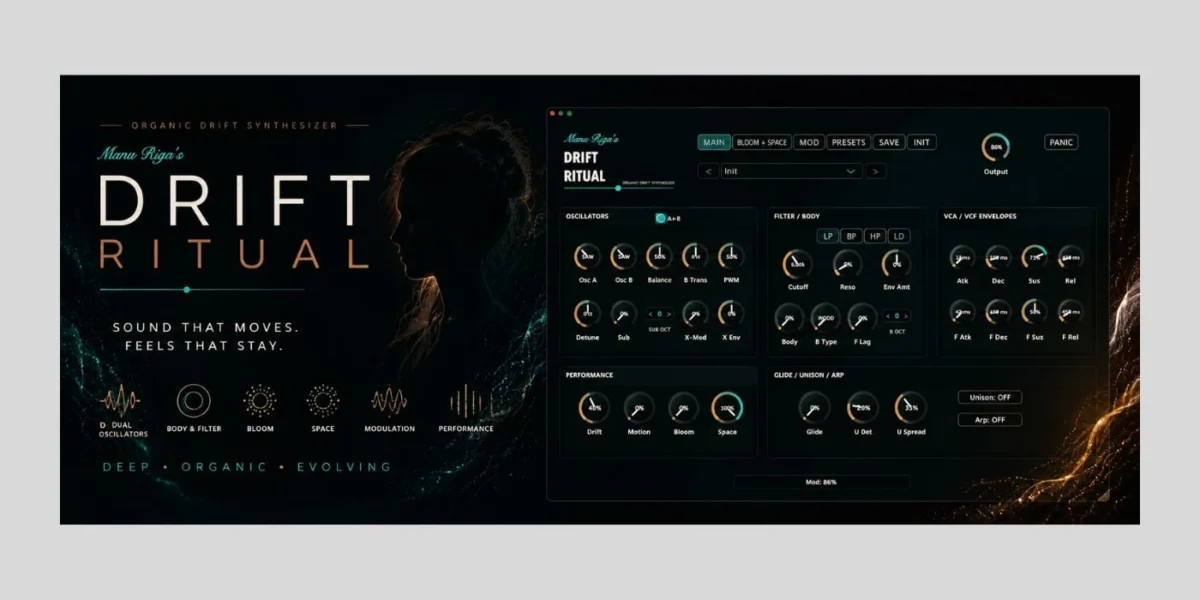
The digital audio workstation landscape has recently welcomed a significant new addition with the official release of Drift Ritual, a novel synth plugin developed by Manu Riga. This innovative software instrument, now available for free download, aims to provide music producers and sound designers with an "organic drift synthesizer" experience, emphasizing rich, dynamic, and analog-inspired sonic textures. The plugin supports both AU and VST formats, ensuring compatibility across a wide range of macOS and Windows operating systems, making it accessible to a broad segment of the music production community.
Introduction to Drift Ritual
Manu Riga’s Drift Ritual emerges at a time when the demand for high-quality, characterful virtual instruments continues to grow, particularly those that offer an authentic analog feel without the complexities and costs associated with hardware. The developer’s vision for Drift Ritual centers on creating sounds that are not merely static but "feel rich and alive," a quality often attributed to classic vintage analog synthesizers. This core philosophy is immediately evident in the plugin’s architecture, which combines robust synthesis engines with intuitive controls designed to foster both immediate musicality and deep sound design exploration.
The release of Drift Ritual as a free plugin is noteworthy, aligning with a growing trend among independent developers to contribute to the music production ecosystem through high-value freeware. This approach not only democratizes access to professional-grade tools but also allows developers like Manu Riga to showcase their expertise and build a community around their creations. While offered at no cost, the developer has expressed that donations are welcome, a common practice that supports ongoing development and acknowledges the significant effort invested in such projects. Notably, Manu Riga has also explicitly stated that Drift Ritual was developed through "many, many hours of coding, with no AI in sight," a clear affirmation of human craftsmanship in an increasingly AI-driven technological environment.
Unpacking the Sonic Core: Oscillators and Analog Emulation
At the heart of Drift Ritual’s sonic engine are its primary sound generators, designed to imbue the plugin with its characteristic warmth and richness. The instrument features two PolyBLEP oscillators, complemented by a multi-wave sub oscillator. This combination forms the foundation for a broad spectrum of sounds, from foundational basslines to complex pads and leads. The choice of PolyBLEP technology for the main oscillators is a deliberate one, aimed at replicating the "fatness" and harmonic richness associated with iconic synthesizers that defined cinematic soundscapes for decades.
The PolyBLEP Advantage
PolyBLEP, short for Polynomial Band-Limited Step, is a sophisticated waveform generation technique crucial for digital synthesizers aiming to emulate analog warmth and clarity. Unlike simpler digital oscillators that can suffer from aliasing—undesirable high-frequency artifacts that create a harsh, "digital" sound—PolyBLEP oscillators employ a form of band-limiting. This process ensures that the generated waveforms are harmonically clean and free from aliasing, even at high frequencies and when modulated. By meticulously shaping the wave’s edges, PolyBLEP effectively prevents the introduction of spurious frequencies, leading to a much smoother, more defined, and ultimately "analog-like" sound.
The developer’s specific reference to synths like the Roland Jupiter-8 and Oberheim OB-X8 highlights the aspirational quality of Drift Ritual’s PolyBLEP oscillators. These legendary hardware instruments are renowned for their massive, rich sound, often characterized by a certain "warmth" and "thickness" that digital emulations have historically struggled to achieve. While the article notes that Drift Ritual may not be "as distinct as something like the OB-X8"—a testament to the unique character of specific analog circuitry—it commends the PolyBLEP oscillators for successfully maintaining a "rich/lush analog-like sound without becoming too soft or introducing digital harshness." This delicate balance is key to creating a versatile instrument that can sit well in various mixes without demanding excessive post-processing. The multi-wave sub oscillator further enhances this foundation, adding depth and power to the lower frequencies, a critical element for creating impactful and full-bodied synth patches.
Crafting Analog Warmth in the Digital Realm
Beyond the oscillators, Drift Ritual extends its commitment to authentic analog character through its filtering section. The plugin incorporates a multi-mode filter, which is further enhanced by "body" and "analog-style lag" controls. The concept of "body" in a filter often refers to a subtle resonance or saturation characteristic that adds perceived weight and presence to the sound, mimicking the way analog components interact with audio signals. "Analog-style lag," on the other hand, implies a gentle, organic response to parameter changes, avoiding the instantaneous, sometimes sterile, precision of purely digital processing. This lag can manifest as a slight delay or softening in the filter’s reaction time, contributing to a more natural and less abrupt sonic evolution, especially during performance or modulation.
Furthermore, the filter section introduces innovative "Vowel Amount" and "Vowel Morph" controls. These features allow users to sculpt vowel-like effects, transforming static tones into expressive, vocalistic textures. This capability significantly expands the plugin’s sonic palette, enabling the creation of unique pads, evolving leads, and atmospheric effects that can convey speech-like qualities without relying on traditional vocoders. Such controls are particularly valuable for experimental sound design and for adding a distinctive human element to synthetic sounds, further distancing Drift Ritual from generic digital synthesizers.
Filtering and Expressive Modulation Capabilities
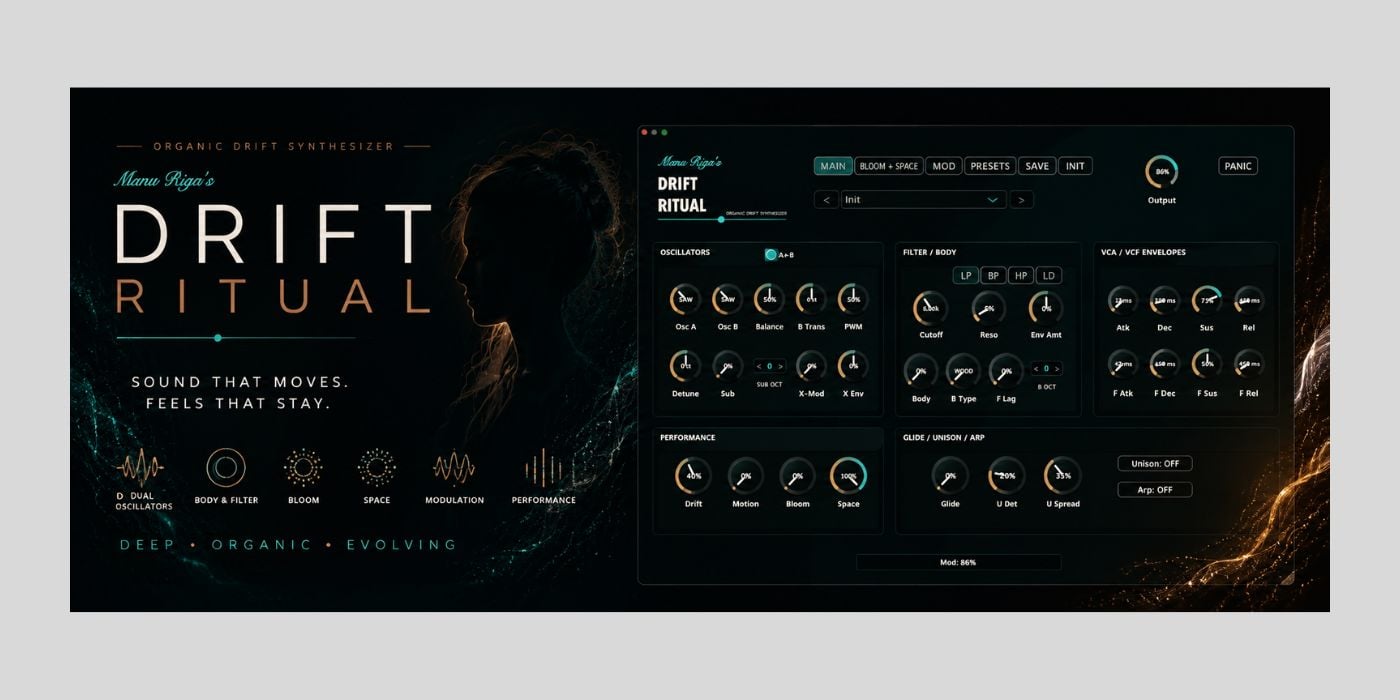
The expressive potential of any synthesizer is heavily dependent on its modulation capabilities. Drift Ritual is designed to strike a "sensible balance between immediately useable sounds and deeper sound design options," a philosophy that extends directly to its modulation architecture. The straightforward interface, complete with multiple pages, includes a dedicated Modulation page that provides comprehensive control over various parameters.
Sculpting Sound: Filters and Envelopes
Adjacent to the robust filter section are two ADSR (Attack, Decay, Sustain, Release) envelopes. These envelopes are fundamental to shaping the temporal characteristics of a sound, dictating how a note begins, sustains, and ends. Having two independent ADSR envelopes typically allows for separate control over the amplifier (volume) and other parameters such as the filter cutoff frequency, enabling complex and evolving timbral changes over time. For instance, one envelope might control a slow attack and long release for a pad, while the other applies a sharp attack and quick decay to the filter, creating a plucked or percussive texture within the same sound.
The multi-mode filter itself offers various filter types (e.g., low-pass, high-pass, band-pass), providing further flexibility in tonal shaping. The integration of "body" and "analog-style lag" parameters within this section is critical for imbuing the filter’s action with a warm, organic feel, preventing the sterile precision sometimes associated with digital filtering. These subtle nuances collectively contribute to the plugin’s ability to emulate the beloved characteristics of classic analog hardware.
Beyond Standard MIDI: MPE and Dynamic Control
The Modulation page is where users can truly delve into the "subtle organic drift" promised by the plugin’s name. It features two multi-mode LFOs (Low-Frequency Oscillators), each capable of generating a variety of waveforms (e.g., sine, triangle, square) to modulate parameters such as pitch, filter cutoff, or amplitude. The "multi-mode" aspect means these LFOs offer diverse behaviors, enabling anything from gentle, sweeping movements to rhythmic pulses and chaotic textures. Additionally, "Motion settings" provide further layers of dynamic control, allowing for intricate parameter automation and evolving soundscapes.
A built-in arpeggiator with "Chord Mode" is another powerful tool for rhythmic and melodic generation. An arpeggiator automatically plays notes of a held chord sequentially, creating rhythmic patterns. The "Chord Mode" likely enhances this by allowing the arpeggiator to trigger full chords in a rhythmic fashion, offering instant melodic and harmonic inspiration. This feature is invaluable for quickly generating sequences, basslines, and synth melodies, making it a powerful compositional aid.
Perhaps one of Drift Ritual’s most forward-thinking features is its full MPE (MIDI Polyphonic Expression) support. MPE represents a significant advancement over traditional MIDI, allowing for polyphonic expression of parameters like pitch bend, aftertouch, and timbre for each individual note played. In traditional MIDI, a single pitch bend wheel affects all notes simultaneously. With MPE, if a user bends a single note on an MPE-compatible controller, only that note’s pitch is affected, while other notes remain stable. This level of granular control unlocks unprecedented expressive potential, allowing musicians to imbue their performances with nuances akin to acoustic instruments. Drift Ritual’s MPE support, combined with velocity and aftertouch sensitivity, ensures that the plugin responds to the most subtle performance gestures, making sounds evolve and breathe in incredibly dynamic ways. This feature positions Drift Ritual as a modern instrument capable of handling the most expressive playing styles, appealing to performers and composers seeking nuanced control over their sound.
Design Philosophy: Intuition Meets Depth
The design philosophy behind Drift Ritual is clearly geared towards usability and versatility. Manu Riga has crafted an instrument that balances the immediate gratification of well-designed presets with the comprehensive tools needed for intricate sound design. This approach caters to a broad spectrum of users, from those seeking quick inspiration to seasoned sound designers looking for a flexible sonic canvas.
Bridging Immediate Inspiration with Advanced Sound Design
The plugin’s "immediacy comes from a large collection of factory presets and a straightforward interface." For many producers, especially those working under tight deadlines or exploring new genres, a strong library of presets is invaluable. These pre-designed sounds serve as excellent starting points, showcasing the plugin’s capabilities and providing instant sonic gratification. The intuitive interface ensures that even beginners can quickly navigate the controls, tweak parameters, and personalize sounds without feeling overwhelmed. This accessibility is crucial for fostering creativity, as users can spend more time making music and less time learning complex menus.
However, Drift Ritual is far from a mere preset player. Its comprehensive modulation options, detailed oscillator controls, and advanced filter section provide ample room for "deeper sound design options." Features like "Unison Detune" allow users to layer multiple voices for a thicker, more expansive sound, with subtle detuning adding width and character. The inclusion of built-in effects—Bloom (a harmonic delay), Space Center (a reverb), and Erode (a bitcrusher)—further empowers users to sculpt their sounds within the plugin itself. These effects are not just add-ons but integral components of the sound design workflow, enabling users to create complete, production-ready sounds without relying solely on external processing. Bloom, with its harmonic delay, can add shimmering, ethereal tails, while Space Center provides ambient depth. Erode, the bitcrusher, offers creative distortion and lo-fi textures, allowing for a wide range of sonic degradation from subtle grit to aggressive digital crunch.
Cinematic Ambience and Experimental Textures
The developer’s stated intention for Drift Ritual is crystal clear: "If you want warm, drifting, textural pads and cinematic atmospheres, it’s got them all day long." This focus on lush, evolving soundscapes positions the plugin perfectly for composers working in film, television, and video games, as well as electronic music producers seeking to inject depth and emotion into their tracks. The ability to generate "cinematic atmospheres" is particularly appealing in an era where immersive audio experiences are paramount. The combination of PolyBLEP oscillators, analog-style filtering, and extensive modulation capabilities ensures that these pads and textures are not static but breathe and evolve, adding a dynamic quality that keeps listeners engaged.
Beyond these core strengths, Drift Ritual also possesses "enough to be a bit more experimental with motion and texture." The multi-mode LFOs, Motion settings, and the arpeggiator with Chord Mode facilitate the creation of complex rhythmic patterns and evolving sonic tapestries. When combined with the Unison Detune and the built-in effects, users can push the boundaries of conventional synthesis, crafting unique and innovative sounds that stand out. This dual capacity—excelling at established sonic aesthetics while also providing tools for avant-garde exploration—makes Drift Ritual a highly versatile instrument. It fulfills the needs of producers and composers who desire "instant inspiration with a decent degree of flexibility," offering a powerful yet manageable toolkit for creative expression.
The Free Software Model and Developer Ethos
The release of Drift Ritual as a free plugin is part of a broader trend within the music technology industry, reflecting evolving monetization strategies and a strong community-driven ethos among developers.
The Growing Trend of High-Quality Freeware
In recent years, the landscape of music production software has seen a significant proliferation of high-quality freeware. Developers, ranging from independent hobbyists to established companies, increasingly offer sophisticated plugins, instruments, and effects at no cost. This phenomenon serves multiple purposes. For smaller developers like Manu Riga, it’s an effective way to gain visibility, build a reputation, and contribute to the community. By providing a valuable tool for free, they can attract a user base that might not otherwise discover their work, fostering goodwill and potentially leading to future commercial successes or direct support through donations. For users, especially bedroom producers, students, and those with limited budgets, these free resources lower the barrier to entry for professional-level music production. They democratize access to tools that were once exclusive to professional studios, enabling a wider array of artists to create high-quality music. Drift Ritual joins a distinguished list of free software instruments that have made a significant impact, demonstrating that "free" does not necessarily equate to "low quality."
The donation-ware model, where developers welcome optional contributions, is a common and often successful strategy within this trend. It allows users who genuinely appreciate the software and benefit from it to show their support financially, ensuring the developer can continue their work. This model relies on community engagement and the perceived value of the product, creating a reciprocal relationship between developer and user.
Manu Riga’s Stance on Development: Craftsmanship Over AI
Manu Riga’s explicit statement that Drift Ritual was created through "many, many hours of coding, with no AI in sight" is particularly resonant in the current technological climate. With the rapid advancements in artificial intelligence and machine learning, discussions around AI’s role in creative industries, including music production, are pervasive. Some AI tools are now capable of generating music, mastering tracks, or even designing plugin interfaces. Manu Riga’s declaration can be interpreted as a deliberate emphasis on human craftsmanship, dedication, and the artistic process. It highlights the intensive, detail-oriented work involved in coding a complex software instrument from the ground up, underscoring the value of human ingenuity and skill.
This stance could appeal to a segment of the user base that values authenticity and traditional development methodologies. It suggests a commitment to personal vision and meticulous engineering rather than relying on automated processes, positioning Drift Ritual as a product of pure human endeavor. In an era where the lines between human and machine creativity are increasingly blurred, such a statement serves as a powerful testament to the developer’s personal investment and ethical approach to software creation.
Broader Implications for the Music Production Community
The release of Drift Ritual carries several implications for the wider music production community. Firstly, its accessibility as a free, high-quality plugin directly contributes to the ongoing democratization of music creation. It empowers a broader range of individuals, regardless of their financial resources, to access professional-grade tools, fostering greater creativity and diversity in musical output. This aligns with the broader movement towards making advanced technology more available to independent artists and producers.
Secondly, the plugin’s focus on "organic drift" and "cinematic atmospheres" addresses a specific and growing need within modern music. As film, television, and video game scores become more sophisticated, and electronic music increasingly incorporates textural and ambient elements, tools like Drift Ritual are invaluable. It provides a dedicated solution for crafting evolving soundscapes, lush pads, and atmospheric textures, which are crucial for contemporary scoring and production techniques. Its MPE support further pushes the boundaries of expressive performance, encouraging musicians to explore more nuanced and dynamic interactions with their virtual instruments.
Finally, Manu Riga’s development philosophy, particularly the explicit rejection of AI in the creation process, could spark further discussion within the developer community and among users about the value of human craftsmanship versus algorithmic generation in software development. It highlights a potential emerging trend where developers actively differentiate their products based on the methods of their creation, emphasizing the human element in an increasingly automated world.
Conclusion
Drift Ritual represents a compelling new offering in the crowded virtual instrument market. With its robust PolyBLEP oscillators, analog-inspired multi-mode filter, extensive modulation capabilities including MPE support, and a thoughtful balance between immediacy and depth, it stands out as a versatile and inspiring synth plugin. Manu Riga’s commitment to delivering a high-quality instrument for free, coupled with an explicit dedication to human craftsmanship, makes Drift Ritual a notable release. It is poised to become a valuable tool for producers and composers seeking warm, drifting textures, cinematic atmospheres, and opportunities for experimental sound design, further enriching the creative possibilities available to the global music production community. As a parting note, for those exploring new sonic horizons, a brief mention should be made of VATRA, the debut plugin by Flame Sound, which is currently available with special introductory pricing, offering another avenue for sound exploration.
