

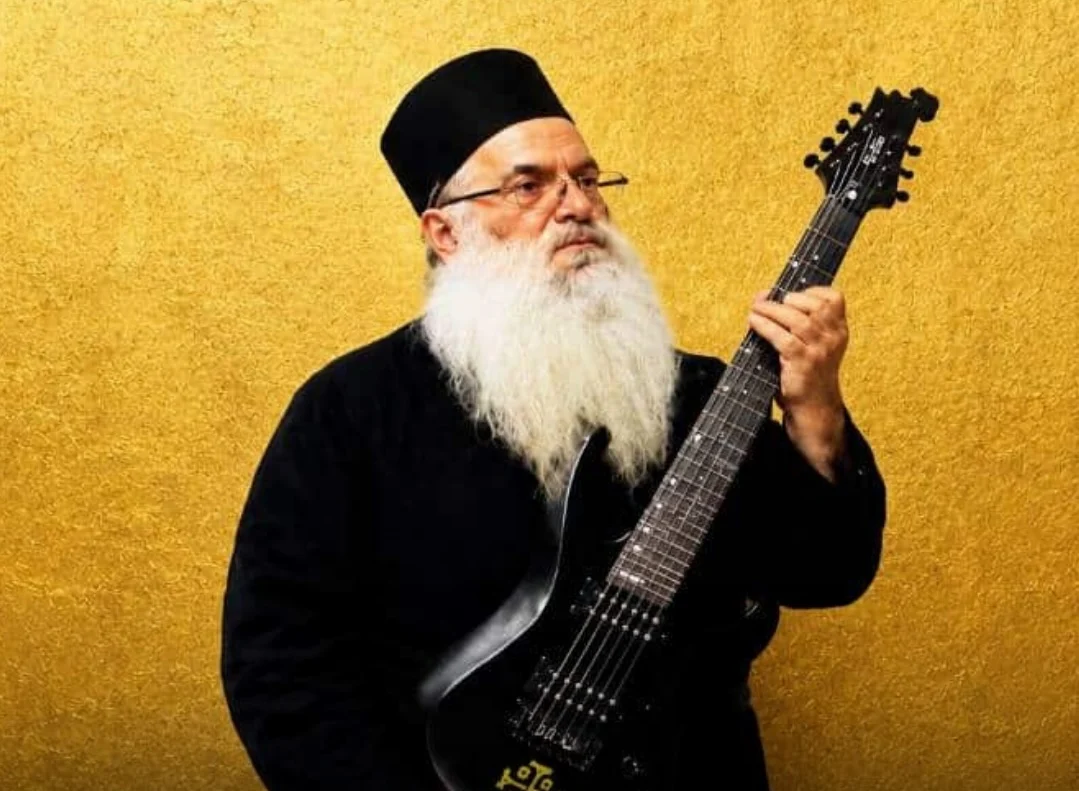
Philadelphia, PA – The unexpected and celebrated entry of Father Dionysios Tabakis, a Greek Orthodox priest, into the experimental music scene as a drone metal artist has taken a controversial turn. Following the announcement of his highly anticipated debut live performance at Philadelphia’s Making Time fest, scheduled for next month, a cascade of public scrutiny has brought to light old blog posts containing homophobic remarks and a past association with a now-criminalized Greek neo-Nazi organization. The revelations have sparked widespread debate across the music community, religious circles, and broader social discourse, challenging the boundaries of artistic freedom, religious doctrine, and public accountability.
The Unveiling of Past Controversies
Father Dionysios Tabakis first garnered international attention with his critically acclaimed drone metal LP, Paradise Metal. His unique persona—a Greek Orthodox priest crafting abrasive, atmospheric soundscapes—captured the imagination of many, positioning him as a fascinating figure bridging disparate worlds of spirituality and avant-garde music. The excitement surrounding his upcoming live debut in Philadelphia, announced in June, was palpable, marking a significant milestone for the artist whose work had previously existed primarily in recorded form.
However, this anticipation quickly transformed into a public relations crisis. In the weeks following the festival announcement, diligent internet users and media outlets unearthed several problematic elements from Father Tabakis’s past and recent online activity. Two blog posts, dated January and February 2024 respectively, were particularly inflammatory. In these posts, Father Tabakis referred to gay individuals as "Sodomites" and described gay marriage as a "sodomitic monstrosity." These remarks, reflective of a conservative theological stance, immediately drew condemnation from LGBTQ+ advocates and allies within the music and broader progressive communities.
Compounding the controversy was the discovery that in 2013, Father Tabakis had performed a sanctification ceremony at the offices of Golden Dawn (Χρυσή Αυγή), a Greek political party widely recognized for its neo-Nazi ideology and xenophobic platform. While Golden Dawn was a legally recognized political entity with representation in the Greek Parliament at the time of the ceremony, its subsequent criminalization in 2020 for operating as a criminal organization, coupled with its well-documented history of violence and hate speech, made this past association a severe point of contention. Critics swiftly highlighted the grave implications of a religious figure, particularly one gaining prominence in a progressive cultural space, having any connection to such an extremist group.
The swift and intense backlash placed Father Tabakis at the center of a storm, compelling him to issue a formal statement addressing the accusations.
Father Tabakis’s Official Response and Defense
On August 25, 2024, Father Dionysios Tabakis released a detailed statement, obtained by Pitchfork and disseminated through various channels, aiming to clarify his positions and defend his actions. The statement offered insights into his personal philosophy and the ecclesiastical context of his activities.
On the Issue of Homosexuality:
Father Tabakis explicitly stated, "My view on homosexuality is the same as that of the Orthodox Church for 2000 years, nothing more, nothing less." This assertion positions his personal belief squarely within the traditional doctrine of the Greek Orthodox Church, which officially condemns homosexual acts while calling for compassion and love towards individuals. He further elaborated on this nuanced approach: "We owe homosexual people love and acceptance because many have at times experienced great rejection from their environment, especially from their families." He recounted personal anecdotes from his 31 years as a priest, noting that he had offered confession and pastoral care to homosexual individuals, emphasizing that he had "always received them with acceptance and love." He shared an instance where he embraced a young man after confession, observing the relief it brought.
A particularly striking phrase in his statement was, "It is better to sin with freedom than to be virtuous with oppression." This philosophical stance suggests a prioritization of individual liberty and conscience, even if it leads to actions deemed sinful by the Church, over forced adherence to virtue. This statement can be interpreted as a defense of personal autonomy within the spiritual journey, implying that true repentance must stem from free will, not coercion.
On the Golden Dawn Sanctification:
Addressing the 2013 ceremony, Father Tabakis clarified that Golden Dawn was a legitimate, legally recognized political party at the time, holding seats in the Greek Parliament. He explained that the sanctification was performed "on official duty" after the party had requested the service from his superior authority, the Metropolis, a common practice for political parties and municipal groups in Greece. He noted that he had participated in similar ceremonies for various other political and municipal entities throughout his priesthood.
Crucially, Father Tabakis emphatically distanced himself from the ideology of nationalism: "I am against Nationalism because it has only brought blood and wars to humanity. The only ones who have interests in nationalism and borders are the weapons factories that spread death." He invoked his family history, stating, "my grandparents from Crete fought Hitler and Nazism, so I follow their spirit." To symbolize his anti-nationalist and anti-restrictive stance, he highlighted a peculiar detail about his musical instrument: "one reason I have removed the frets from my guitar is my mental need not to be confined to borders." This artistic choice, he implied, reflects a deeper philosophical rejection of divisions.
Concluding his statement, Father Tabakis expressed a desire to return to his "hermitism" and "upload my music with passion and peace on my channel," acknowledging that his "path and beliefs as an Orthodox Priest differ significantly from some of the values and cultural positions represented within contemporary experimental music festivals." This last remark suggested a recognition of the ideological friction between his religious convictions and the often-progressive ethos of the experimental music scene, perhaps hinting at the challenges of navigating these two worlds.
Deep Dive: Golden Dawn’s Trajectory in Greece
To fully understand the gravity of Father Tabakis’s past association, it is essential to contextualize the rise and fall of Golden Dawn. The party emerged from the fringes of Greek politics, rooted in a neo-Nazi and fascist ideology that glorified historical Nazism and openly promoted xenophobia, anti-Semitism, and ultranationalism. For decades, it remained a fringe group, primarily known for street violence against immigrants and political opponents.
However, the severe Greek financial crisis, which began in 2009 and intensified in the early 2010s, provided fertile ground for Golden Dawn’s growth. Exploiting widespread public anger, economic hardship, and a sense of national humiliation, the party capitalized on anti-immigrant sentiment and disillusionment with mainstream political parties. In the 2012 general elections, Golden Dawn shocked the political establishment by winning 18 seats in the Hellenic Parliament, securing nearly 7% of the national vote. This marked an unprecedented entry of an openly neo-Nazi party into a European national legislature since World War II. Its presence in parliament lent it a veneer of legitimacy, despite its continued violent activities and extremist rhetoric.
The party’s electoral success continued into 2015, but its decline began shortly after. A turning point came in September 2013 with the murder of anti-fascist rapper Pavlos Fyssas by a Golden Dawn supporter. This high-profile assassination triggered a massive police crackdown and a lengthy judicial investigation into the party’s activities. In October 2020, after a five-year trial, an Athens court delivered a landmark verdict, declaring Golden Dawn a criminal organization, effectively outlawing its operations. Its leaders, including founder Nikos Michaloliakos, were convicted on charges ranging from directing a criminal organization to murder, assault, and illegal possession of weapons. This ruling cemented the party’s status as a criminal enterprise rather than a legitimate political force, making any past association with it highly problematic in retrospect.
Father Tabakis’s explanation that the sanctification occurred when Golden Dawn was a "legal political party" and part of "official duty" reflects a technical truth of the time, but it does not diminish the moral and ethical concerns raised by critics, who argue that clergy should exercise discretion regarding which groups they legitimize with religious rites, regardless of legal status.
Orthodox Doctrine and Modernity: The View on Homosexuality
The Greek Orthodox Church, like many traditional Christian denominations, adheres to a conservative interpretation of sexuality. Its theological position, rooted in centuries of tradition and biblical exegesis, regards marriage as exclusively between a man and a woman, and views homosexual acts as contrary to divine law and the natural order. This stance is reiterated by the Ecumenical Patriarchate and various autocephalous Orthodox Churches globally.
However, the pastoral application of this doctrine often presents complexities. While the Church maintains its theological opposition to homosexual acts, it also emphasizes the imperative for all Christians to love and accept every individual, regardless of their sexual orientation. This distinction between condemning an act and loving the person is a cornerstone of Orthodox pastoral care. Father Tabakis’s statement aligns with this nuanced approach, where he upholds the Church’s doctrine while simultaneously advocating for "love and acceptance" and acknowledging the "great rejection" experienced by homosexual individuals.
The phrase "better to sin with freedom than to be virtuous with oppression" further complicates the interpretation. While it could be seen as an affirmation of free will in spiritual matters, it also potentially offers a degree of latitude for individuals to live according to their conscience, even if that path deviates from strict ecclesiastical norms, so long as it is pursued in freedom and with the potential for repentance. This perspective, while perhaps unconventional in its articulation, highlights the internal tension within the Church between rigid dogma and compassionate pastoral practice, especially in an increasingly secular and pluralistic world where LGBTQ+ rights are gaining widespread recognition.
The Intersection of Faith and Extreme Music
Father Dionysios Tabakis’s unique journey into drone metal itself is a testament to the unexpected intersections of faith and art. Drone metal, characterized by sustained, heavy, often dissonant tones and minimal rhythmic structures, is an experimental subgenre of heavy metal. It is known for its atmospheric, often unsettling, and deeply immersive qualities. Artists in this genre often explore themes of existentialism, transcendence, darkness, and the sublime, making it fertile ground for spiritual or philosophical inquiry, albeit often from unconventional angles.
The juxtaposition of a Greek Orthodox priest, a figure traditionally associated with ancient liturgy, sacred hymns, and community pastoral care, creating music in a genre known for its extreme sound and often dark aesthetics, was inherently compelling. His album, Paradise Metal, was celebrated for its originality and depth, creating a powerful synergy between his spiritual vocation and his artistic expression. This very uniqueness, however, now amplifies the scrutiny when his personal or past statements conflict with the often-progressive and inclusive values prevalent in the contemporary experimental music scene. The audience for drone metal often champions artistic freedom, social justice, and challenges to traditional authority, making the clash with his conservative theological views and historical associations particularly stark.
Reactions from Stakeholders and Broader Implications
The controversy surrounding Father Tabakis has generated a multifaceted response from various stakeholders, each grappling with the ethical and practical implications.
Making Time Fest Organizers: The festival, known for its forward-thinking curation and inclusive atmosphere, faces immediate pressure. Organizers are likely reviewing Father Tabakis’s performance slot, weighing contractual obligations against public outcry and the festival’s stated values. A decision to proceed could be seen as condoning the priest’s past statements, while a cancellation or withdrawal could lead to accusations of censorship or religious discrimination. The festival’s reputation for inclusivity is at stake, and a public statement or action is highly anticipated.
LGBTQ+ Advocacy Groups: Organizations championing LGBTQ+ rights have condemned the "Sodomites" language as deeply offensive and harmful. They would likely call for a clear retraction and an unequivocal apology for the dehumanizing language, arguing that while religious freedom is important, it does not justify hate speech. The emphasis on "love and acceptance" in his statement, while positive, would likely be deemed insufficient without a renunciation of the offensive terminology.
Anti-Fascist and Human Rights Organizations: Groups dedicated to combating fascism and promoting human rights have expressed strong disapproval of Father Tabakis’s 2013 association with Golden Dawn. They would argue that providing religious legitimacy to a party with a neo-Nazi ideology, regardless of its legal status at the time, is a grave error with serious ethical implications. They might call for an explicit denunciation of Golden Dawn’s ideology and a commitment to anti-racist principles.
Greek Orthodox Church Hierarchy: The controversy could prompt an internal review or statement from the Metropolis or the broader Greek Orthodox Church. While Father Tabakis’s theological views on homosexuality align with official doctrine, the manner of their expression (e.g., in blog posts) and his association with a criminalized extremist group could be subject to ecclesiastical scrutiny. The Church may choose to reaffirm its doctrine while also issuing guidance on clergy’s public conduct and associations, particularly those who gain significant public profiles outside traditional church settings.
The Music Community: Reactions within the music world are likely divided. Some fans and artists might defend Father Tabakis’s right to artistic and religious expression, arguing against "cancel culture" and for separating the artist from their personal beliefs, especially those rooted in ancient religious tradition. Others will argue that artistic platforms come with social responsibilities, and that supporting an artist with such views is tantamount to condoning homophobia and past associations with extremism. This debate reflects the ongoing tension within creative industries regarding ethical consumption and the moral responsibilities of artists and promoters.
Chronology of Key Events
- 2013: Father Dionysios Tabakis performs a sanctification ceremony at the offices of Golden Dawn, then a legal political party in Greece.
- October 2020: An Athens court declares Golden Dawn a criminal organization, effectively outlawing its operations and convicting its leadership.
- January/February 2024: Father Tabakis publishes blog posts referring to gay people as "Sodomites" and gay marriage as a "sodomitic monstrosity."
- June 2024: Father Tabakis announces his first-ever live performance at Philadelphia’s Making Time fest, scheduled for the following month.
- August 2024: Old blog posts and the 2013 Golden Dawn association resurface, leading to widespread public backlash.
- August 25, 2024: Father Dionysios Tabakis issues a formal statement addressing the accusations of homophobia and ties to Golden Dawn.
- September 2024 (projected): Making Time fest is scheduled to take place, with Father Tabakis’s performance status uncertain amidst the controversy.
Conclusion and Outlook
The controversy surrounding Father Dionysios Tabakis highlights the complex and often fraught intersection of religious faith, artistic expression, and contemporary social values. His unique position as both a spiritual leader and an acclaimed drone metal artist has brought these tensions into sharp relief. While his statement attempts to reconcile his traditional religious beliefs with an emphasis on compassion and to distance himself from the extremist ideology of Golden Dawn, the public and cultural implications remain significant.
The ongoing discourse will likely influence not only Father Tabakis’s future in music and his standing within the Church but also broader conversations about the responsibilities of public figures, the evolving standards of inclusivity in cultural spaces, and the challenges of reconciling ancient doctrines with modern progressive sensibilities. The outcome of his scheduled performance at Making Time fest will be closely watched as an indicator of how the music industry and public alike navigate these complex moral and ethical landscapes. His desire to return to "peace, my hermitism, and to upload my music with passion and peace" might be a challenging endeavor in the wake of such intense public scrutiny.
