

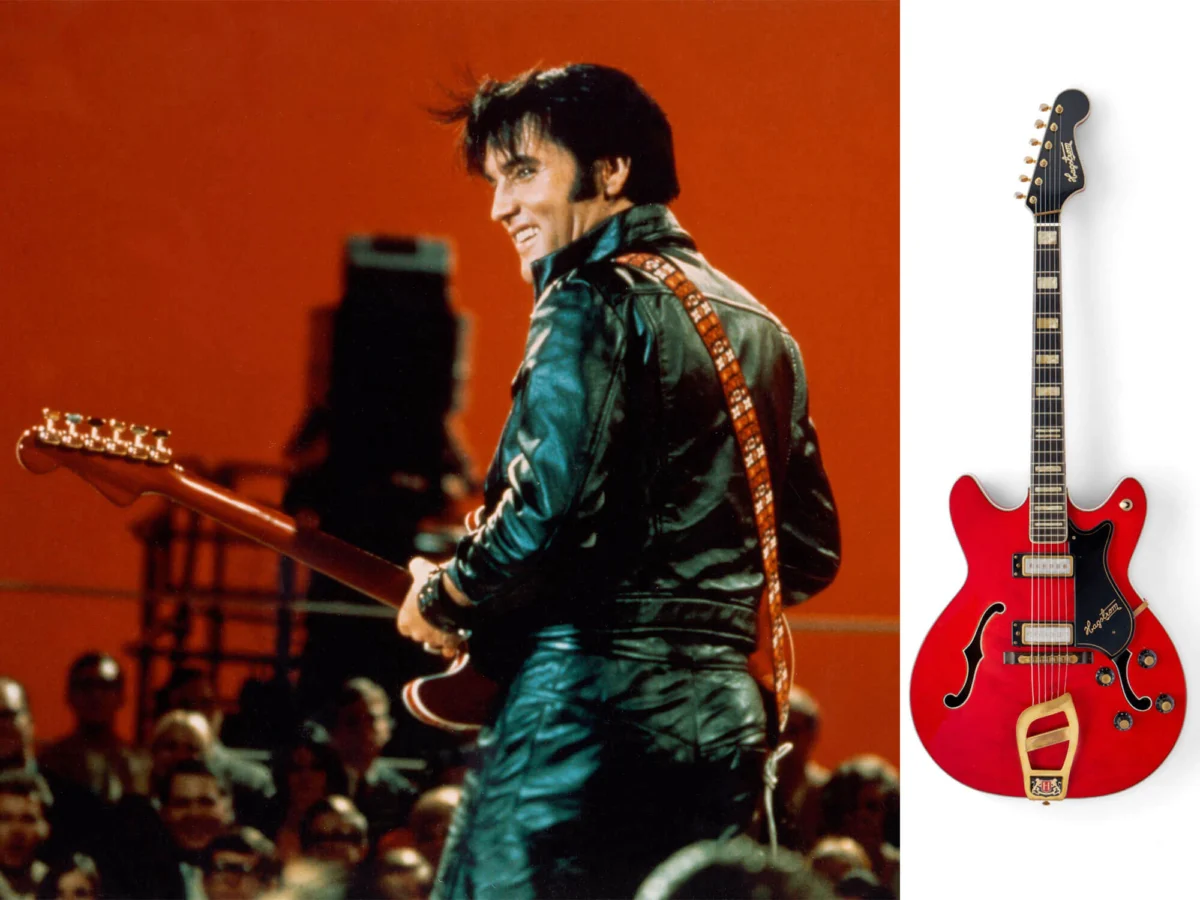
The year 2026 has already distinguished itself as a landmark period for high-profile musical instrument auctions, and the trend shows no signs of abating as Elvis Presley’s legendary 1968 Comeback Special Hagstrom Viking II guitar is once again poised to command significant attention on the auction block at Sotheby’s. This follows a period of unprecedented activity in the memorabilia market, highlighted by the monumental sales stemming from the Jim Irsay Collection earlier this year. The King of Rock and Roll’s distinctive red Hagstrom, a crucial element in one of his career-defining performances, is anticipated to fetch between $1 million and $2 million, underscoring the enduring power and financial valuation of artifacts tied to music’s most influential figures.
A Market Reconfigured: The Jim Irsay Collection’s Impact
The recent sales from the Jim Irsay Collection, a vast assembly put up for auction following the passing of the billionaire Indianapolis Colts owner and prolific guitar enthusiast Jim Irsay, fundamentally reshaped the landscape of music memorabilia. This single collection orchestrated a significant reshuffling of the list of all-time highest-selling guitars, introducing several new entries into the elite tier of multi-million dollar instruments. Notably, David Gilmour’s iconic Black Stratocaster, a cornerstone of Pink Floyd’s sonic identity, now holds the undisputed record, having sold for a staggering $14,550,000. This sale alone set a new benchmark for musical instruments, demonstrating an unparalleled appetite among collectors for pieces with profound historical and cultural resonance.
Further cementing the collection’s historic impact, Jerry Garcia’s legendary "Tiger" guitar, a bespoke instrument synonymous with The Grateful Dead’s improvisational mastery, commanded an impressive $11.5 million. Other instruments once belonging to rock luminaries such as Eric Clapton and Kurt Cobain also garnered substantial seven-figure sums, reinforcing the robust health of this specialized market. In aggregate, the Jim Irsay Collection generated an astounding $94.5 million, establishing 28 new world records and becoming the most valuable memorabilia auction in history, as confirmed by auction house Christie’s, which managed the monumental event. The sheer scale and success of the Irsay auction have set a formidable precedent, suggesting a buoyant market for instruments with verifiable provenance and profound artistic connection.
The Hagstrom Viking II: A Pivotal Prop in a Historic Comeback
Against this backdrop of record-shattering sales, the re-emergence of Elvis Presley’s 1968 Comeback Special Hagstrom Viking II is particularly significant. While it may not reach the eight-figure sums of the very top-tier guitars from the Irsay collection, its historical weight is undeniable. Like Noel Gallagher’s Epiphone EJ-200, which also recently hit the auction block after its storied use during the recording of Oasis’s landmark sophomore album (What’s the Story) Morning Glory?, the Hagstrom is being offered through Sotheby’s, a testament to its status as a highly coveted piece of cultural history. The guitar’s previous sale in 2021 for $625,000 provides a strong indicator of its appreciating value and the intensified interest surrounding Elvis artifacts.
The red Hagstrom Viking II holds a unique place in the pantheon of Elvis Presley’s instruments, despite having been played by the King of Rock and Roll only once during his career-redefining 1968 television special. Originally, Elvis and his team had considered other instruments for the performance. However, a strategic decision was made to utilize this particular guitar, which at the time belonged to esteemed session guitarist Al Casey. The choice was driven primarily by aesthetic considerations: its vibrant red finish perfectly complemented the intimate set design and Elvis’s iconic black leather outfit, contributing to the striking visual narrative of his return. This deliberate integration of the instrument into the visual presentation elevated its status from a mere musical tool to a crucial component of a carefully crafted image.
The Genesis of a Legend: The 1968 Comeback Special
To fully appreciate the Hagstrom Viking II’s significance, one must understand the context of the 1968 Comeback Special. By the mid-1960s, Elvis Presley’s career had largely transitioned from groundbreaking musical innovator to Hollywood movie star. For nearly seven years, he had focused predominantly on acting in a series of formulaic musical films, largely distancing himself from live performances and contemporary music trends. The special, officially titled Elvis, was conceived as a deliberate effort to re-establish his credibility as a dynamic musical force and reconnect him with a new generation of fans, as well as re-energize his existing fanbase.
Directed by Steve Binder, the special diverged sharply from the bland, family-friendly fare Elvis had been producing. It featured intimate, in-the-round jam sessions where Elvis, clad in a now-legendary black leather suit, showcased his raw charisma and powerful vocal delivery. These segments, which evoked the spontaneous energy of early rock and roll, proved to be particularly electrifying. The special also included elaborate production numbers and gospel medleys, but it was the stripped-down, visceral performances that captured the public’s imagination and cemented his return to form. The Hagstrom Viking II, prominently featured during these intimate jam sessions, became intrinsically linked with this pivotal moment of artistic reinvigoration.
Expert Insight on Enduring Imagery

Craig Inciardi, Sotheby’s Music and Pop Culture Specialist, articulates the profound impact of the guitar and the performance. "This guitar became a symbol of Elvis’s legendary comeback," Inciardi states. "Guitars have always been central to his image, but seeing Elvis return to the stage after years away, dressed in his iconic black leather outfit and playing this guitar, created one of the most enduring images in rock history." Inciardi further emphasizes the broader implications: "It marked a pivotal moment, reconnecting him with a generation of fans and cementing his status as the King of Rock ‘n’ Roll." This expert perspective underscores how a single instrument, through its association with a monumental event, transcends its utilitarian function to become a potent cultural artifact, embodying a significant chapter in music history.
The choice of the Hagstrom Viking II, a semi-hollow body electric guitar produced by the Swedish manufacturer Hagstrom, was itself notable. While not as universally recognized as some American guitar brands, Hagstrom guitars were known for their distinctive designs, slim necks, and unique electronics. The Viking II, with its striking red finish and elegant contours, offered a visual flair that perfectly suited the dramatic aesthetics of the Comeback Special. Its selection over more conventional instruments added a layer of distinctiveness to Elvis’s visual presentation, making it instantly recognizable to millions of viewers who tuned in to witness the King’s triumphant return.
A Chronology of Rock Memorabilia’s Ascendance
The current auction of Elvis’s Hagstrom Viking II can be placed within a clear timeline of increasing valuation for rock and roll memorabilia:
- Pre-1968: Elvis Presley’s career largely focused on films, with live performances taking a backseat.
- December 3, 1968: Elvis (The ’68 Comeback Special) airs, marking a monumental shift in his career and showcasing the Hagstrom Viking II.
- 2021: The Hagstrom Viking II is previously sold at auction for $625,000, indicating a growing market interest.
- Earlier 2026 (as per article’s present tense): The Jim Irsay Collection auction at Christie’s shatters multiple records, with David Gilmour’s Black Strat fetching $14.55 million and Jerry Garcia’s Tiger selling for $11.5 million, totaling $94.5 million across the collection.
- Current Period (April 2026): Noel Gallagher’s Epiphone EJ-200 and Elvis Presley’s Hagstrom Viking II are put up for sale at Sotheby’s, with online bidding for the Hagstrom now open.
- April 13-20, 2026: The Hagstrom Viking II is displayed at Sotheby’s New York Breuer Building, allowing potential bidders and enthusiasts a rare opportunity to view the artifact.
This chronology illustrates a consistent upward trajectory in the perceived and realized value of instruments tied to music legends, with 2026 emerging as a peak year for such high-profile transactions.
Broader Implications for the Memorabilia Market
The continued robust performance of the music memorabilia market, exemplified by both the Jim Irsay Collection and the anticipated sale of Elvis’s Hagstrom, has several significant implications. Firstly, it underscores the enduring cultural capital of artists like Elvis Presley, David Gilmour, and Jerry Garcia. Their instruments are not merely tools; they are tangible links to moments of artistic creation and historical significance, imbued with the aura of their legendary owners. The escalating prices reflect a deeper societal appreciation for preserving these connections to cultural heritage.
Secondly, the involvement of major auction houses like Sotheby’s and Christie’s lends considerable legitimacy and global reach to these sales. Their expertise in authentication, marketing, and managing high-value transactions ensures that these items reach a wide network of serious collectors, museums, and investors. This institutional backing further solidifies the market, transforming it from a niche hobby into a recognized segment of the art and collectibles world.
Finally, these auctions highlight a growing trend of investment in cultural assets. While traditional investments fluctuate, iconic musical instruments with unique provenance have shown remarkable resilience and appreciation. Collectors are increasingly viewing these items not just as passion purchases but as valuable assets that can diversify portfolios while offering immense personal enjoyment and historical stewardship. The high expectations for Elvis’s Hagstrom Viking II serve as a clear indicator that the market for such irreplaceable artifacts remains exceptionally strong, driven by both nostalgia and strategic investment.
Auction Details and Viewing Opportunities
For prospective bidders and enthusiasts, the online auction for Elvis Presley’s Hagstrom Viking II is currently open. The guitar is expected to realize a final sale price within the $1 million to $2 million range. In a rare opportunity for public viewing, the legendary instrument will be displayed at Sotheby’s New York Breuer Building from April 13 to April 20, 2026. This exhibition offers a chance for the public to connect with a tangible piece of rock and roll history before it finds its next custodian. Further details regarding the auction and viewing schedule are available directly through Sotheby’s official website.
