

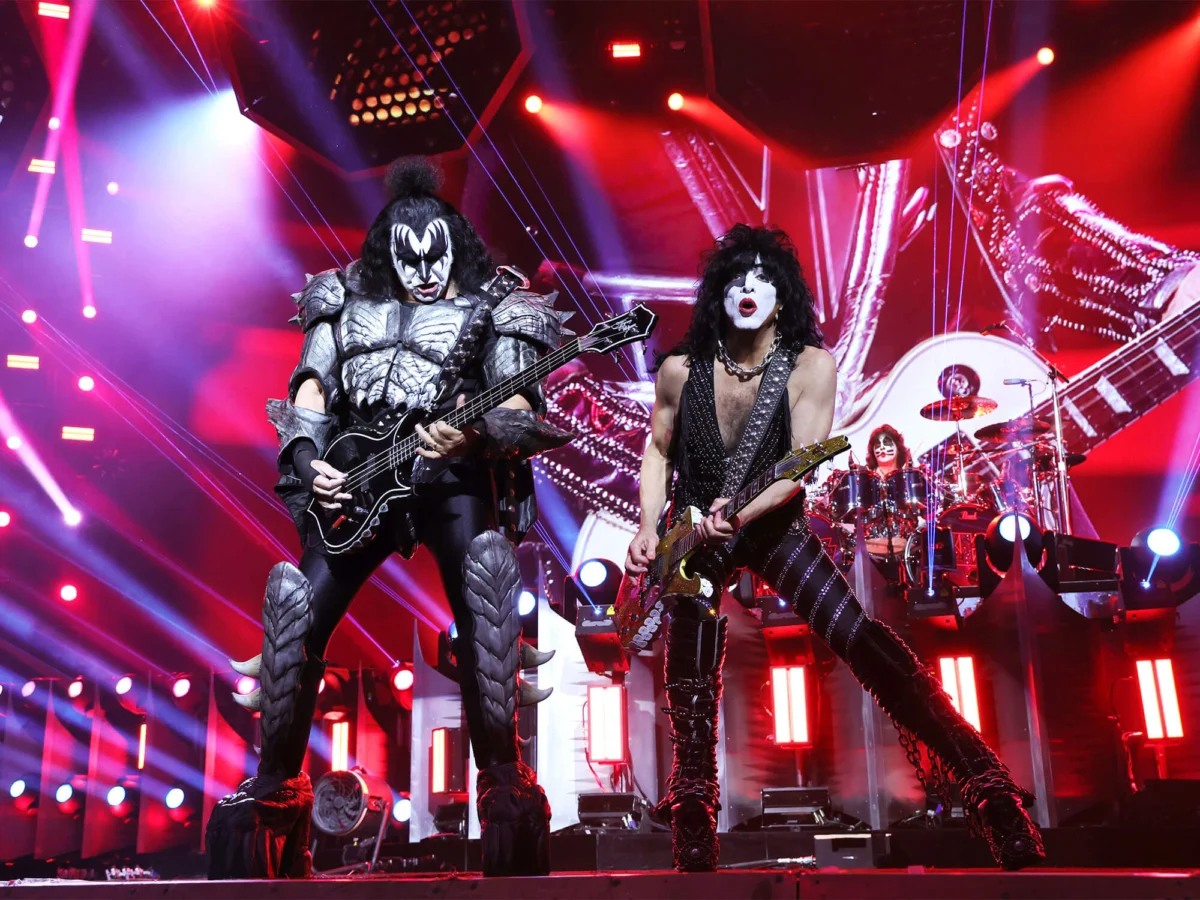
The Las Vegas Sphere, an architectural marvel boasting a 580,000 square-foot spherical enclosure adorned with 1.2 million programmable LED puck lights, has rapidly established itself as a cutting-edge pinnacle in venue design since its grand opening in 2023. Capable of accommodating up to 20,000 concertgoers, the venue has hosted a diverse array of musical acts, ranging from rock titans like U2, Eagles, and Dead & Company, to electronic dance music pioneers such as Anyma and Zedd. The Sphere’s unique immersive capabilities have drawn significant interest from artists eager to explore new dimensions of performance, with Metallica recently making headlines by confirming a highly anticipated residency in 2026. However, not all legendary acts share this enthusiasm for the technologically advanced venue. Paul Stanley, the iconic frontman of the glam rock sensation Kiss, has articulated the band’s decision to forgo a performance at the Sphere, citing concerns that the venue’s overwhelming visual display would diminish the band’s presence.
Stanley’s perspective, shared in an interview with American Songwriter, reveals a deliberate choice rooted in Kiss’s long-standing commitment to being the focal point of their legendary shows. He recounted discussions during the "End of the Road" farewell tour, which concluded in 2023, where suggestions arose for Kiss to perform at the Sphere. "The truth of it is, the Sphere minimizes a band," Stanley stated emphatically. "It makes a band miniature. You’re not going there to see a band—you’re going to see screens." This sentiment underscores a philosophical divergence within the music industry regarding the optimal balance between technological spectacle and live artistic performance. While many artists view the Sphere’s immersive potential as an unparalleled opportunity to enhance their artistic expression, Stanley argues that its very design inherently shifts the audience’s focus away from the musicians themselves, reducing them to a peripheral element within a grander digital canvas.
The Rise of the Sphere: A New Era in Live Entertainment
Opened on September 29, 2023, with U2’s "U2:UV Achtung Baby Live at Sphere" residency, the Las Vegas Sphere represents a monumental investment in the future of live entertainment. Developed by Madison Square Garden Entertainment Corp., the project reportedly cost an estimated $2.3 billion, making it one of the most expensive entertainment venues ever built. Its exterior, the Exosphere, functions as the world’s largest LED screen, offering dynamic visual displays that have transformed the Las Vegas skyline into a constantly evolving canvas. Inside, the main arena features a wrap-around LED screen that spans 160,000 square feet, providing a 360-degree visual experience that envelops the audience. Coupled with 10,000 haptic seats and an advanced audio system comprising 160,000 speakers, the Sphere offers a multi-sensory immersion unlike any other.
The venue’s initial residencies have showcased its transformative power. U2’s groundbreaking shows utilized the Sphere’s capabilities to create breathtaking visual narratives that complemented their music, often transcending traditional concert staging. Dead & Company followed suit, offering their fans a unique visual accompaniment to their improvisational rock jams. The announcement of Metallica’s 2026 residency further solidified the Sphere’s status as a premier destination for top-tier musical acts looking to push the boundaries of live performance. These artists have seemingly embraced the Sphere’s technology as a tool to amplify their artistic vision, integrating it seamlessly into their performances to create unparalleled, unforgettable experiences for their audiences.
Kiss’s Legacy of Spectacle and the Path to Avatars
Kiss, throughout its five-decade career, has been synonymous with theatricality and grand spectacle. From their iconic black-and-white makeup and elaborate costumes to their pyrotechnics, blood-spitting, and levitating drum kits, the band meticulously crafted a larger-than-life stage persona designed to captivate and immerse their audience. Their live shows were never merely concerts; they were elaborate productions where the band members, as characters, were the undeniable stars. This unwavering commitment to being the central focus of their own spectacle provides critical context for Stanley’s stance on the Sphere.
The "End of the Road" farewell tour, which spanned from 2019 to 2023, served as a monumental celebration of Kiss’s enduring legacy, culminating in a spectacular final performance at New York’s Madison Square Garden. This tour itself was a testament to their dedication to delivering an immersive, high-energy experience where the band members were always front and center. Despite officially retiring their touring persona, Kiss announced a bold continuation of their artistic journey through avatar shows. This new venture, set to utilize advanced hologram technology to project digital likenesses of the band members onto a stage, draws parallels with ABBA’s highly successful "Voyage" shows.
This transition to avatar performances highlights that Kiss, and particularly Paul Stanley, are not inherently averse to embracing new and emerging technologies. In fact, their entire career has been marked by a pioneering spirit in stagecraft. However, their technological adoption comes with a crucial distinction: the technology must serve to elevate and center the band, not overshadow it. Stanley elaborated on this philosophy, stating, "We wanted to incorporate the highest of technology, but we want to be the center of it. It’s a very, very different experience than going to see a postage stamp with a band on it. This is the antithesis of that—it’s 180 degrees from that." He emphasized that the upcoming avatar show aims to create an experience where the audience becomes "immersed in those four people on stage," much like the positive reception of ABBA Voyage, but taken "even further."
Technological Divergence: Sphere’s Display vs. Avatar Immersion

The contrasting approaches of the Las Vegas Sphere and the planned Kiss avatar shows represent two distinct philosophies in leveraging technology for live entertainment. The Sphere’s primary innovation lies in its colossal, all-encompassing LED screen, which creates a shared, communal visual experience for the entire audience. The technology here is about environment creation – transforming the physical space into a dynamic digital landscape. This demands a certain level of artistic surrender from the performing act, as their physical presence becomes one element within a much larger, digitally constructed reality. For bands like U2 or Dead & Company, this integration can enhance their music by providing a vast, ever-changing backdrop that complements their artistic narratives.
Conversely, the Kiss avatar shows, much like ABBA Voyage, focus on the digital resurrection and enhancement of the performers themselves. This involves sophisticated motion capture technology, real-time rendering, and volumetric video to create hyper-realistic digital representations that interact with the audience and the stage environment. The technology serves to amplify the presence of the band members, making them appear larger-than-life, eternally youthful, and capable of executing complex stage movements that might be physically demanding for human performers. The immersion here is directed at the avatars, maintaining them as the undeniable focal point, rather than dispersing the audience’s attention across a vast digital landscape. The goal is to make the audience feel like they are watching Kiss, albeit a technologically enhanced version, rather than watching a screen with Kiss performing on it.
The ABBA Voyage show in London provides a compelling precedent. Through meticulous technical execution, the "ABBAtars" perform a full set, convincing many attendees of their lifelike quality and emotional resonance. The show has garnered critical acclaim for its ability to create a genuine connection between the audience and the digital performers, demonstrating that avatar technology can indeed place the "band" at the center of the experience, even without their physical presence. Kiss’s ambition to take this "even further" suggests an exploration of more interactive elements or even greater fidelity in their digital representations, ensuring that the essence of their live performance—the direct engagement with the band—remains paramount.
Broader Industry Reactions and the Future of Live Music
Paul Stanley is not alone in his reservations about the Sphere’s format. Iron Maiden singer Bruce Dickinson voiced similar concerns in August 2025, echoing Stanley’s sentiment about the potential for bands to be overshadowed. Dickinson famously questioned, "What’s the point of even being there, if you’re a band?" This shared perspective among veteran rock musicians highlights a fundamental debate within the industry: where does the essence of a live performance truly lie? Is it in the sheer scale of the visual environment, or in the unmediated connection between performer and audience?
The implications of these contrasting views extend beyond individual artist preferences. The Sphere’s success, coupled with the rising popularity of avatar shows, indicates a significant shift in audience expectations and technological capabilities. Audiences are increasingly seeking immersive, multi-sensory experiences that transcend traditional concert formats. This pushes artists and promoters to innovate, but also forces a re-evaluation of what constitutes "live" music.
For artists who prioritize raw, human connection and the energy exchange with a live audience, the Sphere might indeed feel like a distraction, a barrier between them and their fans. Their focus might be on smaller venues where intimacy can be fostered, or on stage designs that, while elaborate, still keep the performer in sharp relief. For others, the Sphere offers an unprecedented canvas to realize ambitious artistic visions, turning a concert into a multi-media art installation.
The economic implications are also substantial. Residencies at venues like the Sphere command premium ticket prices and attract significant tourism, bolstering the local economy of Las Vegas. The long-term nature of these residencies also offers artists a more stable touring schedule compared to traditional global tours. Similarly, avatar shows offer bands like Kiss, who have concluded their physical touring, a viable and lucrative avenue to continue performing for their fans without the physical demands of constant travel. This opens up possibilities for legacy acts to maintain relevance and engage new generations of fans indefinitely.
Ultimately, the decisions made by artists like Kiss and Iron Maiden, contrasted with those embracing the Sphere, are shaping the future landscape of live music. It’s a future where technology is not merely an enhancement but an integral component, offering diverse pathways for artistic expression and audience engagement. Whether through an all-encompassing digital dome or hyper-realistic avatars, the core challenge remains for artists to leverage these innovations in ways that resonate authentically with their artistic identity and maintain the profound connection with their audience that defines live performance.
Kiss’s avatar shows are tentatively scheduled for 2028, promising a new chapter in the band’s enduring legacy of spectacle, one where technology serves to amplify their iconic presence rather than diminish it. Meanwhile, the Las Vegas Sphere continues to redefine the boundaries of live entertainment, inviting artists to explore the vast potential of its immersive digital canvas.
