

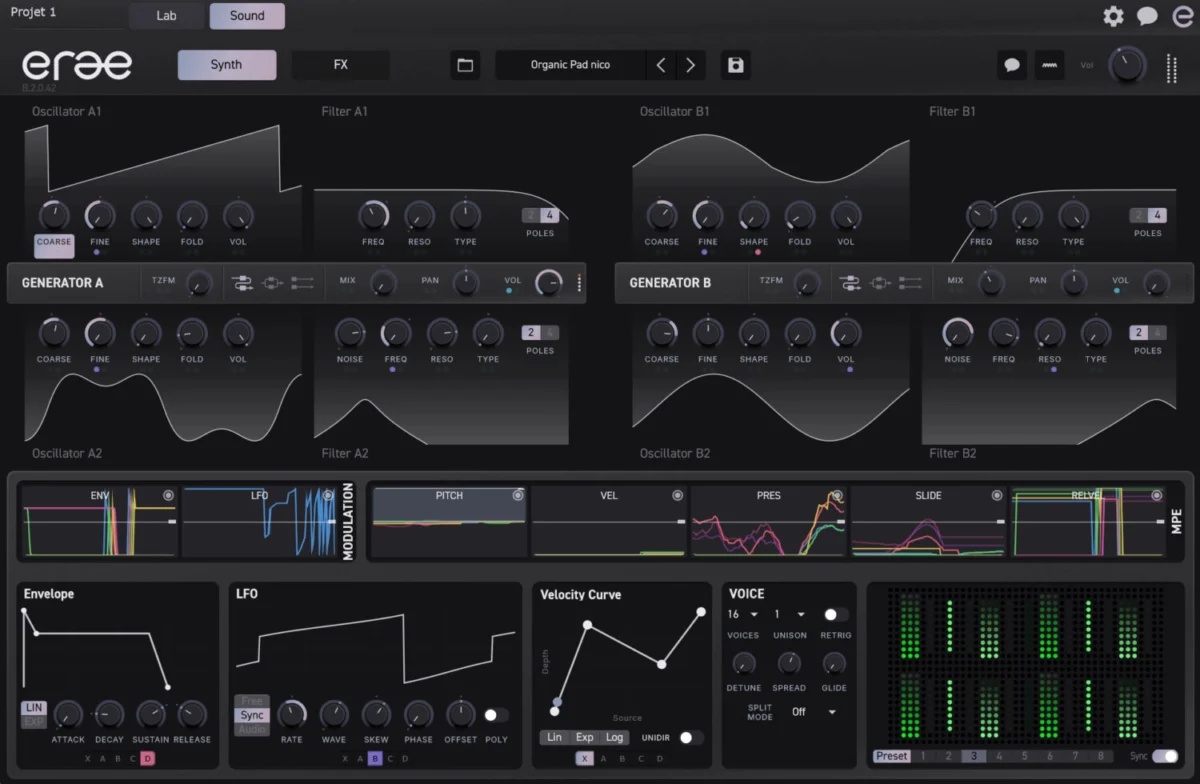
The digital music production landscape has undergone a significant transformation with the introduction of ERAE Sound, a dedicated software synthesizer developed by the French technology firm Embodme. Designed specifically to bridge the gap between tactile hardware interfaces and digital sound generation, ERAE Sound represents a departure from traditional synthesis architecture. While most contemporary software instruments are designed with a mouse-and-keyboard or standard MIDI keyboard workflow in mind and later retrofitted for expressive control, Embodme asserts that ERAE Sound was engineered from its inception to respond to the nuances of multi-dimensional touch. This release marks a strategic expansion for the company, moving from a hardware-centric focus to a comprehensive ecosystem that integrates physical gesture with complex sonic synthesis.
The software arrives as an optimized companion to the company’s flagship hardware, the ERAE Touch, but its utility extends to the broader market of MIDI Polyphonic Expression (MPE) devices. By providing 83 meticulously crafted instruments, each tailored to specific physical interactions, Embodme aims to address a common complaint among electronic musicians: the disconnect between the high-resolution data output of modern controllers and the often-static response of legacy software plugins.
The Evolution of Expressive Synthesis and Embodme’s Trajectory
The journey toward ERAE Sound began with the development of the ERAE Touch, a versatile MIDI controller characterized by its large, pressure-sensitive silicon surface and dynamic LED feedback. Since its successful crowdfunding campaign and subsequent market entry, the ERAE Touch has been adopted by a niche but growing segment of performers seeking more "organic" control over digital sounds. However, the hardware’s potential was frequently limited by the complexity of mapping high-density sensor data to third-party software.
Recognizing this friction point, Embodme spent several years developing a dedicated engine that could interpret 3D touch data—comprising X (horizontal), Y (vertical), and Z (pressure/depth) axes—without the latency or configuration hurdles typical of standard VST instruments. The release of ERAE Sound serves as the culmination of this effort, transitioning the company from a peripheral manufacturer to a full-stack music technology provider. This move mirrors strategies seen by other industry leaders, such as ROLI with its Equator synthesizer or Arturia with its integrated hardware-software ecosystems.
Technical Architecture and Instrument Design
At the core of ERAE Sound is a multi-engine synthesis platform designed to handle the high data throughput of MPE. Standard MIDI communication often limits a performer to a single channel of expression for all notes played. In contrast, MPE allows for per-note modulation, enabling a musician to apply vibrato to one note in a chord while simultaneously filtering another and increasing the volume of a third.
ERAE Sound’s library of 83 instruments is categorized not just by their acoustic properties—such as pads, leads, or percussive elements—but by their "feel" and playability. The internal engines utilize a mix of subtractive synthesis, frequency modulation (FM), and physical modeling. The latter is particularly significant for expressive surfaces; physical modeling simulates the vibrations of strings, membranes, and pipes, which respond naturally to varying degrees of pressure and strike velocity.
The software is structured to interpret four primary dimensions of touch:
- Strike: The initial velocity and force of the impact.
- Pressure (Z-axis): Continuous modulation based on how hard the surface is pressed after the initial strike.
- Slide (Y-axis): Vertical movement across the surface, often mapped to timbre or filter cutoff.
- Glide (X-axis): Horizontal movement, typically used for pitch bends and polyphonic portamento.
By building these parameters into the fundamental code of every preset, Embodme ensures that the transition from a performer’s physical intent to the resulting audio is seamless and requires zero manual mapping.
Compatibility and Integration with Modern DAWs
While ERAE Sound is optimized for the proprietary ERAE Touch hardware, Embodme has maintained an open-standard approach. The software is fully compatible with any MPE-capable controller, including the ROLI Seaboard, LinnStrument, Roger Linn Design instruments, and the Ableton Push 3. This compatibility positions the software as a versatile tool for the broader "expressive control" community.
The software operates as a standalone application and as a plugin in VST3 and Audio Unit (AU) formats. Integration with Digital Audio Workstations (DAWs) is a critical factor for professional adoption. Embodme has confirmed that ERAE Sound works across all major platforms, though the extent of its capabilities depends on the host’s MPE support:
- MPE-Compatible Hosts: In environments such as Ableton Live 11/12, Bitwig Studio, Logic Pro, and Steinberg Cubase, users can access the full suite of per-note expression, including slide, pressure, and release velocity.
- Legacy/Non-MPE Hosts: In older versions of DAWs or those lacking MPE implementation, ERAE Sound functions as a standard MIDI instrument, responding to global channel pressure and standard velocity but losing the individualized note-tracking features.
Market Context and Pricing Strategy
The release of ERAE Sound comes at a time of increased interest in tactile electronic performance. As the market for traditional synthesizers becomes saturated, manufacturers are looking toward "human-centric" interfaces to differentiate their products.
The pricing of ERAE Sound is positioned competitively within the premium software instrument market. It is available for purchase at the following price points:
- European Union: 79€
- United States: $89 USD
- United Kingdom: £69 GBP
This pricing strategy suggests that Embodme is targeting not only professional film composers and sound designers—who frequently utilize expressive controllers for realistic orchestral and cinematic textures—but also hobbyists and live performers looking for a more engaging way to interact with their digital setups.
Industry Implications and Technical Analysis
The shift toward "built-from-scratch" expressive software highlights a growing divide in the music production industry between legacy MIDI 1.0 workflows and the emerging MIDI 2.0 and MPE standards. Industry analysts note that while MPE has been available for several years, its adoption has been slowed by the "mapping fatigue" experienced by users who must manually assign CC (Continuous Control) messages to every new sound.
By providing a curated library where the mapping is "baked-in," Embodme is lowering the barrier to entry for expressive performance. This approach may force other software developers to reconsider their instrument architecture. If the trend continues, the industry may see a move away from the traditional "knobs and sliders" UI in favor of more abstract, gesture-based interfaces that reflect the way musicians actually interact with touch-sensitive surfaces.
Furthermore, the emphasis on "feel" in the ERAE Sound marketing materials points to a psychological shift in electronic music. For decades, the precision of the grid and the mouse has prioritized mathematical accuracy. ERAE Sound, by its very design, prioritizes the "imperfections" of human touch—the slight wobble in pressure or the non-linear slide across a surface—which many believe is essential for making electronic music sound "alive."
Chronology of the ERAE Ecosystem
To understand the significance of this launch, one must look at the timeline of Embodme’s development:
- 2020: Embodme introduces the ERAE Touch concept, promising a high-resolution, low-latency surface capable of tracking thousands of touch points simultaneously.
- 2021: The hardware enters mass production, receiving praise for its hardware build but facing challenges regarding the availability of optimized sound engines.
- 2022-2023: Embodme releases several firmware updates for the ERAE Touch, improving its sensitivity and adding features like "LOOPER" and "STEP SEQUENCER" directly onto the hardware surface.
- Mid-2024: The company announces the development of ERAE Sound, specifically designed to eliminate the need for complex MIDI routing.
- Late 2024: Official launch of ERAE Sound, completing the hardware-software loop.
Official Responses and User Reception
Initial reactions from the electronic music community have been largely positive, particularly regarding the software’s "plug-and-play" nature. Early adopters have noted that the 83 included presets cover a wide range of sonic territory, from aggressive industrial leads that respond to high-pressure strikes to delicate ambient textures that evolve based on subtle finger movements.
While Embodme has not released specific sales figures, the launch has sparked significant discussion on professional audio forums and social media platforms. Users of competing MPE controllers have expressed interest in the software as a standalone sound source, indicating that Embodme’s decision to keep the software open to non-ERAE hardware was a strategic success.
Conclusion and Future Outlook
The launch of ERAE Sound is more than just the release of a new plugin; it is a statement of intent regarding the future of digital musical expression. By moving away from the "adaptation" of old technology and toward the "innovation" of new, touch-first architectures, Embodme is positioning itself at the forefront of the MPE revolution.
As MIDI 2.0 begins to see wider implementation across the industry, the demand for software that can handle high-resolution, bidirectional data will only increase. ERAE Sound serves as a blueprint for how developers might approach this new era—prioritizing the physical relationship between the musician and the sound. For the industry, the success of ERAE Sound may signal a broader shift toward integrated systems where the line between the instrument and the interface becomes increasingly blurred. Musicians now have a dedicated tool that promises to give their touch a distinct, articulate voice, potentially changing the way electronic music is performed and recorded for years to come.
