

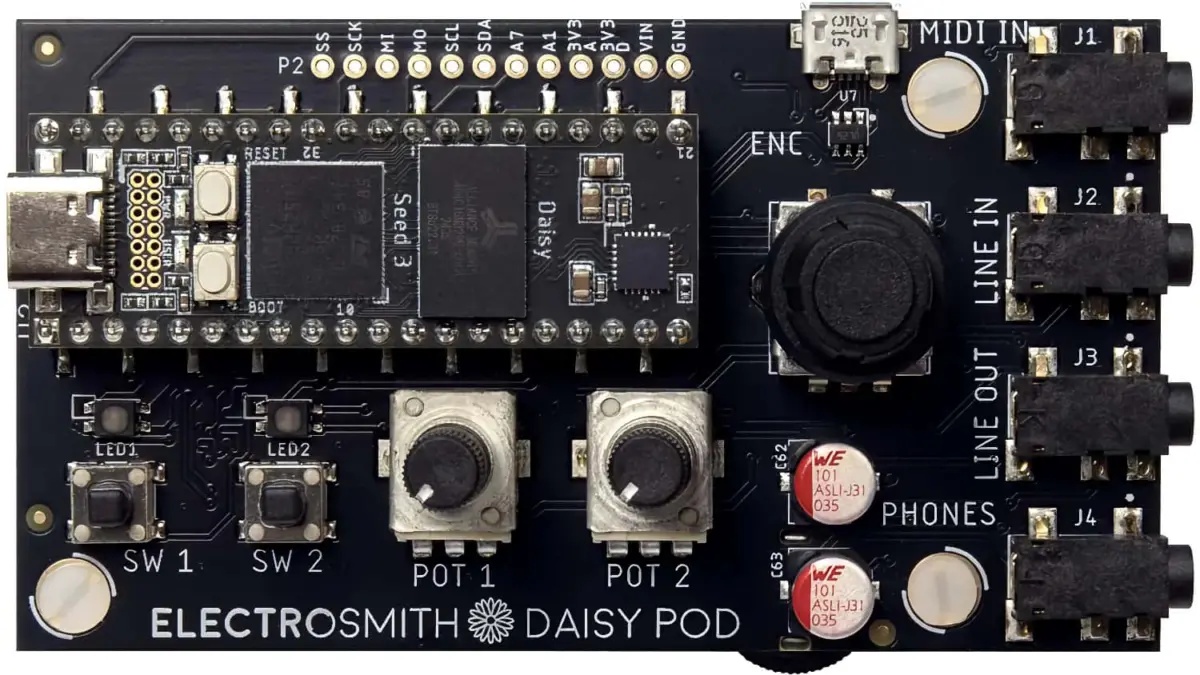
The emergence of the Electrosmith Daisy platform has marked a significant shift in the landscape of DIY electronic music, offering a bridge between complex embedded engineering and accessible creative expression. At the center of this movement is the Daisy Pod, a compact development board designed to lower the barrier of entry for musicians, coders, and hobbyists looking to build their own custom audio hardware. As highlighted in recent demonstrations by creators such as Pocket Trax, the Daisy Pod serves as a "breakout" interface for the Daisy Seed, the powerful microcontroller core that drives the ecosystem. By providing a plug-and-play environment that requires no soldering or breadboarding, the Pod allows users to focus entirely on the software and sound design aspects of their projects. This hardware-software synergy represents a broader trend in the music technology industry: the democratization of high-fidelity digital signal processing (DSP).
The Core Technology: Understanding the Daisy Seed
To understand the utility of the Daisy Pod, one must first examine the Daisy Seed, the underlying hardware module that powers the entire Electrosmith lineup. The Daisy Seed is an embedded platform designed specifically for high-fidelity audio. Unlike general-purpose microcontrollers like the standard Arduino Uno or the Raspberry Pi Pico, which often require external peripherals to handle high-quality sound, the Daisy Seed is built with a dedicated 24-bit audio codec and a high-performance ARM Cortex-M7 processor.
The technical specifications of the Daisy Seed are formidable for its size. It features an STM32H7 microcontroller running at 480 MHz, 64MB of SDRAM for long delay lines and high-quality sampling, and 8MB of flash memory. This combination of speed and memory allows the device to handle complex synthesis algorithms, high-density granular processing, and multi-channel audio routing with minimal latency. The Daisy Pod functions as the physical interface for this power, providing the necessary knobs, buttons, and input/output jacks to turn the "brain" of the Seed into a functional instrument.
Hardware Architecture and User Interface of the Daisy Pod
The Daisy Pod is specifically engineered to be the ultimate starting point for beginners. Its hardware layout is intentionally streamlined yet versatile enough to support a wide range of applications, from simple synthesizers to complex effects processors. The board features two potentiometers (knobs), two momentary pushbuttons, and a clickable rotary encoder. These controls are essential for real-time parameter manipulation, such as adjusting filter cutoff, resonance, or wet/dry mixes.
Connectivity is another area where the Pod excels in a desktop environment. It includes stereo line-level inputs and outputs via 1/4-inch jacks, a dedicated 3.5mm headphone output with its own gain control, and a TRS MIDI input for external sequencing and synchronization. Power is supplied via a USB connection, which also serves as the data link for flashing new firmware. This self-contained nature eliminates the "rats nest" of wires typically associated with breadboard prototyping, allowing the user to move from a programming environment to a musical performance in seconds.
Software Versatility: From C++ to Visual Programming
One of the most compelling aspects of the Daisy ecosystem is its language-agnostic approach to development. Electrosmith has invested heavily in ensuring that creators with varying levels of technical expertise can interact with the hardware. For professional developers and those seeking maximum efficiency, the Daisy platform supports C++ through a dedicated library known as DaisySP. This library contains a vast array of pre-built DSP objects, including oscillators, filters, envelopes, and delays, which can be called with minimal code.
For those coming from a musical background rather than a computer science one, the platform supports visual programming environments. Through the "Oopsy" toolchain, users can export patches from Max/MSP’s Gen~ environment directly to the Daisy Pod. Similarly, Pure Data (Pd) users can utilize the "Heavy" compiler or "PlugData" to design instruments visually and run them on the hardware. The inclusion of Arduino IDE support further expands the reach of the device, tapping into the massive community of hobbyists who are already familiar with the Arduino ecosystem. This multi-tiered software support ensures that the Daisy Pod is not just a tool for engineers, but a creative canvas for artists.
A Chronology of the Daisy Platform and Market Context
The journey of the Daisy platform began in early 2020, when Electrosmith launched a highly successful Kickstarter campaign. The goal was to create a "universal platform for music makers" that could exist in various form factors. Following the release of the Daisy Seed, the company introduced several "official" breakout boards to cater to different markets: the Daisy Patch for Eurorack modular enthusiasts, the Daisy Petal for guitarists, and the Daisy Field for desktop synthesis.
The Daisy Pod was introduced as the entry-level gateway to this world. Since its inception, the platform has seen a steady stream of firmware updates and community-driven expansions. In 2021 and 2022, the platform gained significant traction as global semiconductor shortages made other microcontrollers difficult to source. Electrosmith’s focus on the STM32 architecture allowed them to maintain a presence in the market while building a robust GitHub repository of open-source examples. By 2024, the Daisy ecosystem has become a standard in the boutique synth industry, with several independent manufacturers using the Daisy Seed as the internal engine for their commercial products.
Technical Benchmarks and Comparative Analysis
When compared to other popular development platforms, the Daisy Pod occupies a unique niche. While the Teensy 4.1 is a frequent competitor in the DIY audio space, the Daisy platform distinguishes itself through its dedicated focus on audio-specific I/O and its integrated SDRAM.
- Latency: The Daisy platform is capable of sub-millisecond round-trip latency, a critical requirement for live musical performance. In tests involving complex FFT (Fast Fourier Transform) processing, the Cortex-M7 core on the Daisy Seed outperforms the Cortex-M4 found in many mid-range boards by a factor of nearly four.
- Memory Management: The 64MB of external SDRAM is a standout feature. For context, a standard Arduino has only a few kilobytes of RAM. This massive memory overhead allows the Daisy Pod to function as a high-fidelity looper or a long-window granular processor, tasks that are impossible on most other small-form-factor microcontrollers.
- Audio Quality: The 24-bit/96kHz capable codec ensures that the output is professional-grade. This makes the Daisy Pod suitable not just for lo-fi experimentalism, but for high-end studio effects processing.
Broader Implications for the Music Industry and Education
The rise of the Daisy Pod has implications that extend far beyond the hobbyist’s workbench. In the realm of music education, the Pod is becoming a preferred tool for teaching both digital signal processing and embedded systems. Its "no-soldering" design makes it safe and accessible for classroom environments, where students can see the immediate physical result of their code. By abstracting the hardware complexities, educators can focus on the underlying math and logic of sound synthesis.
Furthermore, the Daisy platform is fueling a "soft-hardware" revolution. In this model, the physical hardware remains static while the functionality is entirely fluid. A musician might use the Daisy Pod as a reverb pedal one night, a drum machine the next, and a MIDI-to-CV converter the following day, simply by flashing a different "bin" file. This versatility challenges the traditional consumer model of buying single-use hardware devices and encourages a more sustainable, software-defined approach to gear ownership.
Community Reception and Official Responses
The response from the developer community has been overwhelmingly positive, particularly regarding the transparency of the platform. Because the Daisy project is open-source, users are encouraged to contribute to the core libraries and share their own projects via forums and social media. Electrosmith has maintained an active presence in these communities, often incorporating user-suggested features into official firmware updates.
While Electrosmith has not released specific sales figures, the growth of their online community—spanning Discord, GitHub, and various synth forums—suggests a user base in the tens of thousands. Independent developers have praised the Pod for its "breadboard-less" workflow, noting that it significantly reduces the time from "concept to sound." Official documentation has also been a point of praise; the company provides a web-based programmer that allows users to flash firmware directly from a browser, further lowering the technical hurdles for non-programmers.
Conclusion: The Future of Embedded Audio
As we look toward the future of music technology, the Electrosmith Daisy Pod stands as a testament to the power of open-source collaboration and specialized hardware design. By providing a professional-grade audio engine in a beginner-friendly package, it has empowered a new generation of creators to build tools that are tailored to their specific artistic needs.
The ongoing development of visual programming tools like PlugData and the continued expansion of the DaisySP library suggest that the ecosystem will only become more accessible over time. Whether used as a learning tool, a prototyping station for a boutique manufacturer, or a versatile utility on a musician’s desk, the Daisy Pod is more than just a development board; it is a catalyst for innovation in the digital audio space. As the boundaries between software and hardware continue to blur, platforms like Daisy ensure that the ability to create custom, high-performance musical instruments remains in the hands of the artists themselves.
