

The Finnish National Theatre in Helsinki has set a new benchmark for children’s theater by seamlessly merging traditional illustration with cutting-edge projection mapping and lighting design for its 2026 production of the beloved classic Puluboi and Poni. At the heart of this visual metamorphosis lies the Hippotizer Media Server system from Green Hippo, a brand under the ACT Entertainment umbrella, which has allowed the production team to transform static book illustrations into a living, breathing stage environment. By utilizing a sophisticated multi-layered digital workflow, the production has demonstrated how modern media servers can bridge the gap between literature and live performance, creating an immersive experience that resonates with a new generation of theatergoers.
A Synergy of Illustration and Technology
The visual identity of the production was born from a close collaboration between lighting and video designer Ville Virtanen and the acclaimed illustrator Emmi Jormalainen. Jormalainen, known for her distinctive work on the original Puluboi and Poni books, provided the foundational aesthetic for the show. However, the challenge for Virtanen was to take these two-dimensional drawings and expand them into a dynamic theatrical space that could evolve in real-time alongside the actors and the musical score.
To achieve this, Virtanen employed a workflow that began with animating Jormalainen’s illustrations in Adobe After Effects. By breaking down the drawings into individual components, he was able to move beyond the limitations of static backdrops. These animated sequences were then imported into the Hippotizer environment, where they were treated not as finished film clips, but as modular visual elements. This approach allowed for a level of flexibility rarely seen in traditional stage projections, enabling the team to adjust individual parts of a scene—such as a single star in the sky or the color of a building—independently of the rest of the image.
The Technical Architecture: Hippotizer and grandMA Integration
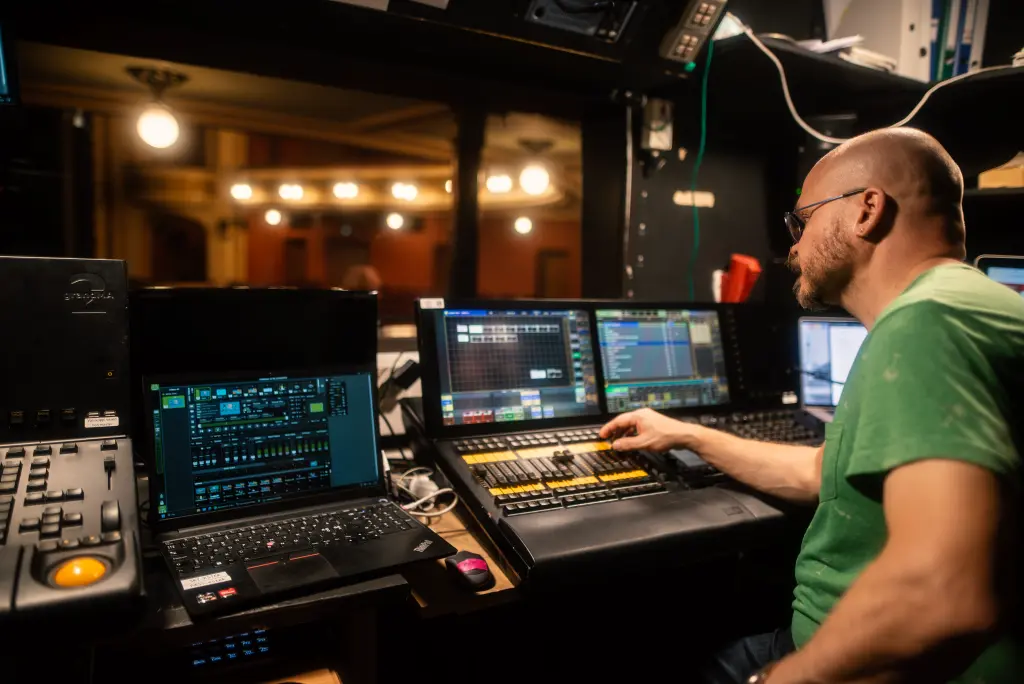
The technical backbone of the production relies on a high-performance Hippotizer media server system, which Virtanen controlled via a single grandMA lighting console. This integration is a critical component of the modern "unified control" philosophy in stage design, where the distinction between lighting and video becomes increasingly blurred. By using the MANet protocol, Virtanen was able to manage the media server as if it were a complex lighting fixture, mapping video parameters to the console’s faders and encoders.
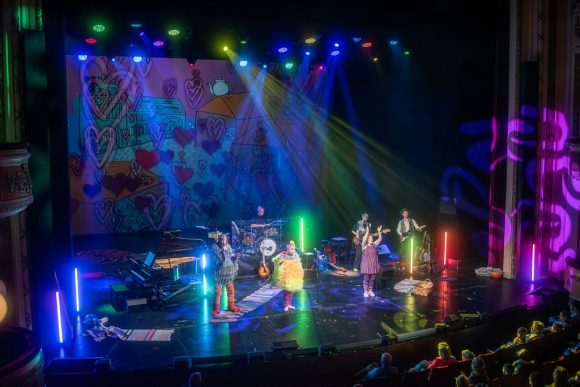
The projection itself was delivered via an Epson EB-L3000U laser projector, equipped with an ELPX03 ultra-short-throw lens. This hardware choice was necessitated by the specific geometry of the Finnish National Theatre’s stage and the need for high-intensity output to compete with the stage lighting. The images were projected onto a near-stage-width anthracite-colored screen provided by Showtex, a material specifically chosen for its ability to maintain deep black levels and high contrast even in the presence of ambient stage light.
One of the standout features of the Hippotizer system utilized in this production is its robust layering capability. Virtanen utilized up to twelve independent layers for a single visual scene. At a minimum, each "look" consisted of a background color layer and a primary image layer. However, for more complex musical numbers, additional layers were added to accommodate moving objects, color-changing elements, and specialized visual effects. This layering allowed Virtanen to program movements, opacity shifts, and blend modes directly within the Hippotizer engine, triggered by cues from the grandMA console.
Redefining the Projector as a Lighting Fixture
A central theme in Virtanen’s design philosophy for Puluboi and Poni was the conceptualization of the projector as a "moving light with infinite gobos." By adopting this mindset, the production team was able to achieve a level of synchronization between light and video that felt organic rather than superimposed. Every lighting change on the stage was mirrored by a corresponding shift in the video content, ensuring that the color palette and emotional tone remained consistent across all visual media.
For example, in a pivotal scene where the setting transitions from a wide city panorama to an intimate street view, the Hippotizer system managed a complex series of transitions. As the perspective shifted, the colors of the sky and buildings altered to reflect the changing time of day, while stars and the moon appeared with pinpoint accuracy. Simultaneously, the street was animated to move toward the audience, creating a "dolly-in" effect that simulated motion through the city. Because the video and lighting were programmed in the same sequence on the grandMA console, the stage lights shifted their direction and hue in perfect lockstep with the digital environment, grounding the actors within the virtual world.
Efficiency Through 3D Pre-Visualization
The production faced a rigorous timeline, a common challenge in high-output national theaters. To mitigate the limited time available for on-stage rehearsals, Virtanen leaned heavily on 3D pre-visualization. The Finnish National Theatre maintains a highly accurate 3D CAD model of its main stage, with a reported precision of within ten centimeters. Utilizing this model in conjunction with Hippotizer Prep and the Capture visualization software, Virtanen was able to program nearly the entire show in a virtual environment before a single projector was rigged.

This "digital twin" approach allowed the designer to establish presets for position, zoom, focus, and color well in advance. By the time the production moved onto the physical stage, the team had only one day for technical adjustments. Because the heavy lifting of the programming had been completed in the visualization studio, the on-site time was used exclusively for fine-tuning and updating presets to account for the physical realities of the space. This production marked the first time Virtanen had fully pre-programmed a show of this scale at the National Theatre, proving the viability of a virtual-first workflow for complex multimedia performances.
Context and Cultural Significance: Godchildren of Culture
The staging of Puluboi and Poni was a key highlight of the Autumn 2026 "Godchildren of Culture" (Kulttuurikummit) program. This initiative, spearheaded by the City of Helsinki, is a visionary cultural project that aims to provide every child born in Helsinki with a "cultural godparent"—an artistic institution that offers free, tailored cultural experiences from infancy through to school age. The program involves various major institutions, including the Helsinki Philharmonic Orchestra and the Helsinki City Museum, with the Finnish National Theatre serving as a primary partner for theatrical arts.
By choosing a technologically advanced production for this program, the National Theatre is not only entertaining young audiences but also introducing them to the possibilities of modern digital storytelling. The use of familiar illustrations from the Puluboi and Poni books provides a sense of continuity for the children, while the immersive digital execution elevates the experience to something grander than a simple reading or a traditional play.
Broader Implications for the Performing Arts
The success of the Puluboi and Poni production offers several insights into the future of theatrical design. First, it highlights the growing importance of "media-aware" lighting designers who can navigate both DMX-based lighting and pixel-based video workflows. As media servers like the Hippotizer become more intuitive and better integrated with lighting consoles, the barrier between these two disciplines continues to dissolve.
Second, the production underscores the economic and creative value of pre-visualization. As theater companies face rising costs and tighter schedules, the ability to "build" a show in a digital space reduces the need for expensive stage time and allows for greater creative experimentation without the pressure of a ticking clock.
Finally, the collaboration between an illustrator and a digital designer demonstrates a path forward for preserving "hand-drawn" aesthetics in an increasingly digital world. Rather than replacing traditional art with CGI, the Finnish National Theatre used technology to amplify and animate the original artist’s vision, ensuring that the soul of the source material remained intact even as it was projected onto a massive scale.
As the 2026 season continues, the technical achievements of Puluboi and Poni serve as a case study for theaters worldwide. The integration of Green Hippo’s Hippotizer servers, Epson’s projection technology, and the grandMA control system has proven that when technology is used as a servant to the story, it can create a magical, seamless world that captivates audiences of all ages. The Finnish National Theatre remains at the forefront of this evolution, blending its long history of dramatic excellence with the cutting-edge tools of the 21st century.
